




Blitz Bureau
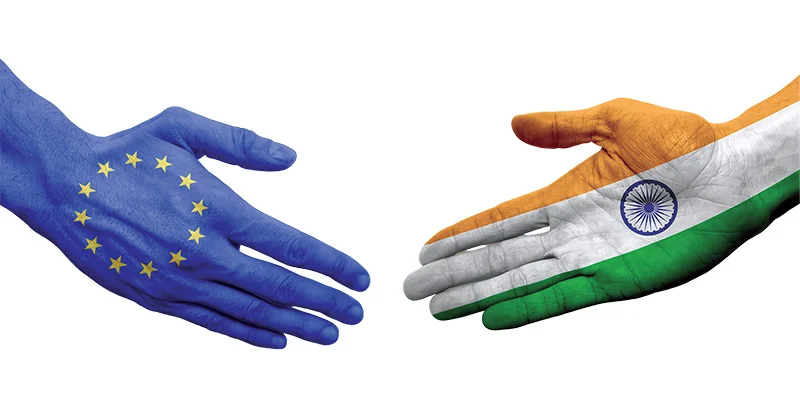
NEW DELHI: After nearly two decades of on-and-off negotiations, India and the European Union (EU) appear closer than ever to sealing a comprehensive Free Trade Agreement (FTA) — a pact that could prove transformative for India’s export ambitions, industrial growth, and strategic positioning in a fragmenting global economy.
What once seemed an unwieldy and politically fraught negotiation is now entering its final stretch, driven by a rare convergence of economic necessity, geopolitical alignment, and high-level political will on both sides.
For India, the benefits of concluding the India–EU FTA at this juncture are substantial and timely. The EU, a 27-nation bloc with a combined GDP of over $18 trillion, is India’s largest trading partner in goods and services combined.
Yet India currently enjoys limited preferential access to this vast market, placing its exporters at a disadvantage compared to competitors from countries that already have trade agreements with the EU. The FTA promises to correct that imbalance.
Negotiations have reached what officials describe as the final and most intensive phase. Commerce Minister Piyush Goyal’s two-day visit to Brussels on January 8-9, was aimed squarely at resolving the remaining issues on market access, rules of origin, services, and regulatory standards.
Indian negotiators are pushing for better access for labour-intensive sectors such as textiles, leather, footwear, gems and jewellery, marine products, and engineering goods — areas where India is globally competitive but faces high tariffs and non-tariff barriers in Europe. Even a modest tariff reduction across these sectors could significantly lift India’s exports and employment.
Equally important for India is improved access for services, particularly IT, digital services, professional services, and skilled mobility. With services accounting for a growing share of India’s exports and economic output, securing easier movement for Indian professionals and recognition of qualifications would reinforce India’s position as a global services hub.
At a time when protectionist pressures are rising in several advanced economies, the EU’s willingness to negotiate services access offers India a critical diversification opportunity.
The political momentum behind the FTA has been reinforced by Germany’s unusually direct intervention. German Chancellor Friedrich Merz’s visit to India on January 12-13 — his first trip to Asia since taking office — was widely interpreted as a strategic signal. Germany, Europe’s largest economy and a manufacturing powerhouse, sees India not merely as a market but as a long-term economic and supply-chain partner.
Merz publicly stated that the FTA could be concluded by the end of January, underlining the urgency Europe attaches to the deal amid supply disruptions, geopolitical uncertainty, and growing economic rivalry with China.
For India, Germany’s backing strengthens its negotiating hand within the EU’s complex decision-making structure. Its support increases the likelihood that remaining internal differences within EU — particularly around sustainability standards, carbon border measures, and regulatory harmonisation — will be resolved pragmatically rather than ideologically.
Beyond trade, the agreements announced during Merz’s visit on defence cooperation, skills, healthcare, critical minerals, and climate collaboration underscore how the FTA would anchor a broader strategic partnership that aligns with India’s long-term development goals.
France and other EU members have also quietly played a stabilising role. While recent public statements from French officials may not have dominated headlines, Paris has consistently supported deeper India–EU economic integration, viewing India as a strategic counterweight in the Indo-Pacific and a key partner in technology, energy transition, and defence manufacturing.
Repeated engagements between Prime Minister Narendra Modi and EU leaders, including European Commission President Ursula von der Leyen, have reinforced the message that the FTA is not an isolated trade deal but part of a future-oriented partnership.
The impending visit of a high-level EU delegation to India later this month — likely coinciding with the India–EU Summit and Republic Day celebrations — could provide the final political push.
The presence of European Commission leaders as special guests at Republic Day is symbolically significant. For India, it signals recognition as a strategic peer rather than merely a market. Substantively, the visit is expected to help close remaining gaps, align political commitments, and prepare the ground for formal signing.
From India’s perspective, the timing of the FTA could not be more critical. With global trade increasingly fragmented by sanctions, tariffs, and strategic blocs, India needs stable, rules-based access to major markets to sustain its export-led growth strategy.
The EU deal would complement India’s existing FTAs with the UAE, Australia, and Asean, while reducing over-dependence on any single market. It would also support domestic manufacturing under the “Make in India” and PLI frameworks by integrating Indian producers more deeply into European value chains.
Perhaps most importantly, the FTA would send a powerful signal to global investors. A concluded India-EU trade pact would enhance policy predictability, encourage European investment into Indian manufacturing, green technologies, and digital infrastructure, and position India as a preferred destination for companies seeking alternatives to China.
As January 2026 unfolds, the signs are unmistakable. Negotiations are at their most advanced stage, political backing from key EU capitals is unusually explicit, and diplomatic engagement has intensified across levels. For India, sealing the EU FTA is no longer just about tariff cuts — it is about securing growth, resilience, and strategic autonomy in an increasingly uncertain world.