




Blitz Bureau
NEW DELHI: In the ever-evolving landscape of global finance, 2026 has emerged as a watershed year for India. While the previous decade was defined by the “great digitisation” led by UPI, the current era is one of “intelligent value.” India’s fintech market, now valued at approximately $51.3 billion and projected to double by 2031, has shifted its focus from mere user acquisition to deep-tech integration and credit democratisation.
Credit on tap
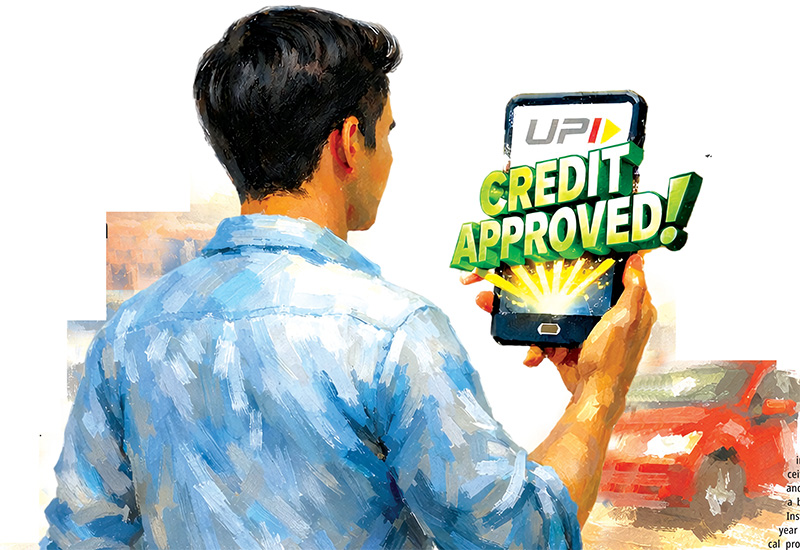
The most significant shift in 2026 is the transformation of UPI from a payment rail into a credit engine. With the Reserve Bank of India (RBI) allowing pre-sanctioned credit lines on UPI, the distinction between a bank account and a credit card is blurring.
This “credit on UPI” movement has effectively turned every smartphone into a virtual credit card, allowing millions of tier-2 and tier-3 residents to access short-term loans for everything from groceries to electronics with a single QR scan.
Digital lending now commands over 50 per cent of the fintech market opportunity. By leveraging the Account Aggregator (AA) framework — which saw a record 2.2 billion authentications in late 2025 — fintechs are now performing “flow-based lending.” Instead of asking for collateral, they analyse real-time GST filings and UPI cash flows to approve loans in seconds.
Beyond payments
The Indian fintech narrative has now matured beyond the “cashback and QR code” era. The industry is witnessing a massive consolidation phase where players are pivoting from “niche providers” to “full-stack financial ecosystems.”
In 2025, the industry saw nearly 69 per cent of publicly listed fintech firms turn profitable, a stark contrast to the “burn-at-all-costs” mentality of the early 2020s. This newfound fiscal discipline has paved the way for more sophisticated service offerings, particularly in wealthtech and insurtech.
WealthTech, in particular, is undergoing a “retail revolution.” With the Indian middle class expanding and traditional savings moving from gold and real estate into financial assets, platforms are now managing over $237 billion in retail investments.
The trend of “sachetised” investments — allowing users to buy fractional units of stocks or blue-chip debt for as little as ₹100 — has brought an estimated 100 million new investors into the fold since 2024.
This isn’t just a metropolitan phenomenon; over 45 per cent of new demat accounts are being opened from tier-3 cities and beyond, facilitated by AI-driven robo-advisors that speak local languages.
Credit for MSMEs
Small businesses (MSMEs) remain the backbone of the Indian economy, but they have historically faced a massive credit gap. In 2025, this gap started narrowing. Total MSME credit exposure has crossed ₹27.7 lakh crore, growing at a steady 15 per cent year-on-year. The catalyst? Cash-flow-based underwriting.
Fintechs are now tapping into the “TReDS” (Trade Receivables Discounting System) and Udyam databases to see a business’s real-time health. Instead of asking for a three-year balance sheet and physical property as collateral, 2026’s digital lenders look at “alternative data.” This includes:
Utility and tax compliance: Consistency in paying GST and electricity bills.
Digital footprints: Transactional data from merchant QR codes.
Supply chain visibility: Tracking goods and payments through integrated logistics platforms.
This shift has resulted in “New-to-Credit” MSMEs rising by 32 per cent in the last year alone. For a small shop owner in Kanpur, this means getting a working capital loan approved in five minutes to buy festive inventory — a process that used to take five weeks of bank visits.
Embedded finance
Another defining trend of 2026 is the “invisibility” of banking. Banking-as-a-service (BaaS) and embedded finance have grown at a staggering pace. Customers no longer need to go to a bank’s app to get a loan or insurance; it is “embedded” where they shop or work.
Whether it is a food delivery app offering instant health insurance to its “gig workers” or an e-commerce giant providing “Buy Now, Pay Later” (BNPL) at the point of sale, financial services have become a feature of the user experience rather than a separate destination.
This sector is projected to reach a transaction value of $100 trillion by 2030, with 2026 serving as the launchpad for “hyper-personalised” offerings. AI models now predict when a customer might need a loan based on their purchasing cycle and proactively offer a “credit nudge” just before they hit the checkout button.
In a move that has sent ripples through the Indian banking sector, Visa is rolling out its innovative “debit-cum-credit” cards in India. While this may sound like a futuristic concept to many Indian consumers, the technology — often referred to as “dual-mode” or “flexible credential”— is already a proven success in markets like Japan, Vietnam, and the United States.
Traditionally, a consumer carries two separate pieces of plastic: one to spend their own money (debit) and one to borrow (credit). Visa’s dual-mode technology allows a single card to be toggled between a debit and credit account.
In some versions, the card uses “smart routing” to decide which account to use based on the transaction value or the merchant category. For instance, a small coffee purchase might default to debit, while a high-value laptop purchase triggers the credit line.
In Japan, the “Olive” card launched by Sumitomo Mitsui Card Company in partnership with Visa became a massive hit, garnering over 3 million users in its first year. The appeal lies in “wallet decluttering” and a unified rewards system. In India, this arrives at a perfect time as the RBI pushes for more integrated payment experiences.
For India, the launch is less about convenience and more about financial inclusion. Many Indians are “credit-starved” but have active savings accounts. By issuing a dual-mode card, banks can provide a debit card for daily use while “switching on” a small credit limit as the user’s credit score improves, without the need to ship new hardware. It simplifies the transition from a cash-first mindset to a credit-active one, making it a critical tool for India’s next 100 million credit users.
AI: The invisible infrastructure
If 2025 was the year of AI hype, 2026 is the year of AI utility. Over 60 per cent of Indian fintech firms have now prioritised AI-led automation. This isn’t just about chatbots; it’s about underwriting.
In 2026, “alternative data” will be the new gold. Fintechs are using AI to analyse non-traditional signals — such as utility bill payment consistency, app usage patterns, and even social professional data — to build “trust scores.”
This has allowed the industry to reach the 1.93 lakh+ startups and millions of MSMEs that were previously ignored by traditional banks due to a lack of formal credit history.
Regulation reset
The industry has also matured under the watchful eye of the regulator. The RBI’s Payments Vision 2025 has successfully transitioned into the 2026 roadmap, focusing on security and “sovereign” tech.
We are seeing a “flight to quality,” where funding is no longer chasing growth at all costs but is instead flowing into “mature” sub-sectors like wealthtech and insurtech. Wealthtech, in particular, is riding a wave of retail investor participation, with the segment predicted to hit $237 billion by 2030.
The secret sauce of India’s fintech success isn’t just private innovation; it is the India Stack. In 2026, India’s Digital Public Infrastructure (DPI) has become the country’s most successful tech export. The stack — comprising Aadhaar (identity), UPI (payments), and the account aggregator (data) — is now being studied and replicated by over 40 countries.
The 2026 roadmap
UPI Global: UPI is no longer restricted to Indian borders. Cross-border linkages with Singapore, the UAE, France, and several Asean nations have turned the rupee into a more “liquid” digital currency for travellers.
Sachetisation of finance: DPI has enabled “sachet” products. One can now buy insurance for a single bus journey for ₹5 or invest ₹10 in gold through “micro-savings” apps. The cost of on-boarding a customer (Know Your Customer) has dropped from nearly $5 a decade ago to just a few cents today, thanks to paperless Aadhaar authentication.
CBDC integration: The digital rupee (e₹), India’s Central Bank Digital Currency, has moved out of its pilot phase. It is now being used for “programmable” payments — for example, Government subsidies that can only be spent on fertilisers or education, ensuring zero leakage.
This infrastructure has created a “level playing field.” A small fintech startup in Bangalore can plug into the same national payment and identity rails as a multi-billion dollar bank.
This “democratised” access is why India now ranks third globally in the number of fintech startups, with over 10,000 entities currently operating. The DPI isn’t just a platform; it’s an economic philosophy that prioritises public good over private monopolies.
Full-stack future
As India moves further into 2026, the trend of “convergence” is undeniable. E-commerce platforms are becoming lenders; payment apps are becoming wealth managers; and banks are trying to look like agile tech startups.
The most anticipated regulatory move for the remainder of the year is the potential licensing of full-stack digital banks. These entities, operating without physical branches, would slash overhead costs and potentially offer higher interest rates to savers and lower rates to borrowers.
With 1 billion internet users and a smartphone in almost every hand, India’s fintech story has moved past the “early adopter” phase. It is now a foundational pillar of the national economy, proving that in the digital age, financial status is no longer determined by where you live, but by how well you are connected to the “grid.”