Blitz Bureau
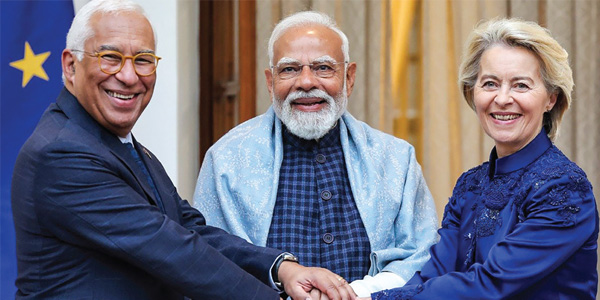
NEW DELHI: A day after India celebrated its 77th Republic Day on January 26, the country announced the conclusion of negotiations for a Free Trade Agreement (FTA) with the European Union, marking an important milestone in one of most strategic economic partnerships.
Designed as modern, rules-based trade partnership, the FTA responds to contemporary global challenges while enabling deeper market integration between the world’s fourth and second largest economies.
With a combined market estimated at over Rs 2091.6 lakh crore (USD 24 trillion), bringing unparalleled opportunities for the 2 billion people of India and the EU, the FTA unlocks significant potential for trade and innovation.
The agreement delivers unprecedented market access for more than 99 per cent of India’s export by trade value, while preserving policy space for sensitive sectors and reinforcing India’s developmental priorities.
Legal scrubbing of the final text of the FTA is now underway from both sides. The ratification of the deal is required by the European Parliament and the Indian Cabinet in this calendar year. It is thereafter expected to be operational by late this year or early next year.
This means that while the political signing has occurred and congratulations poured in from both sides, the deal is not yet “active” for daily trade. The “legal scrubbing” process ensures the text is legally sound and translated into all official EU languages.
The European Parliament must vote to approve the deal. On the Indian side, it requires formal approval from the Union Cabinet.
Even once operational, many tariff cuts will be staggered. For example, duties on European cars (currently up to 110 per cent) are expected to drop to 10 per cent over a 5-to-10-year transition period.
For India, over 99 per cent of exports by value will eventually get duty-free access to the EU, significantly benefiting labour-intensive sectors such as textiles, leather and footwear, tea, coffee, spices, sports goods, toys, gems and jewellery and certain marine products, amongst others.
Eventually, 20.3 per cent tariff lines covering 2.9 per cent of India’s exports will have zero duty access over three and five years for certain marine products, processed food items, arms and ammunition, amongst others.
More than 6 per cent tariff lines covering 6 per cent of India’s exports will have preferential access by way of tariff reduction for certain poultry products, preserved vegetables, bakery products amongst others or through TRQs for cars, steel, certain shrimps / prawns products, amongst others.
For the EU, tariffs will be removed or reduced on over 90 per cent of goods, including wine, spirits, chemicals, and machinery.
Overall, India is offering 92.1 per cent of its tariff lines which covers 97.5 per cent of the EU exports, in particular: 49.6 per cent of tariff lines will have immediate duty elimination; 39.5 per cent of tariff lines are subject to phased elimination over five, seven, and 10 years; 3 per cent of products are under phased tariff reductions and few products are subject to TRQs for apples, pears, peaches, kiwi fruit.
Imports of EU’s high technology goods are expected to diversify India’s import sources, thereby reducing input costs for businesses, benefit consumers and will create opportunities for Indian businesses to integrate into global supply chains.
Bilateral merchandise trade between India and the EU has demonstrated sustained growth, valued approximately at Rs 11.5 lakh crore (USD 136.54 billion) in 2024-25, with India exporting roughly Rs 6.4 lakh crore (USD 75.85 billion) to the EU. India-EU trade in services reached Rs 7.2 lakh crore (USD 83.10 billion) in 2024.
Despite healthy and growing trade, there is a significant untapped potential considering the size of each other’s market and trade. The FTA provides an unparalleled pathway and holds immense promise for both, India and the EU, to emerge as each other’s major economic partners.
This FTA of strategic significance evolves India-EU relations from a traditional into a modern, multifaceted partnership, providing a stable and predictable environment for exporters, enabling Indian businesses including MSMEs to plan long-term investments, integrate into European value chains, and ensure consistent favourable market access amid global economic uncertainties.


