




Blitz Bureau
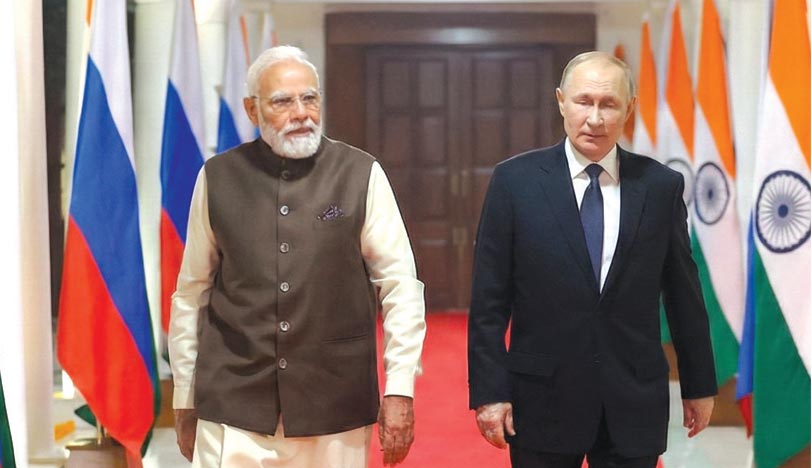
NEW DELHI: In a defining moment for India’s foreign and economic policy, Prime Minister Narendra Modi and Russian President Vladimir Putin concluded a high-stakes summit in New Delhi with an expansive set of agreements that strengthen defence cooperation, deepen energy ties, and lay the foundation for a major expansion in trade.
The outcomes reaffirm India’s resolve to follow a foreign policy grounded firmly in strategic autonomy — despite persistent geopolitical pressure from the West.
The summit, held against the backdrop of global realignments and continued conflict in Europe, marks one of the most significant recalibrations of the India-Russia partnership in recent years.
It projects Modi’s image as a global statesman who can engage rival power blocs simultaneously while anchoring policy in India’s long-term national interest.
The highlight of the summit was the renewed commitment to boost annual bilateral trade to $100 billion by 2030, with both sides indicating that the milestone could be reached earlier if current momentum continues.
The target reflects not only ambition but also the evolving nature of India-Russia commerce, which has surged drastically over the past two years on the back of discounted crude oil imports.
To stabilise expanding trade flows, India and Russia agreed to scale up the use of rupee–ruble settlement mechanisms, a move aimed at reducing dependence on third-country currencies and shielding transactions from the uncertainties of Western sanctions.
Officials noted that this framework will encourage long-term contracts in energy, fertilisers, and critical minerals — sectors where Russia sees India as a priority market.
A major breakthrough came in the decision to fast-track negotiations for a Free Trade Agreement (FTA) with the Eurasian Economic Union (EAEU). The FTA is expected to open access for Indian exports in pharmaceuticals, textiles, engineering goods, and IT services, offering a path to correcting the heavily skewed trade imbalance, which currently favours Russia due to energy imports.
Defence collaboration
Defence cooperation — long the bedrock of India-Russia relations — received a decisive push, with both sides agreeing to expand joint production, technology transfer, and localisation under the Make in India framework.
Key discussions focused on:
• Co-production of advanced fighter platforms, including prospects linked to Su-57 class aircraft.
• New variants and extended localisation of the BrahMos cruise missile, a successful Indo-Russian collaborative model.
• Long-term supply arrangements for spare parts, critical systems, and upgrades for Russian-origin platforms in Indian service.
For India, the agreements align with its goal of building a resilient and self-reliant defence ecosystem. For Russia, they ensure continued relevance in Asia’s defence market at a time when Western markets remain largely inaccessible.
India’s message to the world
Putin’s visit, held under the lens of international scrutiny, underscores India’s determination to maintain an independent diplomatic trajectory amid intense geopolitical polarisation.
The summit conveyed three clear messages to the global community:
First, India will pursue partnerships based on national interest rather than allegiance to any geopolitical bloc. The ability to host the Russian President while expanding ties with the US, Europe, and East Asia illustrates New Delhi’s pragmatic, multi-aligned diplomacy.
Second, Prime Minister Modi’s stature as a pivotal global actor has strengthened. His ability to engage world leaders across conflicting camps — from Washington to Moscow — enhances India’s credibility as a stabilising power in a fragmented geopolitical landscape.
Third, by deepening its Russia partnership at a moment of global strain, India reaffirmed its belief in a multipolar world order, where sovereign choices — not external pressure — define national strategy.
US watchful
American officials are expected to monitor the implementation of new agreements closely, especially those involving advanced defence systems. The spectre of CAATSA sanctions continues to hover but remains unlikely to be activated against India, given Washington’s strategic imperative of keeping New Delhi central to its Indo-Pacific calculus.
The US is expected to adopt a position of strategic tolerance — raising concerns privately, avoiding punitive action publicly, and prioritising broader cooperation in technology, defence, and regional security.
The Modi-Putin summit delivered a clear verdict: India’s ties with Russia, described by both sides as “stable and guiding like the North Star,” remain resilient despite global headwinds. The agreements reflect a mature partnership adapting to new economic realities while retaining strategic depth.
With a strengthened defence roadmap, an ambitious trade trajectory, and a renewed emphasis on energy security, India has signalled that it will remain an independent pole in a complex global order.
The summit not only reaffirms India’s longstanding partnership with Russia but also elevates Modi’s international standing as a leader capable of navigating competing global interests with clarity and confidence.