




Blitz Bureau
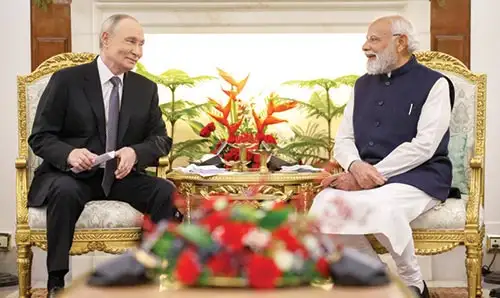
NEW DELHI: President Vladimir Putin’s latest visit to New Delhi could well be remembered as a defining moment in India’s contemporary foreign policy practice. At a time when global geopolitics is fractured — caught between Western sanctions, an evolving Asian security architecture, and renewed competition for influence — India has chosen clarity over hesitation: its partnerships will be shaped only by national interest, not external pressure. The agreements unveiled during the Modi-Putin summit reaffirm this principle with unmistakable confidence.
The decision to push bilateral trade toward the ambitious $100 billion mark by 2030 signals both intent and strategy. India and Russia are now seeking not just higher commerce but structured, de-risked, and diversified economic engagement.
The move towards rupee-ruble settlement mechanisms and the acceleration of the FTA negotiations with the Eurasian Economic Union represent more than transactional reforms. They reflect India’s willingness to reimagine the global financial pathways through which trade flows, even as the world debates de-dollarisation and alternative settlement architectures.
Equally significant is the recalibration of the defence partnership. For decades, Russian systems have formed the backbone of India’s military capability. What is new today is the shift from dependency to co-production, technology integration, and localisation under the Make in India vision.
Conversations on advanced fighter platforms and next-generation BrahMos variants underscore a maturing defence relationship built on shared capability development rather than one-way supply. This evolution strengthens India’s long-term strategic deterrence, while providing Russia with sustained relevance in one of the world’s most important defence markets.
Yet the larger message of the summit is political, not transactional. India has made it clear that strategic autonomy is not a slogan — it is a governing principle. Hosting Putin at a time of Western discomfort demonstrates that New Delhi is prepared to navigate global tensions without compromising its diplomatic independence. This confidence is not confrontational; it is pragmatic.
India continues deep partnerships with the United States, Europe, Japan, and the Middle East, even as it reinforces ties with Moscow. It is precisely this multi-alignment — rooted in interests rather than alignments — that gives India its growing weight in global affairs.
Washington’s response will likely remain measured and cautious. The US understands that India’s Russia relationship, especially in energy and defence, cannot be wished away. Strategic tolerance rather than sanction-driven rigidity will define American engagement in the near term.
The Modi-Putin summit ultimately signals a deeper truth: India is no longer a passive participant in global politics but an independent pole in the emerging multipolar order. It will engage all, align with none, and define its path with confidence.