




Shishir Priyadarshi
NEW DELHI:India and the European Union are on the cusp of a free trade agreement that could become one of the defining pivots of India’s economic rise. After years of cautious diplomacy, the negotiations have reached a point where a deal could reshape global supply chains, anchor India in Europe’s trade architecture, and offer Indian industry a stable, rulesbased alternative to an increasingly unpredictable global trading system.
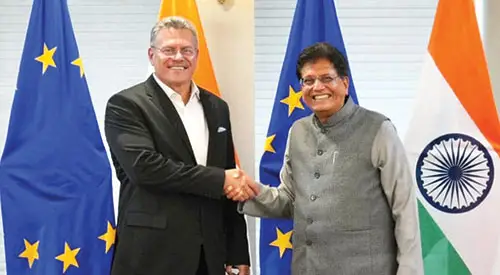
On December 10, Commerce and Industry Minister Piyush Goyal said the “air is pregnant with possibilities” and that both sides are committed to closing the deal early, after meetings with a high-level EU delegation that included Trade Commissioner Maros Sefcovic. For Europe, trade has always been the foundation of prosperity. Nearly 30 million EU jobs depend on trade, and almost half its GDP comes from it. Yet its relationship with the United States, its largest partner, has become a permanent crisis-management exercise.
Survival strategy
In Washington, protectionist fervour now cuts across party lines. Whether under Democrats or Republicans, tariffs and ‘reindustrialisation’ are political gospel. Last August’s EU-US deal narrowly averted a full trade war, but left deep political bruises in Brussels. For European policymakers, this is the new normal: a transatlantic economic relationship sustained by firefighting, not foresight. Diversifying supply chains and securing new markets is no longer optional – it’s survival strategy. And that makes India indispensable.
For India, too, the moment is ripe. The global economy is fragmenting into blocs: US-led industrial nationalism on one side, China’s state-led mercantilism on the other. Between them lies a vast demand for a reliable, rules-based partner with scale, stability, and democratic legitimacy. An India-EU FTA delivers exactly that. The EU remains the world’s largest trader, accounting for roughly 16 per cent of global commerce. An FTA with India, one of the world’s fastest-growing major economies, would be the largest such agreement in economic weight ever concluded.
The strategic benefits flow both ways. For the EU, it’s a gateway to reduce dependence on China for critical raw materials, rare earth magnets, and electronic components. For India, it’s a way to secure predictable access to high-value markets – a crucial offset to the loss of the Generalised System of Preferences (GSP) and a chance to level the playing field against competitors like Vietnam and Bangladesh.
Politics and optics
Equally important, it offers India a trusted alternative to the volatility of US trade politics. Stability, consistency, transparency – traits that mark out European regulation – are precisely what Indian businesses need today.
Both sides understand the political stakes. The goal is not merely to sign another trade agreement but to announce a new phase in India-EU relations, ideally on Republic Day, with the President of the European Commission, Ursula von der Leyen, as the Chief Guest at the parade. A deal signed in Delhi would be a powerful symbol of convergence between two democratic, open economies.
But for the EU, optics must align with substance. Brussels has made clear that any agreement has to be “ratifiable” – a deal that collapses in the European Parliament would be worse than none at all.
The same holds true in India. The politics of trade liberalisation remains delicate, but the national mood has shifted. As one senior policymaker put it, India is in a “new 1991 moment” – a phase of confident, reform-oriented thinking, where opening up is seen not as surrender to external pressure but as a sovereign, strategic choice.