




Blitz Bureau
NEW DELHI: While the new chapter of Rolls-Royce is rooted in 21st century technology, it is built on a century-old foundation of obsession, opulence, and a few legendary instances of royal spite.
The relationship between Rolls-Royce and India began in the early 1900s. For the Maharajas of the British Raj, the “Best Car in the World” was more than transport; it was a mobile throne. Between 1907 and 1947, it is estimated that India imported roughly 20 per cent of Rolls-Royce’s global production.
The brand became so deeply woven into the fabric of Indian royalty that the phrase “doing a Mysore” entered the company’s internal vocabulary. This referred to the Maharaja of Mysore, who famously never bought a single car — he only bought them in batches of seven.
The garbage trucks of Alwar
The most famous anecdote in Rolls-Royce history involves Maharaja Jai Singh of Alwar (though the story is sometimes attributed to the Maharaja of Patiala or the Nizam of Hyderabad).
As the legend goes, around 1920, the Maharaja was walking through London in casual attire and wandered into a Rolls-Royce showroom. The salesman, judging him by his simple appearance, assumed he was a commoner who couldn’t afford a bicycle, let alone a luxury car, and unceremoniously escorted him out.
Furious, the Maharaja returned to his hotel, dressed in his full royal regalia, and sent word that he was visiting. He was greeted with a red carpet and bowing staff. He purchased every car in the showroom on the spot — six in total — and paid for them in full, including shipping to India. Upon their arrival, he issued a decree that shocked the world:
The cars were to be handed over to the Alwar municipality to be used as garbage collection vehicles and street sweepers.
The news spread globally, and the brand’s prestige plummeted. High-society owners in Europe were reportedly mocked with the line: “Is that the same car they use in India to carry trash?” Terrified of the brand damage, Rolls-Royce reportedly sent a formal apology and offered the Maharaja several new cars for free to convince him to retire the “garbage fleet.”
Extraordinary customisations
Indian kings didn’t just buy cars; they redesigned them. Their demands pushed the limits of bespoke engineering:
* The Hunting Cars: The Maharaja of Kota had his 1925 Phantom I fitted with a mounted machine gun and high-intensity searchlights for tiger hunting.
* The Swan Car: The Maharaja of Nabha famously commissioned a car shaped like a giant swan, which “hissed” steam from its beak to clear crowds.
* The Purdah Cars: To respect the tradition of purdah, several rulers had cars designed with darkened “privacy glass” and silk curtains so the queens could travel without being seen by the public.
* The Jewel-Encrusted Fleet: The Maharaja of Patiala, Bhupinder Singh, owned 44 Rolls-Royces. His dashboards were often inlaid with gold, ivory, and precious gemstones.
Today, the “home market” announcement reflects a transition from India as a consumer of British luxury to India as a partner in British engineering. By focusing on co-developing IP and manufacturing engines for the Indian military, Rolls-Royce is acknowledging that India is no longer just a destination for their finest cars, but a critical hub for their future technology.
The creation of Rolls-Royce is a classic story of “opposites attract.” It began with a meeting on May 4, 1904, at the Midland Hotel in Manchester between two men from vastly different worlds: Charles Rolls, an aristocratic, thrill-seeking car dealer, and Henry Royce, a modest, obsessive mechanical engineer.
Henry Royce had a relentless mantra: “Strive for perfection in everything you do.” Dissatisfied with the loud, vibrating cars of the era, he built his own two-cylinder vehicle, the Royce 10, in 1904. When Charles Rolls saw and drove it, he was stunned by its silence and smoothness. Despite their social differences, they formed a partnership: Royce would build the cars, and Rolls would sell them under the name Rolls-Royce.
In 1906, they formed Rolls-Royce Limited and launched the 40/50 hp, later known as the Silver Ghost. To prove its reliability, they drove it 14,371 miles non-stop, an unheard-of feat at the time. The press immediately dubbed it “The Best Car in the World,” a title the company has claimed ever since.
From the “L” to the “Y” of luxury
In the automotive world, many brands offer “premium” features, but Rolls-Royce occupies a tier known as “Ultra-Luxury.” This distinction is defined by three core pillars:
The “magic carpet ride”
The hallmark of a Rolls-Royce is its ride quality. Engineers use a combination of massive V12 engines (designed for effortless torque rather than racing) and advanced “Planar” suspension systems. Using cameras to “read” the road ahead, the car adjusts its suspension in milliseconds to flatten out bumps. The goal is a sensation of floating, where passengers feel completely detached from the friction of the road.
Absolute silence
Rolls-Royce goes to extreme lengths to eliminate noise. Modern models contain over 100kg (220 lbs) of sound-deadening material. The tires are even filled with a special acoustic foam to dampen the sound of air moving inside the rubber. The result is a cabin so quiet that the company famously claimed the loudest thing in a Rolls-Royce at 60 mph is the ticking of the electric clock.
Bespoke craftsmanship
A Rolls-Royce is not “manufactured” so much as it is “curated.”
* The Leather: Sourced only from bulls (cows have stretch marks from pregnancy) raised in high-altitude European regions where there are no fences or mosquitoes, ensuring the hides are free of scars and bites.
* The Wood: Veneers are “book-matched” to ensure perfectly symmetrical grain patterns. If a piece of wood in your car is damaged years later, the company keeps remnants of the original tree in a “wood shop” vault to ensure a perfect replacement match.
* The Starlight Headliner: This feature uses over 1,300 fiber-optic lights hand-woven into the roof leather to mimic the night sky. Clients can even request the stars to be arranged in the exact constellation of the night they were born.
The Spirit of Ecstasy
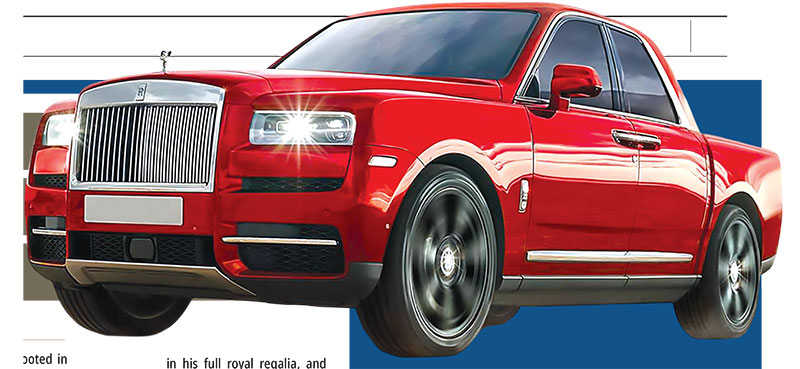
No Rolls-Royce is complete without the Spirit of Ecstasy mascot on the grille. Interestingly, this emblem was born from a secret love affair between Baron Montagu and his secretary, Eleanor Thornton. Today, the statue is a marvel of engineering itself—it automatically retracts into the hood if it senses any pressure, both to prevent theft and to protect pedestrians in the event of an impact.
By combining the obsessive engineering of Henry Royce with the high-society vision of Charles Rolls, the brand transformed the car from a machine into a “moving sanctuary.”