Sukumar Sah
In what could mark the beginning of a new phase in India-US trade relations, the announcement of a bilateral tariff reset has already begun reshaping markets, investor expectations and corporate strategies.
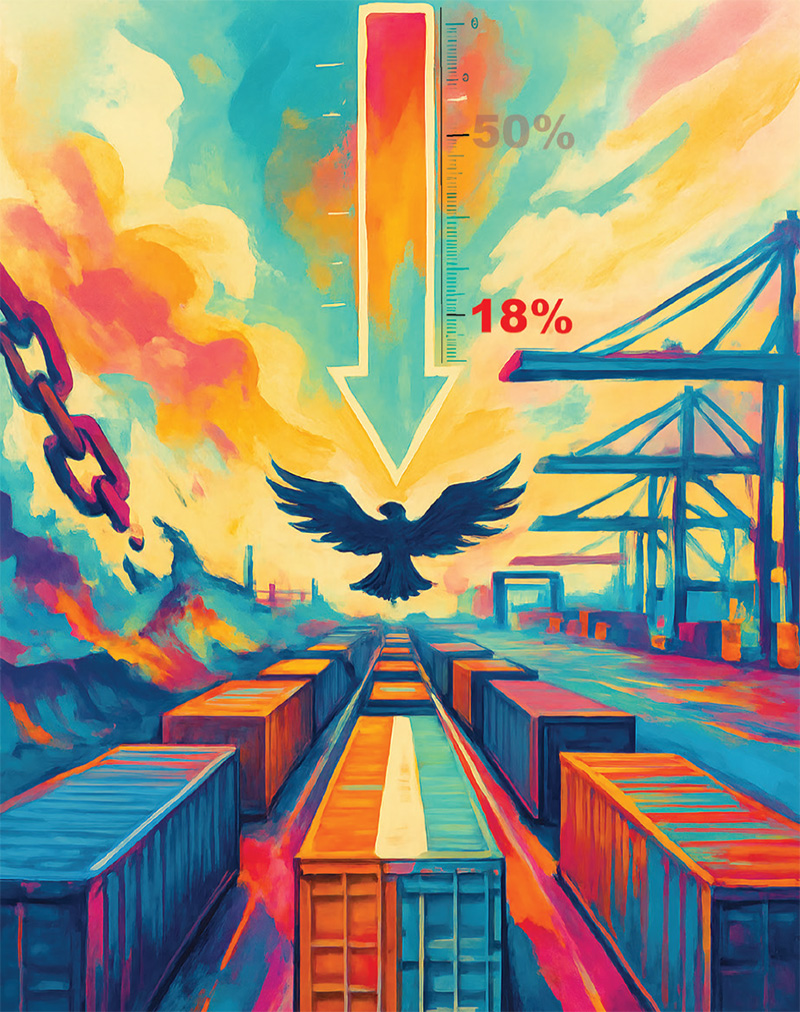
The early response from financial markets suggests that the sharp reduction in punitive US tariffs on Indian exports — from levels as high as 50 per cent to about 18 per cent — has materially improved the economics of India’s export sectors and revived investor confidence.
The headline change is significant. Under the arrangement announced by US President Donald Trump, duties on many Indian goods entering the US, previously burdened by punitive levies, have been reduced to a flat 18 per cent across a broad range of products. This brings India much closer to the tariff levels faced by competitors such as Vietnam and Thailand and marks a decisive retreat from the punitive trade measures imposed during recent geopolitical and economic tensions.
Prime Minister Narendra Modi placed the move within India’s broader global economic strategy, saying after his call with President Trump that the understanding “signals renewed confidence in India’s role as a reliable partner in global supply chains and provides fresh momentum to our exports and jobs.”
He added that the agreement reflects the “deep trust and growing economic ambition” that define the India-US strategic partnership.
In practical terms, US tariffs on Indian goods — previously inflated by additional punitive charges, nearly half of which were linked to trade tensions and India’s imports of Russian oil — have now been reset to 18 per cent for most product categories.
Certain sectors such as electronics, pharmaceuticals and petroleum products were already largely exempt from these additional levies and will continue under lower tariff regimes.
However, not all duties have been rolled back. Section 232 tariffs on steel, aluminium and copper remain at 50 per cent, reflecting US domestic protection concerns, while duties on select auto components are expected to stay around 25 per cent. Even with these exclusions, the overall reduction sharply alters the competitive calculus for Indian exporters in the US market.

Textiles and apparel are among the most immediate beneficiaries. The US is India’s single-largest market for garments and cotton textiles, accounting for nearly 28 per cent of total textile exports. Under higher tariffs, Indian manufacturers struggled to compete with suppliers from Bangladesh and Vietnam. At an 18 per cent duty rate, exporters can now offer more competitive landed costs, supporting order inflows, better capacity utilisation and improved margins.
Engineering goods and auto components — the largest component of India’s merchandise exports to the US — also stand to gain. These sectors typically operate on thin, single-digit margins, meaning tariff relief translates almost directly into profitability.
Companies such as Sona BLW, which derives about 40 per cent of its revenue from the US, and Bharat Forge, with roughly 25 per cent exposure, are expected to see tangible earnings benefits.
Gems and jewellery exporters, particularly those shipping cut and polished diamonds and gold jewellery, benefit from lower landed costs that help sustain retail pricing in the US. While duties had weighed heavily on this value-intensive sector, the reset eases cost pressures and improves pricing stability.
Seafood exports, especially shrimp — where India is the largest supplier to the US — will also see stronger margins and demand. Marine exports worth about $2.7 billion are expected to gain relief.
Financial markets reacted emphatically. On the day of the announcement, the Nifty 50 surged nearly 3 per cent — its biggest single-day gain in five years — while the Sensex posted broad-based advances. Reliance Industries, with significant US exposure through petrochemicals and refining, rose about 4 per cent.
Finance Minister Nirmala Sitharaman said the rally reflected “market confidence that the trade deal provides a more predictable trade environment — a critical input for investor decisions, capital flows and export-led growth.” She added that the tariff reset strengthens India’s growth narrative without compromising strategic autonomy or policy space.
The rupee appreciated more than 1 per cent against the US dollar, signalling renewed confidence in India’s external balance and export outlook. Investors are also betting that tariff relief will revive foreign institutional inflows, stabilise earnings for export-oriented firms and ease the external headwinds that weighed on sentiment through much of 2025.
Industry leaders highlighted the longer-term implications. Anand Mahindra, Chairman of the Mahindra Group, called the move “a confidence signal for global buyers and Indian manufacturers alike,” noting that stable access to the US market can materially influence investment decisions in autos, manufactured components and renewable energy.
Tata Group Chairman N. Chandrasekaran said the deal adds momentum to India’s integration with global value chains, while Bharti Airtel Chairman Sunil Bharti Mittal described it as an important structural step reinforcing India’s attractiveness as an export destination.
Some details still await formal notification, including product-level tariff lines, effective dates and potential non-tariff measures. Certain high tariffs, particularly on metals, remain untouched. Even so, the direction is unmistakable.
The tariff reset to 18 per cent is not just a numerical adjustment but a meaningful recalibration that restores competitiveness, unlocks value across sectors and signals a tangible economic reset in India’s trade relationship with the United States.
The tariff reduction by the US brings India much closer to the tariff levels faced by competitors and marks a decisive retreat from the punitive trade measures imposed during recent geopolitical and economic tensions
Goldman Sachs has de-scribed the US decision to reset tariffs on Indian ex-ports to about 18 per cent as a net positive for India.
The American investment bank and financial services firm says the lower tariff rate improves India’s competitiveness in the US market, bringing it broadly in line with other Asian exporters who face duties in the mid-teens to high-teens range, instead of the much steeper punitive tariffs imposed earlier.
On the macro front, Goldman Sachs said the tariff reset could pro-vide a modest but tangible boost to growth. It upgraded India’s calendar-year 2026 GDP growth forecast to around 6.9 per cent, roughly 20 basis points higher than its earlier estimate.
It noted that sectors with signifi-cant exposure to the US market – including electronics, pharma-ceuticals, textiles and chemicals –stand to benefit the most, as lower tariffs improve pricing power and reduce trade friction.


