Blitz Bureau
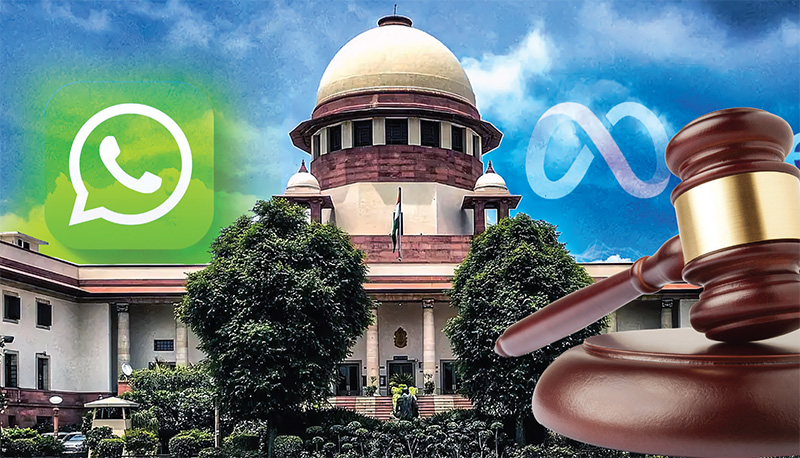
NEW DELHI: The Supreme Court last week issued a stern warning to Meta, the owner of WhatsApp, over the messaging platform’s privacy policy. Chief Justice Surya Kant said that Meta could leave India if it was unable to follow the country’s law, according to a report in The Daily Jagran.
“You can’t play with the privacy of our country. We will not allow you to share a single digit of our data,” CJI Kant told the US company while hearing a plea on WhatsApp’s 2021 privacy policy. Meanwhile, Solicitor General Tushar Mehta termed the policy “exploitative” in nature. To this, the CJI said, “If you can’t follow our Constitution, then leave India. We won’t allow any citizen’s privacy to be compromised.”
“… a poor woman or a roadside vendor, or someone who only speaks Tamil… will they be able to understand?” the apex court pointed out.
“Sometimes even we have difficulty understanding your policies…” the court ripped into Meta and WhatsApp, “… so how will people living in rural Bihar understand them?” it added.
Earlier, a lawsuit was filed in the United States, challenging Meta’s long-standing claims that WhatsApp messages are fully private, alleging that the company can store, analyse, and access user communications despite its end-to-end encryption assurances.
The case was filed in a US District Court in San Francisco and accuses Meta Platforms Inc. and WhatsApp of misleading users worldwide by marketing the messaging service as secure and inaccessible even to the company itself, according to a Bloomberg report.
End-to-end encryption has been a cornerstone of WhatsApp’s privacy pitch, with Meta repeatedly stating that messages can only be read by the sender and the recipient. Inside the app, WhatsApp tells users that “only people in this chat can read, listen to, or share” their messages, noting that the feature is enabled by default.
However, the plaintiffs argued that these assurances do not reflect how the service actually works behind the scenes.
According to the complaint, Meta and WhatsApp “store, analyse, and can access virtually all of WhatsApp users’ purportedly ‘private’ communications.” The filing claims Meta intentionally created security weaknesses that allow it to collect user information, allegedly violating privacy standards associated with the Signal protocol used by WhatsApp. The lawsuit cites internal whistle blower information, though it does not identify the whistle blowers or explain their roles.
Earlier, a lawsuit was filed in the United States, challenging Meta’s long-standing claims that WhatsApp messages are fully private, alleging that the company can store, analyse, and access user communications despite its end-to-end encryption assurances.