




Blitz Bureau
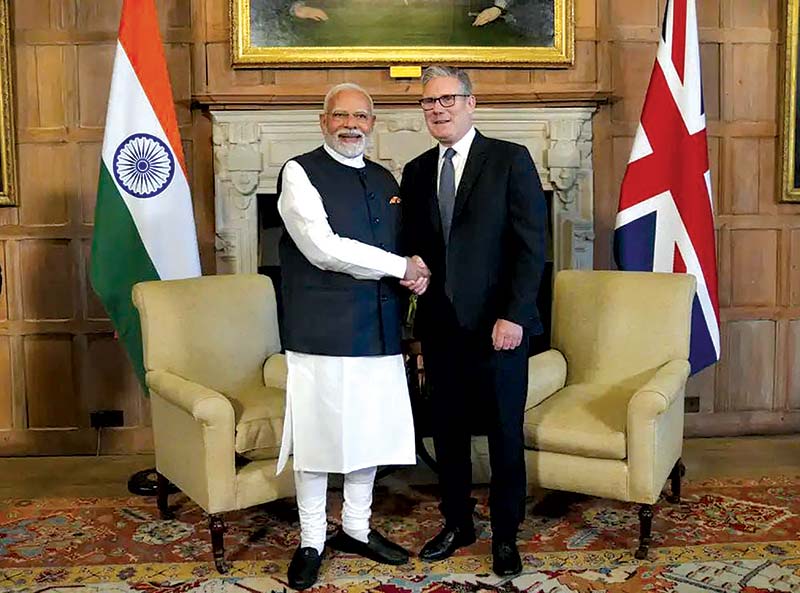
LONDON : In a moment destined to reshape global economic partnerships, India and the United Kingdom today formally sealed a transformative Free Trade Agreement (FTA) in London. The culmination of nearly three years of intricate negotiations, the pact, signed by Prime Minister Narendra Modi and British Prime Minister Keir Starmer, sets an ambitious target: to nearly quadruple current bilateral trade to $120 billion by 2030.
The ceremonial signing, attended by India’s Commerce and Industry Minister Piyush Goyal, marks a new chapter in the Comprehensive Strategic Partnership between the two nations. It signifies a decisive move beyond historical ties, embracing a future of shared prosperity and strategic alignment.
“This agreement is more than just a trade deal; it’s a testament to the patient diplomacy and mutual respect that underpins our relationship,” a senior Indian diplomat stated, highlighting the thorough “legal scrubbing” that preceded the accord. The sentiment was echoed by British officials, who view the FTA as a cornerstone of their post-Brexit global trade strategy, leveraging India’s burgeoning economic might.
The agreement, a sprawling document covering goods, services, investment, and intellectual property, is poised to unlock vast opportunities.
Key Decisions & Negotiation Milestones
• Goods Liberalization: 99% of Indian goods will gain immediate duty-free access to the UK market, directly benefiting labor-intensive sectors such as textiles, leather, footwear, and gems and jewellery.
• UK Market Entry: India will eliminate or significantly reduce tariffs on approximately 90% of its tariff lines, with 64% experiencing immediate liberalization.
• Scotch Whisky: Duties will be halved from 150% to 75% immediately, reducing further to 40% over 10 years.
• Automobiles: Tariffs on British cars will be slashed from over 100% to 10% under a quota system.
• Services and Mobility: Indian professionals working temporarily in the UK will receive a three-year exemption from UK social security contributions, a projected annual saving of ₹4,000 crore (approx. $463 million). Expanded visa routes and mutual recognition of professional qualifications are also included.
• Government Procurement: In a significant policy shift, India will allow UK firms to participate in non-sensitive federal government procurement tenders above Rs 2 billion, opening up a vast market.
• Intellectual Property Rights: The agreement includes provisions on IPR, aiming to foster innovation while balancing access.
• Social Security Pact: A separate Double Contribution Convention Agreement has been concluded, easing financial burdens for short-term workers.
The economic impact is projected to be substantial. Current bilateral trade in goods and services stood at approximately £42.6 billion ($58 billion) in the four quarters ending Q4 2024. India’s exports to the UK alone surged by 12.6% to $14.5 billion in 2024-25, showcasing the existing momentum. The UK remains India’s 4th largest export destination, while India is the UK’s 11th largest trading partner. Investment flows are also robust, with UK outward FDI in India at £17.4 billion and Indian FDI in the UK at £13.1 billion in 2024. The FTA is expected to catalyze a surge in these figures, fostering job creation and economic growth across both nations.
Beyond the immediate economic benefits, the FTA holds profound diplomatic significance. It reinforces the shared democratic values and strategic interests of both countries, particularly in promoting a rules-based international order in the Indo-Pacific.
Yet, the journey was not without its intricate challenges. Negotiations navigated sensitive areas, including the UK’s Carbon Border Adjustment Mechanism (CBAM), set for 2027, which could impose levies on Indian carbon-intensive exports like steel. While the FTA is signed, a crucial Bilateral Investment Treaty (BIT)remains under negotiation, aiming to provide comprehensive investment protection. The persistent issue of extradition also continues to be a point of diplomatic friction, impacting the broader trust framework.
The agreement now enters a critical ratification period, requiring approval from the British Parliament and India’s Union Cabinet. This process, anticipated to take up to a year, will pave the way for the full implementation of what both nations hope will be a defining partnership of the 21st century. The signing today in London is not merely a formality but a powerful statement of intent, signalling a future where two global powers intertwine their destinies for mutual prosperity and influence.
The Union Cabinet has approved the FTA, and the signing is scheduled for July 24, 2025, during Prime Minister Narendra Modi’s visit to London. Commerce and Industry Minister Piyush Goyal will accompany him. The agreement aims to double bilateral trade to $120 billion by 2030. Key elements include removing taxes on Indian labour-intensive products and making British whisky and cars cheaper. It also includes provisions for services, innovation, government procurement, and intellectual property rights. A social security pact has been concluded, but a bilateral investment treaty is still under negotiation.
Bilateral trade in 2023-24 stood at $21.34 billion, up from $20.36 billion in the previous year. In 2024-25, India’s exports to the UK rose 12.6% to $14.5 billion, while imports grew 2.3% to $8.6 billion. The UK was India’s 4th largest export destination in 2024 and India was the UK’s 11th largest trading partner (goods and services) in the four quarters to the end of Q4 2024, with total trade at £42.6 billion. UK outward FDI in India was £17.4 billion, and Indian FDI in the UK was £13.1 billion in 2024.
Concerns include the UK’s Carbon Border Adjustment Mechanism (CBAM) set for 2027, which could impact Indian carbon-intensive exports like steel, and the ongoing issues with the Bilateral Investment Treaty (BIT) and extradition.