




Blitz Bureau
NEW DELHI: With the war in West Asia driving up oil prices, unsettling markets and sharpening fears of wider supply disruptions, the call for ‘Swadeshi’ has returned with unusual urgency. For Indian business, the word now carries a meaning that is more strategic than sentimental.
It means building more at home, reducing dangerous external dependence, securing critical supply chains and preparing for a world in which trade is no longer shaped by economics alone, but by conflict, sanctions and power politics.
The immediate trigger is the West Asia crisis itself. Every fresh escalation in the region sends a warning to India: that a country heavily dependent on imported energy and critical foreign inputs remains exposed to shocks it cannot control.
That is why Chief Economic Adviser V. Anantha Nageswaran’s recent remark in Kochi has resonated so strongly. He said, “Swadeshi matters more than ever amid global uncertainty,” capturing the sharper mood now visible in policy thinking.
The point is not to revive the old language of autarky or economic closure. It is to recognise that self-reliance, in current conditions, has become a form of economic insurance.
Prime Minister Narendra Modi has repeatedly framed the same idea through the language of Atmanirbhar Bharat, linking domestic capability to national confidence, resilience and long-term strength.
India’s top business chambers have also begun to reflect this harder Swadeshi mood. CII has stressed the need to deepen domestic value chains in sectors such as semiconductors, electronics and critical minerals, while FICCI has argued that self-reliance should be seen not as inward-looking economics but as a way to build globally competitive strength.
Convergence between Government and industry now is significant: Swadeshi is no longer being pitched merely as political rhetoric, but as a business response to geopolitical risk.
With the West Asia conflict jolting oil markets and exposing India’s external vulnerabilities, ‘Swadeshi’ is being recast as a business necessity rather than a nationalist slogan
The shift is important because India’s broad economic strategy for the past three decades rested on deeper integration with the world economy.
Trade, imported technology, foreign investment and insertion into global supply chains helped expand manufacturing, strengthen exports and create a more confident private sector. That approach delivered real gains. But the global environment that sustained it is no longer stable.
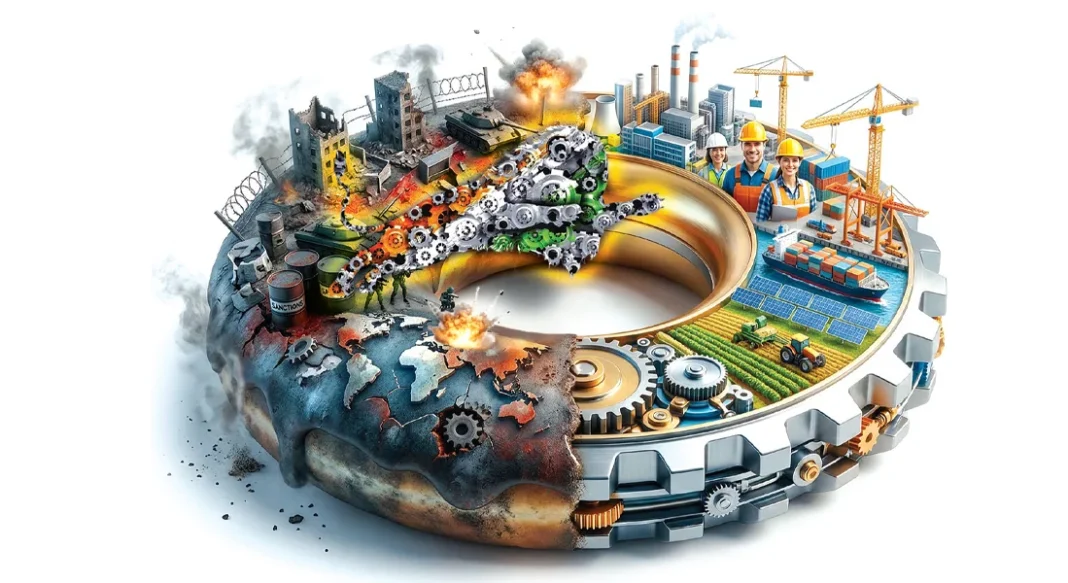
Trade is increasingly shaped by sanctions, strategic rivalry, export controls, industrial subsidies and geopolitical fragmentation. The old assumption that supply will always flow smoothly from the cheapest source now looks fragile.
Two sectors show most clearly why Swadeshi has become the need of the hour. The first is energy. India’s dependence on imported crude means every conflict in West Asia quickly feeds into the domestic economy through a higher import bill, inflationary pressure, currency weakness and fiscal stress.
In this context, Swadeshi in energy does not mean India can eliminate oil imports anytime soon. It means reducing long-term vulnerability by expanding domestic alternatives such as solar manufacturing, battery storage, green hydrogen, biofuels and a broader clean-energy ecosystem. For Indian business, that is not just an energy transition story. It is a resilience strategy.
The second is electronics and semiconductors. India has made progress in mobile phone assembly and electronics manufacturing, but it still relies heavily on imported chips, components and upstream technologies.
In a world of tightening technology controls and concentrated supply chains, that dependence is a serious strategic weakness. Any disruption in East Asian production networks or tougher export restrictions can ripple across telecom, automobiles, defence and consumer electronics.
Swadeshi in this sector means going beyond assembly to build deeper capability in components, design, fabrication and trusted domestic supply ecosystems. Without that, India risks remaining integrated into the global digital economy at its most vulnerable end.
This is the key to the new Swadeshi argument. It does not mean sealing borders, shutting out foreign capital or returning to the licence-permit raj. Nor does it mean rejecting globalisation altogether.
It means engaging with the world from a position of greater domestic strength. In practical terms, that means identifying sectors where import dependence creates strategic risk and then building capacity at home, while still remaining open to trade, technology and investment. Self-reliance, in this reading, is not the opposite of openness. It is the condition for sustaining openness in a harsher world.
That logic is already visible in policy. Electronics, semiconductors, defence production, renewable energy equipment, digital public infrastructure and critical minerals are increasingly being treated not merely as commercial sectors but as strategic domains.
The emphasis is not on blanket import substitution but on resilience. A country that cannot make enough of what it critically needs, or source it through trusted and diversified channels, is more vulnerable than conventional economic models once assumed.
For India Inc, this changes the business calculus. Companies can no longer plan based on smooth trade routes, reliable overseas suppliers and neutral markets.
They have to factor in source concentration, geopolitical risk, strategic inventories, trusted partnerships and domestic capability. Efficiency still matters, but resilience now matters as much. The cheapest source is not always the safest one, and the most globalised supply chain is not always the most dependable.