




Blitz Bureau
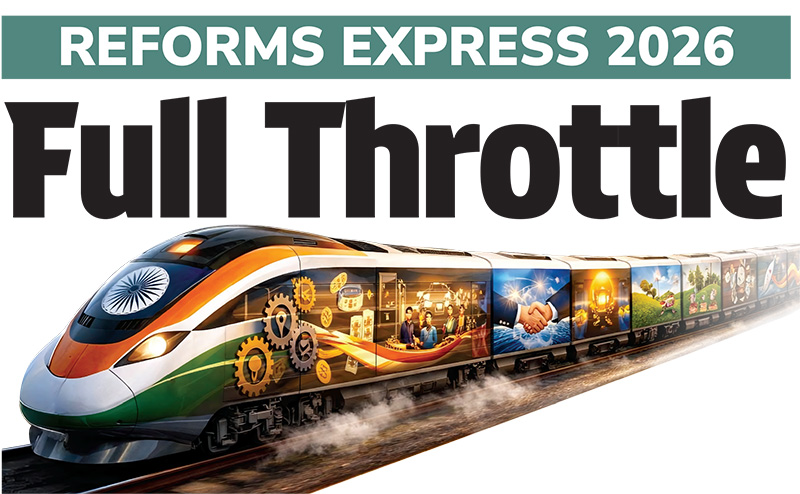
NEW DELHI: Prime Minister Narendra Modi says that “India has boarded the Reforms Express”. He is not merely offering a metaphor but defining a governing philosophy for the next phase of India’s economic and institutional transformation.
Reiterated both in a recent LinkedIn post and at the Chief Secretaries’ Conference, the phrase signals a decisive shift: India is no longer debating whether to reform, but how fast, how deep and how irreversibly those reforms can be carried through.
Modi’s assertion that 2025 will be remembered as a landmark year underscores the belief that the country has entered a stage where reform outcomes — not intentions — will shape India’s growth trajectory.
The imagery of a fast-moving train is deliberate. Reforms, once set in motion at scale, are difficult to reverse without cost. By invoking the “Reforms Express,” the Prime Minister seeks to lock India into a momentum-driven reforms cycle that transcends individual ministries, electoral calendars and levels of Government.
His choice of audience at the Chief Secretaries’ Conference was telling. These officials translate policy into execution, and the message to them was unambiguous: reforms will now be judged at district, state and municipal levels, not in Delhi’s policy corridors.
At the heart of this narrative lies a shift from a control-based economy to one founded on trust. Modi has argued that excessive regulation, overlapping compliances and a control-oriented bureaucracy long constrained growth.
The new reform push aims to invert that relationship — placing facilitation over regulation and collaboration over coercion. In this framework, the state’s role is to enable markets, empower citizens and build platforms rather than micromanage outcomes.
The Prime Minister has also identified the engines pulling this Reforms Express: India’s demography, its young generation and what he calls the “indomitable spirit” of its people. Unlike past reform cycles driven by balance-of-payments stress or external pressure, today’s changes are being justified as aspirational — designed to unlock the productivity, innovation and risk-taking potential of a young population. In that sense, reforms are being framed not as elite economic adjustments but as instruments of mass opportunity.
The year 2026 is expected to mark the consolidation of next-generation structural reforms across taxation, labour, trade, energy, rural employment and ease of doing business.
In taxation, simplicity is central. A two-slab GST structure — 5 per cent and 18 per cent — aims to reduce disputes and widen compliance. The replacement of the Income Tax Act of 1961 with the Income Tax Act, 2025, has made tax law more readable and predictable, including relief for individuals earning up to Rs12 lakh annually.
Ease of doing business, especially for smaller enterprises, remains a recurring theme. Expanding the definition of small companies to firms with turnover up to ₹100 crore, scrapping outdated laws and cutting compliance burdens are intended to free entrepreneurial energy and ensure regulation no longer acts as a growth tax on ambition.
Labour reforms, long politically sensitive, are being positioned as essential for inclusive growth. The consolidation of 29 central labour laws into four codes seeks to balance flexibility with worker security, emphasising fair wages, social security, safer workplaces and higher female participation. The focus is on formalisation and transparency.
On the external front, trade policy is being aligned with India’s manufacturing and investment ambitions. The operationalisation of free trade agreements with the European Free Trade Association and new deals with partners such as New Zealand, Oman and the UK are intended to signal India’s willingness to integrate with global value chains on its own terms. These agreements are projected not merely as trade instruments but as confidence-building mechanisms for long-term foreign investment.
Energy reforms mark another departure. The SHANTI Act, opening nuclear energy to private participation, reflects recognition that future energy needs and climate commitments require capital and expertise beyond the public sector.
The reforms agenda also extends to rural India. The Viksit Bharat–Gramin Act, 2025, increasing guaranteed rural employment days from 100 to 125, seeks to balance reform momentum with social stability, presenting welfare and reform as complementary.
Collectively, these cross-sectoral reforms are being positioned as building blocks of the “Viksit Bharat” vision—a developed India defined not just by income levels but by institutional efficiency and opportunity creation.
Whether the Reforms Express reaches its destination on time will depend on execution, political will and cooperative federalism. But the message from the Prime Minister is clear: the train has left the station, the tracks are being laid at speed, and 2025 is expected to mark the point where India’s reform journey becomes both visible and irreversible.