




Blitz Bureau
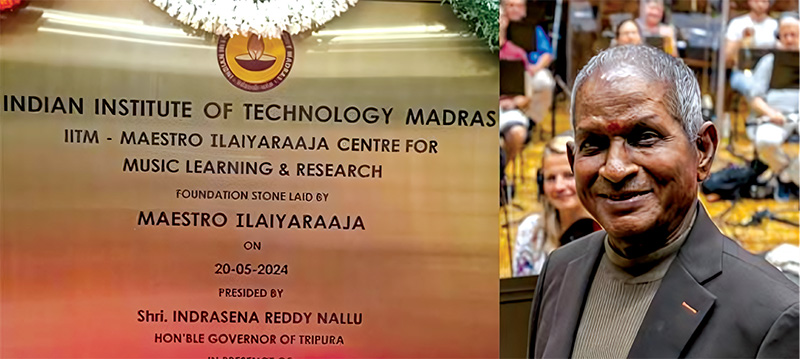
NEW DELHI: The Indian Institute of Technology Madras (IIT-M) is orchestrating a sweeping academic reset, one that positions Indian cultural heritage at the heart of future-facing technology. In a bold move to bridge the gap between ancient artistry and modern engineering, the institute is set to launch the IITM–Maestro Ilaiyaraaja Centre for Music Learning and Research starting in the 2026-27 academic year.
This initiative, according to Prof V Kamakoti, Director of IIT – who gave an in-depth interview to DT Next on this – represents a shift in how we perceive the relationship between the arts and sciences. By decoding the mathematical DNA of Indian music, IIT-M aims to not only preserve cultural wealth but also to redefine global sound technology.
Music as mathematics
While music is traditionally viewed as an art form, Prof Kamakoti asserts that it is, at its core, a highly structured science. Every melody, rhythm, and tonal transition is governed by precise mathematical principles.
There is mathematics behind every kutcheri, every rhythmic cycle and every tonal movement. Even traditional forms such as Siva Vadhyam, he says, follow precise numerical and rhythmic logic.
Classical dance, too, is governed by timing, symmetry and mathematical patterns. The centre will bring together musicians, mathematicians, engineers and technologists to document and formalise these structures.
Once captured mathematically, they can be modelled and simulated for advanced research in acoustics, sound synthesis, music cognition and immersive audio environments. This work will also extend to instrument design and digital reproduction.
Melodies themselves are mathematical constructs, and recognising this formally is critical for the future of sound research.
Indian classical traditions, such as Carnatic and Hindustani music, offer an unparalleled foundation for this exploration, built upon centuries of structured, yet often undocumented, knowledge.
The Ilaiyaraaja Centre aims to bridge this gap by capturing these musical elements mathematically. The vision is to bring together an interdisciplinary cohort of musicians, mathematicians, and engineers to formalise these structures.
“If we can mathematically decode the extraordinary theoretical depth of Indian classical music, it can redefine global sound technology,” Prof Kamakoti explains.
The practical applications are vast, ranging from advanced research in acoustics and sound synthesis to the development of AI-driven audio tools and innovative musical instrument design.
Countries such as Japan have made significant advances in sound synthesis and electronic instruments. While Indian musicians excel in performance, the theoretical depth of Indian classical music is extraordinary.
Acoustic sanctuary
The physical home of the Ilaiyaraaja Centre is as innovative as its mission. Currently under construction with a heavy focus on sustainability, the facility is being built largely using bamboo, with the expertise of skilled workers from Assam.
A flagship feature of the center will be a 100-capacity, mic-less auditorium. Designed to rely entirely on natural acoustics rather than electronic amplification, the space stays true to traditional sound principles while utilizing modern engineering to optimize the listening experience. The building is expected to be completed by April 2026.
Creativity in engineering
In a significant policy shift, IIT-M has begun admitting students with strong backgrounds in traditional music into its BTech programmes. This pathway allows talented artists to pursue an engineering education even if their JEE scores are relatively lower, recognising that culture is essential for holistic development.
Prof Kamakoti believes these students bring a unique creative and intellectual energy to the campus. By encouraging these engineers-in-training to continue their musical performances alongside their studies, the institute hopes to nurture discipline, emotional balance, and innovative thinking.
Medicine and global access
The evolution of IIT-M extends beyond the arts. Recognizing that over half of modern medical diagnosis now depends on technology—from AI tools to advanced imaging—the institute is expanding aggressively into medical science.
IIT-M has already established a Medical Science and Technology Centre and launched a BSc in Medical Science and Engineering. The roadmap for the near future is even more ambitious:
* PhD pathways: Several MD doctors have already joined the institute to conduct research at the intersection of clinical medicine and technology.
* MBBS programmes: The institute plans to offer full MBBS degrees in the coming years to remain globally competitive.
* New BS branches: The next academic year will see the introduction of new branches under the BS degree programs.
Parallel to these high-tech advancements is the ‘IIT-M for All’ initiative. This programme seeks to democratise high-quality education by inviting students from rural, tribal, and under-represented backgrounds to experience the IIT ecosystem first hand.
By simplifying STEM pedagogy and opening its doors to over 70,000 schoolchildren for the 2026 Open House, IIT-M is ensuring that the “New Economy” is built on a foundation of inclusivity and interdisciplinary brilliance.