The APP that lost altitude

For over a decade, one piece of software controlled the entire arc of a journey – the search, the seat, the boarding pass, the meal. That control has quietly slipped away

K Srinivasan

NEW DELHI: Here is another piece of bad news for airlines: their apps have quietly plateaued. How do you know? There are multiple publicly visible signals: flat download curves on the Play Store and App Store, ‘Travel & Local’ category rankings have gone static, and there has been a seismic drop in new user acquisition for almost three years now.
Since 2012, these apps were year-by-year hot property – literally the digital gateway to flying. Your boarding pass, your seat map, your check-in formalities, and the food you consume on board. All booked through the app. Starting 2023, though, the ecosystem around them matured and evolved much faster than the apps did. The stagnation is now data-confirmed.

Passenger behaviour

The prime reason is the evolution of passenger behaviour. No longer does the traveller’s journey start on the app. Dozens of search funnel analyses and multiple industry studies have revealed that more than 70 per cent of flight searches begin on Google, MakeMyTrip, Ixigo, and dozens of other aggregators. Airline apps have been pushed way down the value chain – they are now used only once the passenger has made up his/her mind and chosen the flight.
This shift alone explains the plateau: you can never control growth if you do not control discovery and the decision-making process.

The reason number two is competition – and it is not even close. Airlines are, by nature, cagey about their numbers. Aggregators are the opposite. MakeMyTrip puts out quarterly disclosures that show double-digit year-on-year growth in transactions. Ixigo crossed 100 million downloads. EaseMyTrip reported record booking volumes in both 2024 and 2025. What these platforms have built – fare calendars, price alerts, multi-city combinations, train-plus-flight options, UPI payment funnels – airline apps cannot replicate. One airline, one ecosystem. The aggregators are playing an entirely different game.

Structural reason

The third reason is structural – and uniquely Indian. Almost every major metro airport is far from city centres. Delhi, Bengaluru, Hyderabad, Navi Mumbai, Jewar – all require long commutes, and data shows that 70-80 per cent of passengers use cabs or Metro systems to reach airports. The home-to-airport leg is, more often than not, the most consequential part of the journey. Google Maps has quietly become the most powerful travel tool in the country as a result.

Look at what Google Maps integrated between 2024 and 2026: Metro schedules, cab ETAs and pricing, airport traffic predictions, real-time disruption alerts, and flight timings. It now controls the entire chain – from home to airport to flight to destination. When Maps tells a traveller that the Metro is faster at 6 PM, or that cab surge pricing makes a morning flight cheaper overall, the traveller adjusts. Airline apps have no visibility into this behaviour. They are blind to the most influential part of the decision-making process.

One last reason, and the most important one, that is functional. Airline apps retain loyal users well, but for everyone else, usage spikes only at check-in. Aggregators engage daily – through fare alerts, multi-modal planning, and payment integration. Airline apps simply don’t give users enough reasons to return.

Different thinking

The fact of the matter is that India is thinking and operating differently now, especially the generation under 40. It has all the spending power. We have lived under the assumption for years that flying was the default option for any distance that meant an overnight journey. That calculation has changed dramatically: the expansion of expressways, the Vande Bharat rollout, and a general upgrade in road and rail comfort have made a 300-to-600 kilometre journey an opportunity full of options.

A Delhi-to-Jaipur or Mumbai-to-Pune trip that once meant booking a flight now competes with a five-hour drive on a highway that didn’t exist a decade ago. The translation is simple: while air travel is the preferred mode for long-haul, in the shorter haul it has clearly lost its monopoly. Going ahead, it’s likely to lose more and more heft, considering the high-speed trains that will be introduced in the next decade.

What it means is that applications need to be nimble and dynamic; building an app around an assumption that the flight is the solution for every journey is actually trying to solve a problem that arose the day before yesterday.

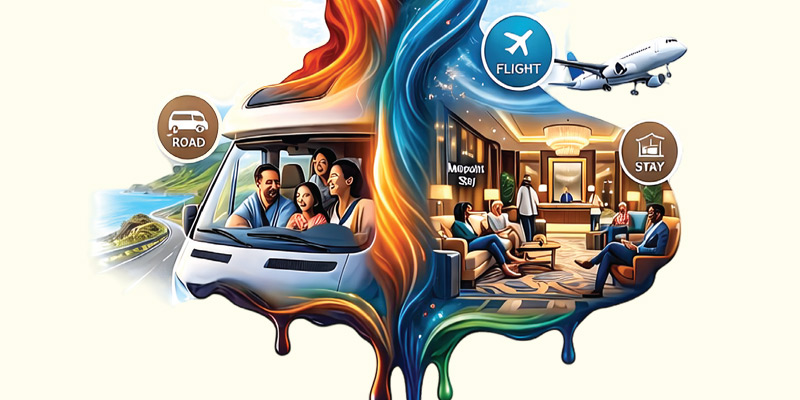
Today’s traveller wants options: travel by road, stay at a midpoint, and take a flight if they feel like it. If you want to succeed, you need a platform that offers a bouquet of services

Latest News

NUT CASE. Meet, coconut.

India’s coconut sector supports rural livelihoods, agricultural growth, and...

Golden Girls of Indian Badminton

Saji Chacko NEW DELHI: The roar inside New Delhi's...

Fulcrum of Indian middle-order

Saji Chacko NEW DELHI: Two centuries in Sri...

Race to save the oceans

Blitz India Business NEW DELHI: Global responses to SDG...

20,000 feet below the ocean surface

Blitz India Business NEW DELHI: The Matsya 6000 (meaning...

Topics

NUT CASE. Meet, coconut.

India’s coconut sector supports rural livelihoods, agricultural growth, and...

Golden Girls of Indian Badminton

Saji Chacko NEW DELHI: The roar inside New Delhi's...

Fulcrum of Indian middle-order

Saji Chacko NEW DELHI: Two centuries in Sri...

Race to save the oceans

Blitz India Business NEW DELHI: Global responses to SDG...

20,000 feet below the ocean surface

Blitz India Business NEW DELHI: The Matsya 6000 (meaning...

Genesis of the goal

Blitz India Business NEW DELHI: The inclusion of a...

Water water everywhere…

Blitz India Business NEW DELHI: India’s strategic approach to...

Powering the FUTURE

Blitz India Business NEW DELHI: Semiconductors are the foundation...
spot_img