Three of Twelve Approved Fabs Are Now Running

Blitz India Business

NEW DELHI: Twelve commercial semiconductor facilities have been approved in India. Three of them are operating. The distance between those two numbers is the entire story of the programme, and it is closing on schedule rather than behind it.

As of August 2026, three of the twelve commercial facilities approved under the India Semiconductor Mission are operational. Two to three more are expected to begin commercial production by the end of this year, with the remainder coming online across 2027 and 2028. The Union Cabinet has separately approved two further projects — Crystal Matrix, an integrated compound semiconductor fab with assembly, test and packaging at Dholera in Gujarat, and Suchi Semicon, an outsourced assembly and test facility at Surat.

The financial commitment behind the next phase is substantial. The Cabinet has approved Semicon 2.0, the next stage of the Semicon India Programme, with a fiscal outlay of ₹1,27,500 crore. India Semiconductor Mission 2.0, launched in the 2026-27 Budget, extends the first phase beyond fabrication into equipment, materials, design, supply chains and skills — which is the correct sequencing, because a fab without a domestic supply of gases, chemicals, photomasks and trained technicians is an import-assembly operation with a high electricity bill.

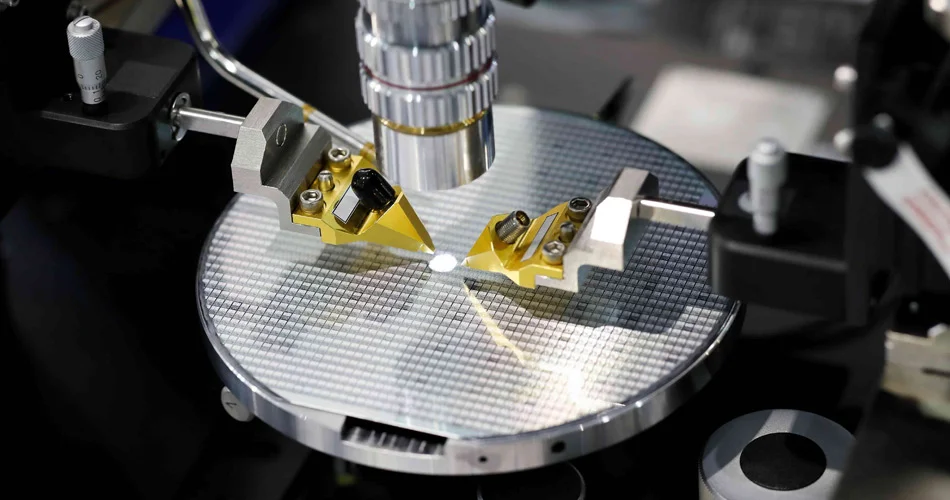
The output that takes years: A silicon wafer carrying integrated circuits. Three of the twelve commercial facilities approved under the India Semiconductor Mission are operational as of August 2026, with two to three more expected to begin commercial production by the end of the year.

A fab draws its ecosystem or it does not. At Semicon India in September, the exhibitor list of gas, chemical and mask suppliers will say more about the programme than the value of the memoranda signed.

At a Glance

• Approved commercial facilities: 12
• Operational as of August 2026: 3
• Expected to start commercial production by end-2026: 2 to 3
• Remainder: 2027 and 2028
• Semicon 2.0 outlay: ₹1,27,500 crore
• Recent Cabinet approvals: Crystal Matrix (compound semiconductor fab and ATMP, Dholera) and Suchi Semicon (OSAT, Surat)
• ISM 2.0 scope: equipment, materials, design, supply chains, skills
• Semicon India 2026: 17-19 September, Yashobhoomi, Dwarka, New Delhi

Approval-to-operation lag is the metric that distinguishes a semiconductor programme that works from one that announces. Fabrication plants take three to five years from approval to qualified output anywhere in the world, and the cleanroom, the utilities and the equipment-installation sequence cannot be compressed by policy. Three operational units from a 2021-22 approval cohort is broadly consistent with that global timetable. The reason to watch it monthly rather than annually is that the delay pattern, if one develops, appears in the utilities and water-supply stages long before it appears in a production announcement.

The scale of the domestic prize is what justifies the outlay. India already assembles and consumes electronics at volume — the same July that produced record merchandise exports also produced record output from the vehicle industry, and every one of those 33,70,958 vehicles carries semiconductors. A country that designs a substantial share of the world’s chips, through the engineering centres in Bengaluru, Hyderabad and Noida, and manufactures almost none of them, carries a strategic exposure that no amount of design capability offsets.

The showcase for all of this is Semicon India 2026, the fifth edition, running from 17 to 19 September at Yashobhoomi, the India International Convention and Expo Centre in Dwarka, New Delhi. The useful thing to look for there is not the investment announcements but the supplier exhibitors — the gas, chemical, mask and equipment firms. A fab draws its ecosystem or it does not; the composition of the exhibitor list is a better forward indicator than the value of memoranda signed.

The constructive marker for the programme would be a published quarterly dashboard against each approved unit: land, utilities, equipment installation, pilot production, qualified output. The projects are named and located, so the milestones are matters of public record rather than of interpretation. A programme that reports its own conversion rate raises money more cheaply than one that does not.

Latest News

Dubai airport takes a hit

Blitz India Business NEW DELHI: The Dubai International Airport...

World’s busiest airport

Blitz India Business NEW DELHI: South Korea’s Incheon airport...

From hope to a troubling new reality

Anoop Saxena NEW DELHI: In 2003, two years after...

The unseen web

Blitz India Business NEW DELHI: If one wants to understand...

CHURNING Ocean for Energy

Blitz India Business NEW DELHI: Energy powers every aspect...

Topics

Dubai airport takes a hit

Blitz India Business NEW DELHI: The Dubai International Airport...

World’s busiest airport

Blitz India Business NEW DELHI: South Korea’s Incheon airport...

From hope to a troubling new reality

Anoop Saxena NEW DELHI: In 2003, two years after...

The unseen web

Blitz India Business NEW DELHI: If one wants to understand...

CHURNING Ocean for Energy

Blitz India Business NEW DELHI: Energy powers every aspect...

India emerging as Global Space Hub

Blitz India Business NEW DELHI: The space sector in India...

Egoistic encounters paralyse Parliament

Prabhu Chawla Democracy does not die only when elections...

Census 2027: 40 Questions notified

Blitz India Business NEW DELHI: The Centre has notified...
spot_img