




Blitz India Business
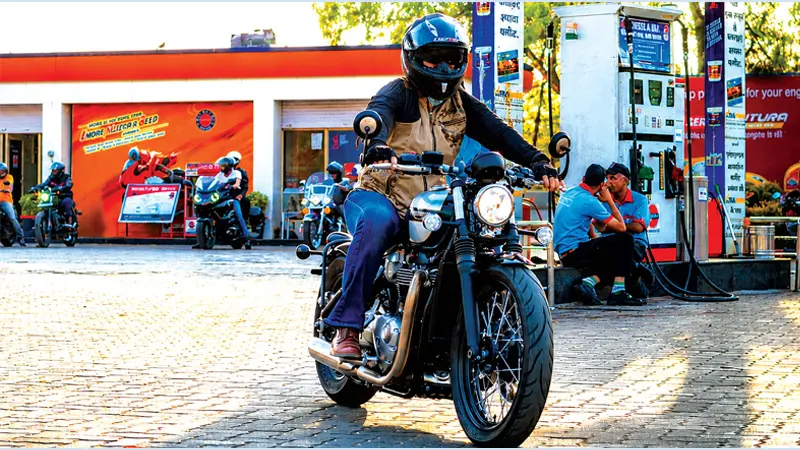
NEW DELHI: At a handful of filling stations in Delhi and Mumbai, a small number of motorists are doing something that would have seemed absurd two years ago. They are queuing for petrol that costs ₹160 a litre when the pump beside them sells at ₹102.12. In Mumbai the same fuel is ₹167.35 against ₹111.21. It is 100-octane, and its distinguishing feature is that it contains no ethanol at all.
Sales of it have more than doubled in recent months, sharpest in July. The scale remains negligible — 0.1 per cent of India’s petrol sales, stocked at fewer than 1 per cent of the country’s one lakh-plus retail outlets, largely in metros, sold as IndianOil XP100, BPCL Speed100 and HPCL poWer100. But the 57 per cent premium some Indians are willing to pay is worth understanding, because it is the first consumer signal of any kind against one of the most successful industrial programmes of the past decade.
The achievement is not in dispute, and it is very large. What the programme now needs is not defence but data.
An import-substitution success
India’s Ethanol Blended Petrol Programme has moved from under 1.5 per cent blending in 2013-14 to 20 per cent through Ethanol Supply Year 2025-26 — five years ahead of the original 2030 target, which the Cabinet Committee on Economic Affairs advanced to 2025-26 in March 2025. Only Brazil, which went to E30 in August 2025, blends more.
The dividend, as recorded by the Petroleum Ministry on 10 July: ₹1.97 lakh crore of foreign exchange saved, 316 lakh tonne of crude substituted, 952 lakh tonne of carbon dioxide avoided, and ₹1.66 lakh crore paid to farmers since 2014-15. Distillation capacity has risen from 421 crore litres in 2014 to about 2,000 crore litres — nearly fivefold — with 183 distilleries financed under the interest subvention scheme between July 2018 and August 2023, according to an IIT Kanpur assessment for the Department of Food and Public Distribution. India imports roughly 88.5 per cent of the crude it consumes; every litre blended is a litre not bought.
Where the numbers diverge
The consumer question is mileage, and here four official figures exist for one phenomenon.
NITI Aayog’s own Roadmap for Ethanol Blending in India 2020-25, the programme’s founding document, estimated a 6-7 per cent efficiency drop for four-wheelers designed for E0 and calibrated for E10, 3-4 per cent for such two-wheelers, and 1-2 per cent for four-wheelers designed for E10 and calibrated for E20. The Petroleum Ministry’s public line has been 3-5 per cent. The Society of Indian Automobile Manufacturers cites 2-4 per cent from controlled testing. And on 30 July, Road Transport Minister Nitin Gadkari told the Lok Sabha in a written reply that efficiency “may be reduced by 2 to 6 per cent depending on the vehicle category and vintage.”
None of these is wrong. They measure different fleets. The difficulty is that India does not know how its fleet is distributed across them. Asked in the Rajya Sabha on 27 July, Minister of State for Petroleum Suresh Gopi replied that the ministry has “not conducted an assessment regarding the exact percentage of vehicles in India fully compatible with E20 petrol.” The fleet in question is 20 crore two-wheelers and 3 crore petrol cars.
The engineering evidence is reassuring. Gadkari’s reply also recorded that ARAI, SIAM and IOCL testing across BS-III, BS-IV and BS-VI vehicles has “not shown any failures due to E20” on either dynamometer durability tests or road trials. Maruti Suzuki serviced 2.84 crore vehicles in 2025-26, including 1.5 crore not certified for E20, with no ethanol-linked corrosion or abnormal wear reported. SIAM’s P.K. Banerjee said in August 2025 that “not a single vehicle breakdown or engine failure has been reported,” and confirmed warranties and insurance claims would be honoured. The Supreme Court dismissed a petition challenging the E20 rollout on 1 September 2025.
Why the policy cannot simply reverse
E0 and E10 are not returning, and the reason is financial. Ethanol capacity was built on the strength of an assured offtake at administered prices — ₹57.97 a litre for C-heavy molasses, ₹65.61 for sugarcane juice, ₹71.86 for maize in 2025-26. Behind that capacity sits bank credit, and behind the bank credit sits the mandate. Weakening the mandate would strand the asset.
The feedstock mix has also shifted in ways worth watching. Maize supplied 42.74 per cent of ethanol production in 2023-24, the single largest share; kharif maize area rose from 83.15 lakh hectares in 2024-25 to 91.89 lakh hectares in 2025-26, up 10.5 per cent and 16.3 per cent above the five-year average, while oilseeds fell about 7 lakh hectares. Poultry and cattle feed absorb 60-70 per cent of India’s maize. On water, NITI Aayog’s roadmap put sugarcane ethanol at about 3,000 litres of water per litre of ethanol and rice ethanol above 10,000.
The work ahead
Four measures would close the confidence gap without touching the mandate, and each is achievable within a year.
Publish a model-wise compatibility register. The ministry’s own answer concedes no fleet assessment exists. A public, searchable list of vehicles by make, model and year — E20-material-compliant from April 2023, E20-tuned from April 2025 — would replace speculation with a lookup.
Standardise the warranty statement. SIAM has given the assurance verbally. A common OEM declaration, printed in owner’s manuals and displayed at service centres, would carry further.
Commission independent, published mileage testing. The 1-7 per cent range in NITI’s roadmap is honest engineering. Publishing category-wise results — pre-2023 two-wheeler, post-2025 car — would let a buyer see their own number.
Cost the programme in full. The Council on Energy, Environment and Water estimated in July that oil marketing companies paid ₹62,566 crore for ethanol in 2024-25, against a true public cost of ₹87,390 crore once subsidies and foregone revenue are counted. Publishing an annual full-cost statement, as CEEW recommends, would strengthen the programme’s standing rather than weaken it.
India built this industry in 12 years. The remaining task is smaller than the one already accomplished.
| Metric / Indicator | Value / Status |
|---|---|
| Blending, 2013-14 | Under 1.5% |
| Blending, ESY 2025-26 | 20% — five years early |
| Forex saved since 2014-15 | ₹1.97 lakh crore |
| Paid to farmers | ₹1.66 lakh crore |
| Crude substituted | 316 lakh tonnes |
| CO₂ avoided | 952 lakh tonnes |
| Distillation capacity | 421 crore litres (2014) → ~2,000 crore litres (2026) |
| Ethanol supplied, ESY 2025-26 | 1,200+ crore litres |
| Fleet on the road | 20 crore two-wheelers, 3 crore petrol cars |
| India’s crude import dependence | ~88.5% |
Sources: PIB, 5 and 10 July 2026; NITI Aayog Roadmap for Ethanol Blending in India 2020-25; Lok Sabha reply, 30 July 2026; Rajya Sabha reply, 27 July 2026
What the car makers discuss in private
A report by Reuters shows that “multiple” automakers had conducted extensive tests by collecting over 250 fuel samples from pumps over a year from as many as 21 of 36 states and Union territories. They found high chloride contamination in many of the samples in 18 states, as well as high moisture content.
The executives’ emails raised no concern about data authentication.
Asked for comment on the private emails, the Society for Indian Automobile Manufacturers (SIAM) told Reuters the data was intended only for internal circulation, discussion and validation, and collected by “very few” automakers.
Maruti, Tata and Mahindra, who were part of the SIAM internal emails seen by Reuters, account for 67 per cent of India’s car market.
As “the testing basis and sample size were insufficient to support definitive conclusions, the communication was withdrawn” as it was sent inadvertently, SIAM said, adding it intends to undertake a proper scientific study.
The Ministry of Petroleum and Natural Gas did not respond to requests for comment. Minister Hardeep Singh Puri, said that two weeks prior to receiving the letter from SIAM, India’s oil marketing companies had begun “rigorous testing” of fuel at retail outlets to check for contamination.
Only four cases of contamination were found, he said. State-run fuel retailers, also said that extensive random and scientific tests showed “no cause for any alarm on account of fuel contamination”.
Mahindra said conclusions drawn from its executive’s emails “are completely baseless and incorrect”, industry data is limited and preliminary, and it does not see issues with E20. Maruti and Tata did not respond to requests for comment.
In the group emails exchanged among Maruti, Tata, Mahindra and SIAM, Maruti’s senior executive Anoop Bhat raised concerns on the high chloride findings saying this had been privately discussed with the petroleum ministry on July 26.
The state-wide findings shared by the industry on group emails showed they recorded chloride levels of 6 to 570 parts per million (ppm) in Rajasthan, 1.4 to 420 ppm in New Delhi and 10 to 357 ppm in Maharashtra. The Government says the permissible limit is 3 ppm.