




Blitz Bureau
NEW DELHI: The Semicon India programme was capitalised at ₹76,000 crore. Close to ₹65,000 crore of that has been committed to approved projects. That leaves about ₹11,000 crore of headroom — and it is the single clearest explanation of why a second mission was needed.
The Production Linked Incentive corpus for semiconductors, announced at ₹76,000 crore and implemented through the India Semiconductor Mission under the Ministry of Electronics and Information Technology, had nearly ₹65,000 crore committed as of the Government’s own accounting. That is 85.5 per cent of the fund allocated to projects representing about ₹1.60 lakh crore of investment across fabrication, advanced packaging, compound semiconductors and assembly and test facilities.
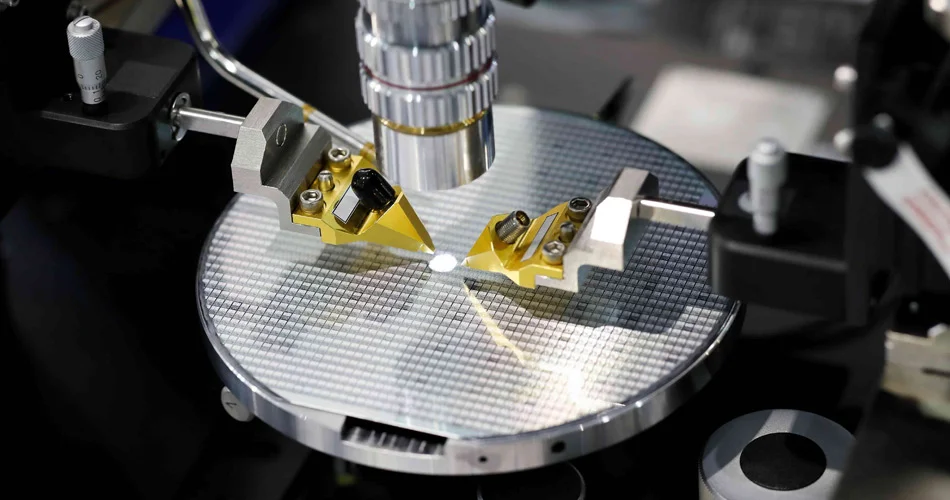
The unit of the industry: A patterned silicon wafer. India’s approved projects span high-volume fabrication, compound semiconductors including silicon carbide, advanced glass packaging and outsourced assembly and test — four different points on the value chain with four different capital intensities.
A capital-subsidy fund that is 85 per cent committed is not a fund running out. It is a fund that has done its job and needs a successor.
At a Glance
• Semicon India programme outlay: ₹76,000 crore
• Committed: nearly ₹65,000 crore — about 85.5%
• Headroom remaining: roughly ₹11,000 crore
• Total project investment mobilised: about ₹1.60 lakh crore
• Implementing body: India Semiconductor Mission, under MeitY
• ISM 2.0: launched in the 2026-27 Budget, with ₹1,000 crore provided for FY 2026-27
• ISM 2.0 focus: equipment, materials, design, supply chains and skills
• Design Linked Incentive: 23 chip design projects sanctioned
• Skilling: over 60,000 students through semiconductor training programmes
The leverage ratio is the number that decides whether the policy worked. Roughly ₹65,000 crore of public commitment has been placed against about ₹1.60 lakh crore of project investment — a little under two and a half rupees of private and partner capital for every rupee of public incentive. For a first-generation industrial policy in a capital-intensive sector where India had essentially no incumbent base, that is a defensible ratio. It is not a spectacular one, and it should not be described as such.
What the first mission bought was capacity announcements. What it did not buy, by design, was the layer underneath: the equipment vendors, the ultra-high-purity chemicals and gases, the specialty materials, the metrology, the calibration labs and the trained technicians who make a fab run at yield rather than merely exist. That layer is precisely what ISM 2.0 targets, with an initial provision of ₹1,000 crore for 2026-27 and an explicit emphasis on industry-led research and training centres.
The sequencing is right, and it mirrors what Taiwan, South Korea and more recently the United States and the European Union have each done: anchor the fabs first, then build the supply chain around them, because a supply chain has no customer until a fab exists. It also means the second mission’s success will be judged on different metrics from the first — local content share, yield ramp, engineer output, and the number of Indian suppliers qualified into a fab’s bill of materials, rather than headline investment announcements.
The honest challenge to name is time. Fab construction runs three to five years from approval to volume output, and yield learning curves take longer still. India’s approved projects are at very different stages, from operating pilot lines to plants under construction. The way forward is patience paired with measurement: publish the operating metrics annually, and let the leverage ratio and the local-content share — not the announcement value — be the public scoreboard.