




Blitz India Business
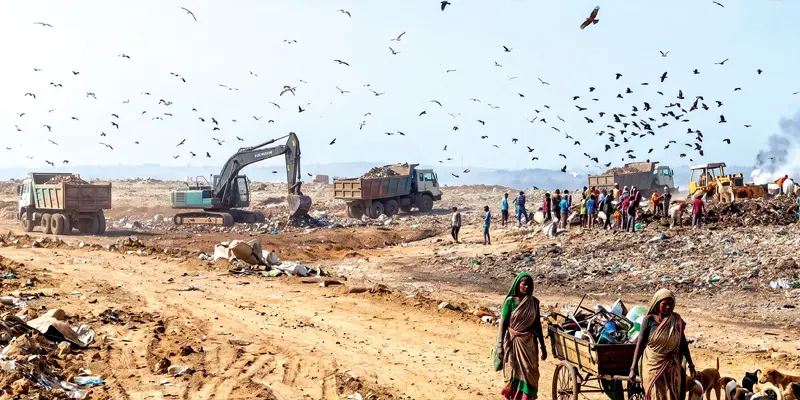
NEW DELHI: If one wants to understand the future of global sustainability, one need not look at the glass-fronted corporate towers of Bandra-Kurla Complex (BKC) or the air-conditioned think-tanks of New Delhi. One should walk instead through the labyrinthine, soot-stained alleys of Old Delhi’s electrical markets, or the sprawling, informal tech-recycling clusters of Bengaluru.
Here, in the chaotic underbelly of India’s informal economy, a quiet revolution is taking place. It is a story not of UN resolutions or high-level ministerial handshakes, but of an eccentric, high-stakes alliance: barefoot informal recyclers trading logistics data with multinational tech giants, and neighbourhood waste-pickers partnering with Artificial Intelligence start-ups.
For years, development economists viewed the UN Goal 17 – Partnerships for the Goals – through a lens of institutional elitism: governments signing pacts with multilateral banks. But now, the most radical, thrilling partnerships are happening sideways. They are marriages of convenience and necessity between the hyper-modern and the ultra-traditional, proving that the world’s most intractable supply chain crises cannot be solved by boardrooms alone. They require the street-smart alchemy of the informal sector.
Survival ecosystem
Consider the mechanics of modern electronic waste. When a smartphone is discarded in Europe or North America, its journey to safe recycling often ends in a developing nation. Traditionally, this process was hazardous, polluting, and economically exploitative.
Today, a fascinating multi-stakeholder model has inverted the narrative. Grassroots cooperatives in urban India have formed digital federations. Using open-source supply chain tracking apps developed by agile tech start-ups and backed by municipal policy frameworks, these once-invisible workers are plugging directly into the ESG auditing systems of global electronics brands.
The scrap collector with a pushcart is no longer a footnote; they are a verified node on a blockchain-secured carbon ledger. They receive fair-trade pricing for rare-earth metals, while global corporations secure the certified, traceable recycled inputs they need to meet stringent international environmental laws. It is a messy, beautiful collision of worlds where ancestral survival tactics meet cutting-edge telemetry.
Friction and future
This alliance is not without its friction though. Trust between Silicon Valley-style accelerators and grassroots community organisers does not happen overnight. Bureaucratic red tape, deep-seated economic disparities, and cultural divides often threaten to stall these collaborations.
Yet, the sheer momentum of mutual survival keeps them locked together. Corporations need the hyper-local agility and labour power of the informal economy to meet their net-zero targets; the informal economy needs the capital injection, digital tools, and legal protections that institutional partnerships provide.
This is the untold story of SDG 17: it is less about polite diplomacy and more about high-wire industrial acrobatics. When the marginalised and the multinational finally realise they are reading from the same script, the entire geometry of global development shifts.
For years, development economists viewed the UN Goal 17 through a lens of institutional elitism: governments signing pacts with multilateral banks. But now, the most radical, thrilling partnerships are happening sideways

Lessons from the bottom
For decades, global sustainability standards were written in Western capitals and imposed downward on developing nations. Today, that power dynamic is fracturing from the bottom up.
Reversing the flow: Rather than top-down policy mandates, grassroots coalitions in South Asia are designing the frameworks for informal sector integration. Because their models work with brutal efficiency on the ground, international organisations are adopting them as global benchmarks.
The trust economy: Multinational brands are realising that traditional third-party audits often fail in complex, informal markets. By partnering directly with trusted community leaders and local NGOs, companies gain authentic visibility into labour practices and environmental safety standards.
Resilience through redundancy: By distributing supply chain logistics across decentralised micro-networks rather than monolithic factories, these hybrid partnerships insulate global brands from regional shocks, geopolitical friction, and climate disruptions.
When the informal street economy links arms with global capital, the result is a rugged, shock-proof engine of sustainable growth that traditional economic models could never dream of engineering.
The new algorithm
In the bustling industrial backstreets of western India, a new breed of micro-enterprise is rewriting the rules of the circular economy.
The digital bridge: Local waste-picker cooperatives have begun utilising low-code mobile applications built by civic-tech start-ups. These apps allow collectors to instantly log, categorise, and price electronic and plastic waste streams right from the curb.
Algorithmic arbitrage: By aggregating real-time data from hundreds of independent scrap yards, these cooperatives can bypass predatory middlemen. They pool their inventory and negotiate directly with heavy manufacturing firms looking for certified post-consumer recycled material.
The human dividend: For the workers, this partnership means predictable income, safety equipment funded by corporate ESG grants, and formal financial inclusion. For the corporations, it guarantees a frictionless, scandal-free supply of green raw material.
It is a striking example of technology acting as a social equaliser, transforming informal labour into an organised, indispensable pillar of industrial supply chains.
THOSE WHO MAKE IT POSSIBLE
Karo Sambhav (Delhi NCR)
A technology-led producer responsibility organisation and circular economy enterprise. Karo Sambhav specialises in designing and implementing pan-India EPR (Extended Producer Responsibility) take-back programmes for e-waste, plastics, and battery waste on behalf of major global tech and electronics brands.
Founded in 2016, the organisation was built explicitly on the premise that India’s informal sector scrap-dealers and aggregators could not simply be legislated out of existence. By integrating grassroots aggregators, repair shops, and informal waste pickers into a transparent, app-tracked digital ecosystem, they transformed marginalised workers into certified nodes of a compliant national collection web.
Saahas Zero Waste (Bengaluru)
The company handles dry waste segregation, e-waste collection, IT asset refurbishment, and material traceability tracking to meet strict ESG and EPR compliance mandates. Originating from an active community-led citizen initiative (Saahas), the organisation incorporated as a formal enterprise to institutionalise source segregation.
From its early days advocating for community waste management, SZW evolved into a professional corporate partner. It heavily prioritises social inclusion, formalising waste pickers, integrating informal micro-entrepreneurs into clean supply chains, and turning discarded waste streams into upcycled products.
Eco Recycling (Mumbai)
A pioneer in total waste electrical and electronic equipment management, secure IT asset disposition, and lithium-ion battery recycling, Ecoreco offers pan-India reverse logistics, data destruction, and customised sustainability solutions.
Established in 2007, Ecoreco recognised that small scrap merchants lacked the technological capacity to safely strip precious metals without environmental damage, and bridged the gap by setting up compliant recycling infrastructure while partnering with localised collection networks.
Attero Recycling (Noida)
A clean-tech, end-to-end e-waste and lithium-ion battery recycling company. Attero uses proprietary, patented metallurgy and chemical extraction technologies to recover pure battery-grade metals from end-of-life electronics and EV batteries at scale.
Founded in 2008 Attero approached the waste crisis through an R&D lens. Rather than relying entirely on conventional mechanical processing, the founders invested heavily in metallurgical science to extract high-purity rare-earth elements domestically.
E-Parisaraa (Bengaluru)
A specialised e-waste recycling and dismantling enterprise recognised for processing hazardous electronic equipment with minimal ecological impact, utilising specialised manual dismantling alongside semi-automated safety controls.
Founded in 2005, E-Parisaraa holds the distinction of being the first Government-authorised electronic waste recycler. Emerging during a time when hazardous computer and appliance waste was largely dumped in open landfills, the company built a compliant template for safe recycling.