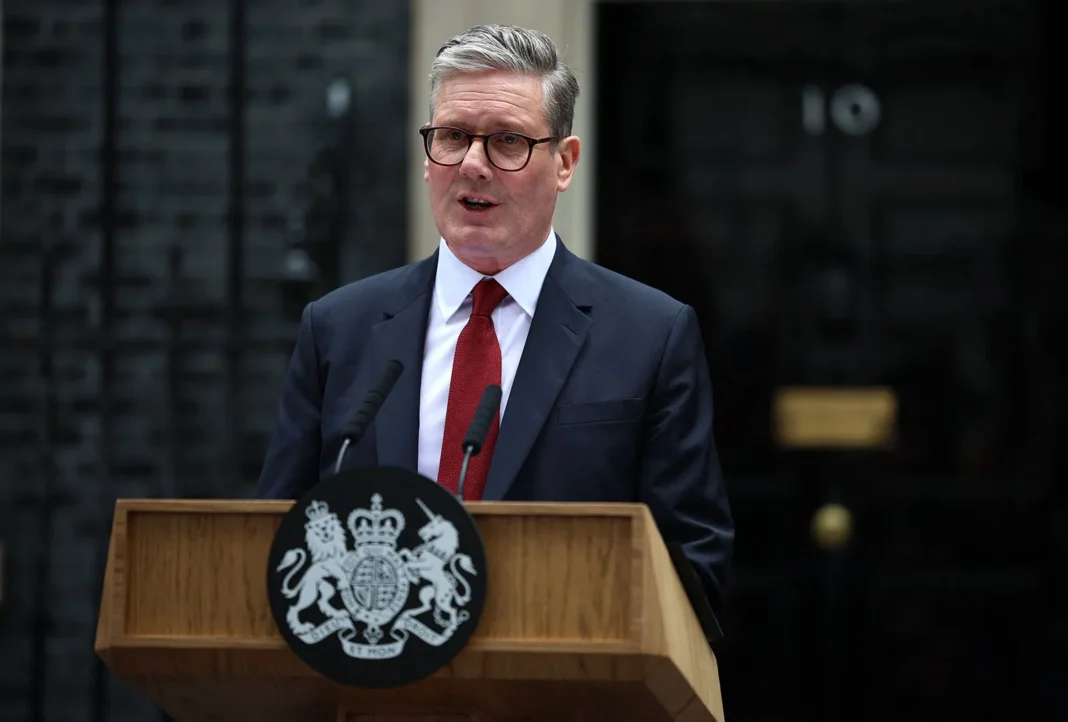
Starmer’s Fall

How Britain’s Prime Minister Lost Power in Just Two Years

Blitz Bureau

London: Keir Starmer’s resignation as British Prime Minister marks one of the sharpest political reversals in modern British politics. Less than two years after winning a historic Labour majority, Starmer has been forced to accept that the party which brought him to power no longer believes he is the best person to lead it into the next general election.

A political liability

The immediate reason for his exit was not a single scandal or a dramatic parliamentary defeat. It was the slow collapse of authority inside the Labour Party. Starmer’s MPs, increasingly nervous about Labour’s poor public standing and the rise of Reform UK, concluded that his leadership had become a political liability. The return of Andy Burnham to Westminster after his Makerfield by-election victory gave Labour MPs a clear alternative and accelerated the pressure on Downing Street.

Starmer came to office promising stability, discipline and national renewal after years of Conservative turbulence. For a time, that message worked. His calm, lawyerly style helped Labour appear serious and electable. But in government, the same style began to look cautious, distant and uninspiring. Voters who had been promised “change” saw little immediate transformation in their daily lives.

The economy played a major role in this political collapse. Britain was not facing a sudden financial emergency, but the economic mood remained deeply fragile. Living standards were under pressure, business confidence was weak, public finances were tight and growth was not being felt strongly by ordinary households. Starmer’s central promise was to revive growth and repair public services, yet many voters felt the country remained stuck.

Immigration also became a powerful pressure point. Although official figures showed that overall net migration had fallen from earlier peaks, the politics of immigration was shaped by public anxiety over small-boat crossings, asylum hotels and border control. Reform UK used the issue aggressively, while Labour struggled to convince voters that it had restored control. Starmer’s language on immigration also angered some Labour supporters without fully satisfying voters demanding tougher action.

This left the Prime Minister trapped between competing political forces. On the right, Reform UK attacked him as weak on borders and disconnected from working-class concerns. On the left and centre-left, critics accused him of lacking boldness, empathy and a clear national mission. Inside Labour, the fear was simple: if Starmer remained leader, the party could lose the next election despite its huge majority.

Andy Burnham’s rise changed the calculation. As former mayor of Greater Manchester, Burnham has cultivated an image as a more direct, regional and emotionally connected Labour figure. Many MPs now see him as better placed to confront Reform UK and reconnect with disillusioned voters.

Starmer’s resignation therefore reflects more than one man’s failure. It exposes Britain’s wider political instability: repeated changes of prime minister, public impatience, economic strain and a volatile immigration debate. His fall shows that in today’s Britain, even a landslide majority is no guarantee of political survival.

Loss of confidence

The central cause of Starmer’s resignation was the loss of confidence inside Labour. But the forces behind that loss were economic frustration, immigration pressure and a growing belief that the promise of change had not been delivered fast enough.

Latest News

BrahMos deal likely with UAE

Blitz Bureau NEW DELHI: The Government is in talks with...

Oil imports from Russia at new high

Blitz Bureau NEW DELHI: India is set to import a...

Drafts rules for spectrum allocation

Blitz Bureau NEW DELHI: The Department of Telecommunications (DoT) has...

‘Namo Cities’ coming

Blitz Bureau NEW DELHI: Four greenfield "Namo Cities" will be...

Deeper cooperation

Blitz Bureau NEW DELHI: Prime Minister Narendra Modi on June...

Topics

BrahMos deal likely with UAE

Blitz Bureau NEW DELHI: The Government is in talks with...

Oil imports from Russia at new high

Blitz Bureau NEW DELHI: India is set to import a...

Drafts rules for spectrum allocation

Blitz Bureau NEW DELHI: The Department of Telecommunications (DoT) has...

‘Namo Cities’ coming

Blitz Bureau NEW DELHI: Four greenfield "Namo Cities" will be...

Deeper cooperation

Blitz Bureau NEW DELHI: Prime Minister Narendra Modi on June...

Naval might

Blitz Bureau NEW DELHI: In a major milestone in India’s...

Awesome foursome rattles BJP

PRABHU CHAWLA NEW DELHI: In the sprawling Rashtrapati Bhawan complex,...

Partition trauma with a thoughtful mind, secular spirit and sharp eye

MJ Akbar NEW DELHI: His salary was top tier, but...
spot_img