




Blitz India Business
NEW DELHI: India ran a $31.98 billion merchandise deficit in July and reported an overall deficit of $15.03 billion. The $16.95 billion in between is the whole argument about what kind of trading economy India has become.
Do the July arithmetic in the order the Commerce Ministry releases it and the story assembles itself. Merchandise exports were $44.24 billion, up 19.63 per cent from $36.98 billion a year earlier and the highest July on record, past the $38.34 billion of July 2022. Merchandise imports were $76.22 billion, up 17.52 per cent from $64.86 billion. That leaves a goods deficit of $31.98 billion — a large number, and the one most coverage stopped at.
Now add the invisible half. Services exports were an estimated $35.89 billion against $33.74 billion a year earlier; services imports were $18.94 billion against $17.30 billion. That is a services surplus of $16.95 billion in a single month. Set it against the goods deficit and the overall gap falls to $15.03 billion — which is precisely the figure reported, up 31.5 per cent year-on-year. Services did not soften India’s trade deficit in July. They cancelled 53 per cent of it.
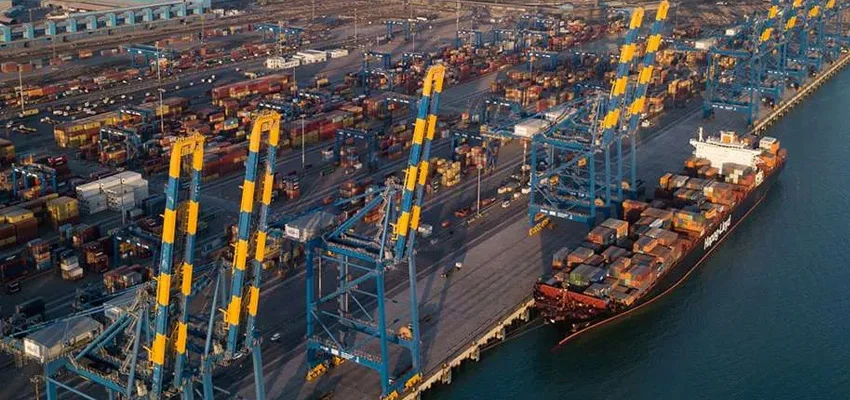
The half you can photograph: merchandise exports set a July record at $44.24 billion — while the $16.95 billion services surplus that offset most of the goods deficit moved through no port at all.
The goods deficit is what India ships. The services surplus is what India sends without shipping anything.
At a Glance · July 2026
• Merchandise exports: $44.24 bn, up 19.63 per cent — highest July on record
• Previous July high: $38.34 bn, July 2022
• Merchandise imports: $76.22 bn, up 17.52 per cent
• Merchandise deficit: $31.98 bn
• Services exports: $35.89 bn, from $33.74 bn
• Services imports: $18.94 bn, from $17.30 bn
• Services surplus: $16.95 bn
• Overall exports: $80.14 bn, up about 13.3 per cent
• Overall imports: $95.16 bn, up about 15.8 per cent
• Overall deficit: $15.03 bn, up 31.5 per cent year-on-year
Two implications follow, and they point in opposite directions. The reassuring one is about the current account: a services surplus of this size is structural rather than cyclical, because it rests on contracted work — software, global capability centres, professional and business services — that does not reprice month to month the way a commodity import does. It is the reason India can run a large goods deficit without the external accounts behaving like those of a country that runs a large goods deficit. The uncomfortable one is about composition: overall imports grew at 15.8 per cent against overall exports at 13.3 per cent, so the gap widened even in a record month. Growth in the deficit is not, by itself, a warning — a fast-growing economy imports capital goods and energy — but the direction is worth tracking rather than celebrating.
What professionals should watch over the next two prints is the split inside each half. On goods, whether the export record broadens beyond petroleum products, or narrows back onto them, tells you whether the July number reflects demand or refining margins. On services, whether the surplus keeps compounding at roughly 6 per cent year-on-year while services imports rise at over 9 tells you whether India is still net-selling capability or beginning to buy more of it back. And the whole calculation sits on top of a favourable tariff position: India’s reciprocal rate into the United States is now 18 per cent, below Vietnam and Bangladesh at 20. The correct read of July is neither triumph nor alarm. It is that India has two trade accounts, they behave differently, and only one of them is visible at a port.