Blitz Bureau
NEW DELHI: In a sun-drenched clinic in the Vidarbha region of Maharashtra, a local health worker holds a smartphone over a patient’s chest. There is no stethoscope, no bulky machinery, and no specialist within 500 miles. Within seconds, an AI-powered cloud interface, connected via 5G, analyses the heart sounds and flags a minor valve irregularity.
The patient’s Ayushman Bharat Health Account (Abha) is instantly updated, a tele-consultation with a cardiologist in Hyderabad is scheduled for that afternoon, and a potential cardiac crisis is averted before it even begins.
This is the new face of Indian healthcare in 2026. What was once a fragmented system defined by urban-rural divides has transformed into a USD 372 billion powerhouse.
By blending aggressive physical infrastructure expansion with a world-leading “digital health stack,” India has effectively leapfrogged the traditional development curve to become the global laboratory for 21st century medicine.
Great hospital migration
The most visible indicator of this boom is the changing skyline of India’s tier-2 and tier-3 cities. The era of “metropolitan monopoly” is over. Leading private equity-backed chains like Apollo, Manipal, and Max Healthcare have shifted their primary growth engines to cities like Lucknow, Indore, Coimbatore, and Ahmedabad.
Driven by the Ayushman Bharat (AB-PMJAY) scheme — the world’s largest Government-funded health insurance programme — the private sector has found a high-volume, sustainable model in smaller towns. As of March, over 36,000 hospitals are empanelled under the scheme.
By blending aggressive physical infrastructure expansion with a world-leading “digital health stack,” India has effectively leapfrogged the traditional development curve to become the global laboratory for 21st century medicine.
The “hub-and-spoke” model has matured: while “hub” hospitals in metros perform robotic transplants, “spoke” facilities in smaller towns provide specialised secondary care, linked by a seamless digital umbilical cord.
“The economics of Indian healthcare have shifted,” says Dr. Anirudh Varma, a healthcare analyst. “We are seeing a democratisation of beds. Hospital chains are no longer just chasing the elite; they are building for the 500 million people now covered by national insurance. Efficiency is the new currency.”
The $13 billion healing magnet
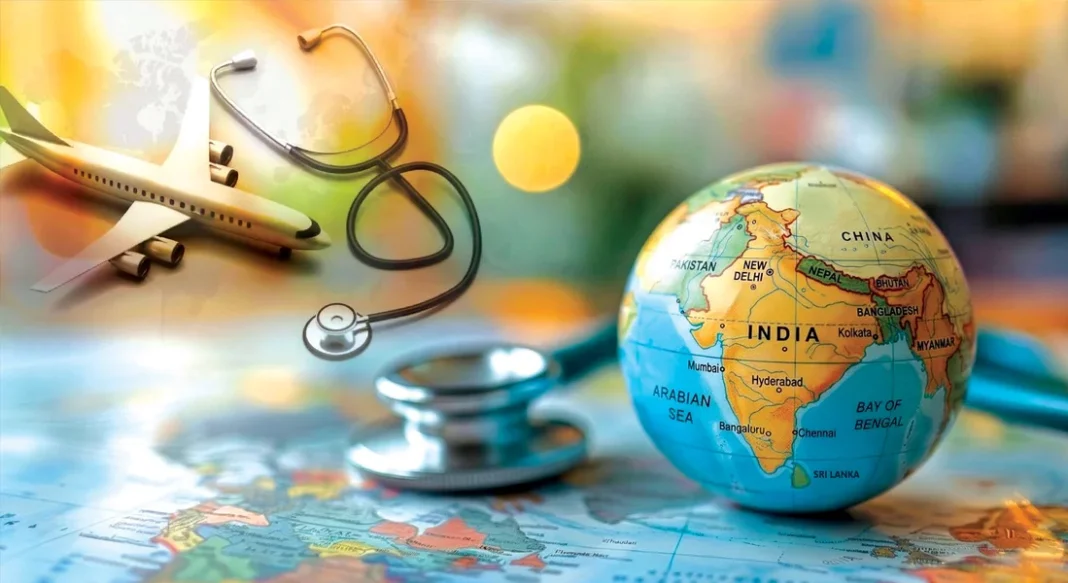
While India builds for its own, it is also healing the globe. In 2026, India is officially ranked among the top three destinations for medical value travel. The sector is projected to hit USD 13 billion by the end of this year, a staggering climb from the USD 6 billion recorded in 2022.
The draw remains the “quality-cost delta.” A heart bypass that costs $100,000 in the United States or $40,000 in Thailand is performed in Chennai or Mumbai for approximately $8,000, often by surgeons with higher procedural volumes than their Western counterparts.
However, the 2026 edge is the “Heal in India” portal. This Government-backed platform has streamlined the journey for international patients, offering a unified interface for e-Medical Visas, price transparency for 44 core procedures, and post-operative tele-follow-ups.
The integration of Ayush (Ayurveda and Yoga) with traditional surgery has created a unique “holistic recovery” niche that has proven particularly popular with patients from West Asia, Central Asia, and Africa.
Telemedicine: The 282 million milestone
The smartphone has officially replaced the clinic as the primary point of entry for Indian patients. By March 2026, the national telemedicine platform, eSanjeevani, along with private players, recorded a cumulative 282 million consultations.
Telemedicine has evolved from simple video calls to “remote diagnostic events.” Health-ATMs, which are 5G-enabled, at Railway stations and rural post offices now allow patients to record vitals — ECG, blood pressure, glucose — which are synced in real-time to a doctor’s dashboard.
This has effectively solved the “last-mile” specialist shortage, allowing a dermatologist in Bangalore to treat a skin condition in a remote village in Meghalaya.
Abha and the data revolution
The “software” of this revolution is the Ayushman Bharat Digital Mission (ABMD). India has achieved what most developed nations still struggle with: true medical interoperability.
As of March, over 86.6 crore Abha IDs have been created. This means nearly two-thirds of the population now has a “longitudinal health record.” Whether a patient visits a public dispensary or a high-end private hospital, their entire history — prescriptions, lab reports, and imaging — is accessible via a secure, consent-based digital vault.
“This is the ‘UPI moment’ for healthcare,” says a NITI Aayog digital health consultant. “Data liquidity reduces redundant testing, prevents drug-to-drug interactions, and allows for instant insurance claim settlements. It has removed the ‘friction’ from being sick.”
AI diagnostics
If the digital record is the nervous system, AI is the brain. In 2026, AI is no longer a buzzword; it is a frontline diagnostic tool. The IndiaAI Networking Cluster of Graphics – Computer-Aided Tools for Chip Design (NCG-CATCH) initiative has successfully integrated AI models into the national health grid to tackle the country’s biggest killers: cancer and tuberculosis.
In rural oncology, AI tools like MammoX and Thermalytix are screening women for breast cancer at a fraction of the cost of traditional mammography. These systems use thermal imaging and pattern recognition to flag “high-risk” cases, which are then prioritised for biopsy.
Similarly, AI-powered “smartphone pathology” is being used to detect sickle cell anemia and malaria in tribal belts, providing results in minutes rather than days.
Beyond diagnostics, AI is being used for “predictive public health.” By analysing real-time data from millions of digital consultations, the Government can now map the “heat” of a viral outbreak — be it dengue or a new flu strain — before it becomes a local epidemic, allowing for surgical interventions in specific pin codes.
As India moves toward its centennial in 2047, the healthcare sector has become the lighthouse for the nation’s “frugal innovation” philosophy. By refusing to follow the high-cost, high-barrier models of the West, India is proving that high-quality healthcare can be a right, not a luxury.
The “pharmacy of the world” has successfully rebranded itself as the “provider for the world,” and in doing so, it has built a blueprint that the rest of the global south is now eager to follow.
How AI slashed the cost of survival

For decades, the “diagnostic gap” was the silent killer of rural India. A diagnostic test that cost ₹3,000 was effectively a death sentence for a family earning ₹10,000 a month. In March 2026, that gap is being closed by the “₹200 breakthrough.”
The convergence of indigenous AI and low-cost hardware has collapsed the cost of life-saving screenings:
Thermal Breast Screening: Using the Niramai platform, rural health workers now perform non-invasive, radiation-free breast cancer screenings for just ₹200, down from the ₹3,500 charged for traditional mammograms.
Smartphone Cervical Screening: New AI-integrated lenses that clip onto a standard Android phone can now detect pre-cancerous lesions in the cervix with 92 per cent accuracy in under 60 seconds.
The AI Triage: By using AI to “filter” healthy scans, the workload on India’s overstretched radiologists has been reduced by 65 per cent, allowing them to focus only on confirmed “red flag” cases.
“We aren’t just making healthcare cheaper,” says a lead developer at the Bangalore health-tech hub. “We are making it invisible. When a screening costs less than a meal, people stop fearing the test and start focusing on the cure.”