




Blitz Bureau
NEW DELHI: Four successive increases in petrol and diesel prices in less than two weeks are beginning to have a ripple effect across transport networks and household budgets, raising fears of a broader inflationary cycle in the economy. Businesses dependent on fuel, logistics and transportation are already facing higher operating costs, even as Finance Minister Nirmala Sitharaman insists there is “no real danger” of inflation at present.
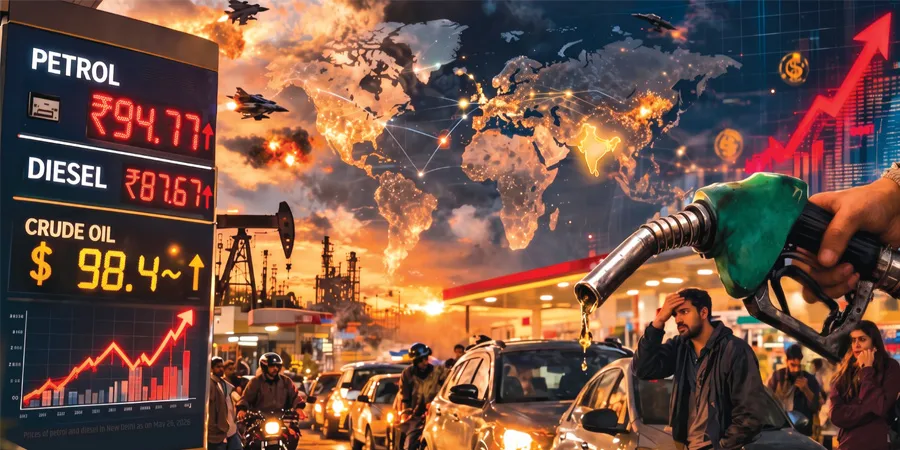
The latest revision raised petrol prices by Rs 2.61 per litre and diesel by Rs 2.71, taking the cumulative increase since May 15 to nearly Rs 7.5 per litre in major cities. Petrol prices in Delhi have crossed Rs 102 per litre while diesel is nearing Rs 95. Mumbai continues to record among the country’s highest fuel rates because of elevated state taxes, while Chennai, Kolkata and Bengaluru have also witnessed steep increases.
The hikes follow rising global crude oil prices, with oil marketing companies resuming regular price adjustments after a prolonged period of relative stability. India imports nearly 85 per cent of its crude oil requirements, leaving the economy highly exposed to external energy shocks, geopolitical tensions and fluctuations in the rupee.
Economists say the impact of rising fuel prices extends far beyond petrol pumps because diesel remains the backbone of India’s transport and logistics system. Trucks move the overwhelming bulk of India’s freight traffic, while diesel also powers agricultural machinery, generators, mining operations and parts of industrial production. As transport costs rise, inflationary pressures gradually spread across supply chains and consumer markets.
Truck operators in several states have already begun revising freight charges upward, raising fears that prices of vegetables, fruits, milk, edible oils and packaged consumer goods could soon rise further. Wholesale traders warn that transportation expenses are beginning to climb across agricultural mandis and distribution networks, particularly for perishable goods.
Industry is also expected to face mounting pressure if fuel prices remain elevated for an extended period. Aviation companies may eventually raise airfares as aviation turbine fuel costs climb. Cement, steel, chemicals and construction sectors are likely to witness higher production and transportation expenses, while consumer goods companies may pass rising logistics costs on to buyers. Analysts say the impact could be especially visible in sectors where transportation forms a large component of overall costs.
India’s expanding e-commerce and app-based delivery ecosystem may also feel the strain. Rising fuel prices increase last-mile delivery costs for online retailers, courier companies and food delivery platforms. Companies may either raise delivery charges or absorb the costs at the expense of already tight margins.
Small and medium enterprises are considered particularly vulnerable because many operate on thin profit margins and limited pricing power. Economists warn that if fuel prices continue rising, smaller businesses may struggle to absorb higher transport and energy costs without cutting investments, slowing hiring or increasing prices. Some industry associations have already called for temporary tax relief on fuel to ease operational pressure.
Export-oriented industries may also face competitiveness challenges. Higher freight and manufacturing costs could make Indian goods more expensive in global markets at a time when international demand remains uncertain. Sectors such as textiles, leather goods, engineering products and processed foods could face additional margin pressure if exporters are unable to fully pass on higher costs to overseas buyers.
For businesses and industry, the bigger fear is that prolonged fuel inflation could squeeze margins, weaken demand, slow investment momentum and gradually spread inflationary pressures across nearly every sector of the economy
Economists say the inflationary effect of fuel price increases usually spreads with a time lag. Headline retail inflation may initially appear moderate even as underlying cost pressures begin building across transport, manufacturing and supply chains. By the time official inflation numbers rise sharply, households and businesses may already be facing substantially higher costs.
Despite mounting concerns, the Government does have some basis for its confidence. India’s retail inflation remains within the Reserve Bank of India’s comfort band of 2-6 per cent, with April retail inflation recorded at 3.48 per cent. India also enters the current phase with stronger foodgrain stocks, improved subsidy systems and larger foreign exchange reserves than during earlier inflation crises.
The Reserve Bank has so far avoided alarmist signals, though policymakers have acknowledged emerging risks from global crude prices and external uncertainties. Analysts note that RBI may eventually face a difficult balancing act if fuel-driven inflation intensifies. Higher inflation could reduce room for future interest rate cuts aimed at supporting growth and investment.
Sitharaman’s recent emphasis on the “3Fs” — fuel, fertiliser and forex — has itself been interpreted by economists as a sign of official concern over rising external vulnerabilities, especially crude oil prices and pressure on the rupee. Governments rarely focus simultaneously on fuel conservation, fertiliser costs and foreign exchange management unless they are worried about prolonged external stress.
For households, the effects are already visible in rising commuting and transportation expenses. For businesses and industry, the bigger fear is that prolonged fuel inflation could squeeze margins, weaken demand, slow investment momentum and gradually spread inflationary pressures across nearly every sector of the economy.