





Parth Nadpara
India’s small businesses carry the economy on their backs and are handed a fraction of its money. They account for 30.1 per cent of gross domestic product, 35.4 per cent of manufacturing output and 45.73 per cent of exports, and they employ, on the Government’s own count, some 28 crore people.
Yet only about 16 per cent of all bank credit reaches them, and formal lenders meet barely 14 to 16 per cent of the sector’s borrowing needs. The rest is scrounged from moneylenders, family, supplier credit and the entrepreneur’s own savings — at a cost, and on terms, that keep millions of viable firms permanently small. The scale of the shortfall is now measured, not guessed.
In a report released in May 2025, the Small Industries Development Bank of India (Sidbi) put the sector’s addressable debt demand at ₹64 lakh crore. Formal institutions supply just ₹34 lakh crore of it. The diاٴerence — a credit gap of about ₹30 lakh crore, or 24 per cent of demand — is the single most important number in Indian smallbusiness finance, and it has barely budged in years. The Reserve Bank’s own U K Sinha committee had ۇٴagged a gap of ₹20-25 lakh crore back in 2019. The hole has, if anything, grown.
Who gets left out
Averages conceal the cruelty of the arithmetic. The gap is widest precisely where finance could do the most good. For medium enterprises it runs to 29 per cent of demand; for firms in trading, 33 per cent; for services, 27 per cent. Most striking of all, the gap for women-owned businesses stands at 35 per cent — more than a third of what they could productively borrow simply never arrives. A young entrepreneur in a small town, without inherited property to pledge or an audited balance sheet to show, is the archetype of the borrower the formal system was built to overlook.
Why the banks stay away
The reasons are structural, and they begin with informality. A large share of India’s estimated 6.3 crore small enterprises operate oاٴ the books, keeping no audited accounts, holding no titled assets, filing thin or no tax returns. To a loan oيٴcer trained to price risk from documents, such a firm is close to invisible. The result is a textbook case of information asymmetry: the bank cannot easily tell a sound business from a shaky one, so it treats them all as risky, demands collateral many cannot provide, and lends less than it safely could.
The irony is that the caution is largely unwarranted. The MSME sector’s bad-loan ratio has fallen to about 3.6 per cent as of March 2025, better than several other categories of bank lending and steadily improving. Small firms, in aggregate, repay. Where losses have crept up is in the Government’s own ۇٴagship micro-loan scheme, PMMY (Mudra), whose non-performing assets rose to 9.8 per cent by March 2025 — a reminder that lending pushed by target rather than judgement carries its own risks. The lesson banks have drawn, unfortunately, is to stay cautious rather than to lend smarter.
Economics reinforces the reluctance. A ₹5 lakh working-capital loan costs a bank almost as much to appraise, document and monitor as a loan many times larger, but earns a fraction of the return. Faced with that maths, a branch manager rewarded for volume and punished for slippage will always prefer a handful of big corporate borrowers to a hundred small ones. For the entrepreneur turned away, the alternatives are dear: informal loans can carry interest of 24 per cent or more, and every rupee paid to a moneylender is a rupee not spent on a new machine or an extra worker. Credit denied does not merely inconvenience a small firm; it caps how large it can ever grow.
The collateral trap
For the smallest borrowers, the sticking point is collateral. Rules already bar banks from demanding security on micro-enterprise loans up to ₹20 lakh, raised from ₹10 lakh under the RBI’s 2026 directions, and the Credit Guarantee Fund Trust (CGTMSE) now covers collateralfree loans of up to ₹10 crore, guaranteeing 75 to 85 per cent of the amount. Since 2000 the trust has backed more than 65 lakh loan accounts worth over ₹5 lakh crore in cumulative guarantees. It is real progress. But guarantees reimburse a bank only after a loan sours and a lock-in expires; they do not remove the paperwork, the branchlevel caution, or the oيٴcer’s instinct to lend against a house rather than a cash ۇٴow. Many eligible firms never learn the schemes exist.
Starved of their own money Compounding the credit squeeze is a liquidity crisis of a diاٴerent kind — money the firms have already earned
but cannot collect. Delayed payments owed to MSMEs stood at around ₹7.34 lakh crore as of March 2024; large and Government buyers routinely hold invoices for months, and close to 40 per cent of the sums stuck on the Government’s MSME Samadhaan grievance portal are owed by public agencies and state-owned firms themselves. A business waiting on its receivables must borrow to bridge the gap, often informally and expensively, to pay wages and buy the next lot of raw material. The state that exhorts banks to lend is frequently the buyer that does not pay on time.
The digital fix-promise and limits
The most hopeful development is a quiet re-plumbing of how creditworthiness is judged. The Reserve Bank’s Unified Lending Interface (ULI), part of a wider digital public infrastructure alongside UPI and the Account Aggregator framework, lets a lender pull a borrower’s GST filings, bank statements, tax records and even land data digitally, with consent, in minutes. Sidbi’s GST Sahay offers ‘on-tap’, invoice-based loans to micro firms with no branch visit at all. On the receivables side, the TReDS platforms, which let firms sell unpaid invoices for instant cash, have been opened up by a mandate requiring all companies with turnover above ₹250 crore to register; transaction volumes there have quadrupled.
The early numbers are encouraging. On TReDS, the value of invoices discounted has grown roughly nine-fold in a few years as more large buyers have been drawn in, converting a firm’s unpaid bills into same-day cash. The promise of the wider shift is genuine: cash-ۇٴow-based lending that judges a business by the money moving through its accounts rather than the property it can mortgage. This is exactly the change a data-rich, assetpoor sector needs.
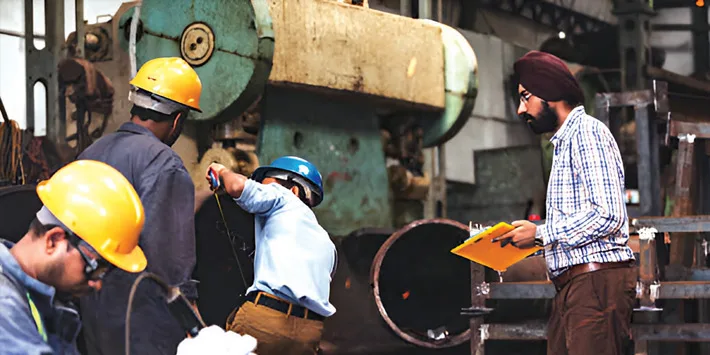
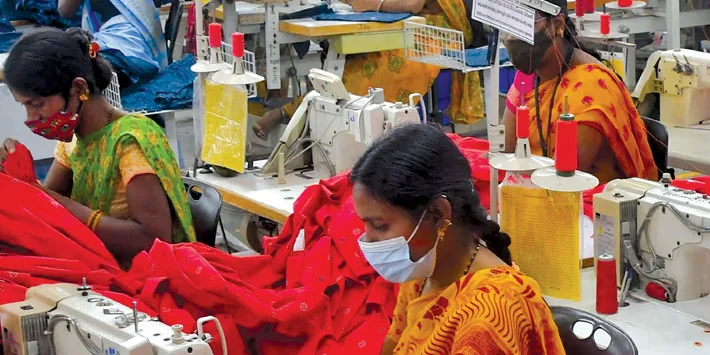
Yet the rails are new, their reach still modest against a ₹30 lakh crore gap, and they work only for firms that are formal enough to leave a digital trail. The very smallest enterprises — the roadside fabricator, the home-based garment unit, the trader who deals in cash — generate little of the GST data or bank-statement history that the new systems read. For them, formal credit remains as remote as ever. Technology can widen the door; it cannot, by itself, bring inside those who were never counted.
What must change
None of this is beyond fixing, but it will take more than another scheme. The priority is to pull small firms into the formal fold — through simpler registration, GST and digital payments — so that they generate the data that modern lending runs on. Banks must be pushed, through priority-sector rules and their own incentives, to move from collateral-based to cash-ۇٴow-based underwriting, and to treat the CGTMSE guarantee as a reason to lend rather than a form to file. The delayed-payments crisis demands enforcement with teeth, starting with the government’s own departments and public-sector buyers. And the digital rails — ULI, Account Aggregator, TReDS — must be scaled aggressively and made known to the borrowers who need them most.
The stakes are hard to overstate. A sector that already produces a third of national output while starved of credit is a sector running with a handbrake on. Release it — give India’s small businesses credible, affordable, timely finance — and the country’s growth story gains its most powerful, and most neglected, engine. Until then, for tens of millions of entrepreneurs, the bank loan will remain what it has always been: a distant dream.