




Shalini S Sharma
On June 17, US President Donald Trump and Iranian President Masoud Pezeshkian signed a major agreement establishing a formal 60-day ceasefire framework. Under this agreement, Tehran committed to allowing safe passage through the Strait of Hormuz, while Washington agreed to lift its blockade on Iranian ports while wider terms were negotiated.
The very next day, i.e., on June 18, the Indian Oil Corporation (IOC) floated three shipping tenders for A) A Very Large Crude Carrier (VLCC) to lift crude from Kuwait B) A Suezmax tanker to lift crude from Saudi Arabia, and C) A Very Large Gas Carrier (VLGC) to transport Liquefied Petroleum Gas (LPG) from Qatar, Kuwait, or the UAE.
The refiner moved with unusual speed to secure the vessels, aiming for an immediate operational window to lift cargoes out of the Gulf between June 28 and July 4. But, between the intent and the execution, fell the shadow.
No ship owner exhibited the same enthusiasm in responding to this tender and the public sector refiner had to close the call with zero bids, leaving the planned cargo transport unfinalised.
Why shipping lines refused to respond
Despite the temporary diplomatic thaw, maritime operators chose to stay in a “wait-and-watch” mode. Ship owners and insurers cited extreme geopolitical uncertainty and the lack of clear, reliable safety parameters for transiting the chokepoint.
Their caution proved justified: Towards June end, regional friction escalated again after an Iranian drone attacked a cargo ship, drawing retaliatory US military strikes on drone and missile storage facilities near the strait. This swift breakdown of the interim peace window heavily reinforced the shipping lines’ decision to bypass the route or demand an incredibly steep risk premium that left the tenders empty.
Indian refiners now continue to aggressively lean on diversified alternative supplies — such as Russian, West African, and US crude — to maintain domestic stability.
The modern global economy is fundamentally maritime. While consumers witness the seamless arrival of goods on store shelves or the steady supply of fuel at petrol stations, the intricate mechanics of the global shipping industry remain hidden beneath the horizon. Structural gridlock keeps the water economy heavily geopolitical, hypersensitive and hyper-capitalised.
Water, water everywhere
The modern global economy is fundamentally maritime. While consumers witness the seamless arrival of goods on store shelves or the steady supply of fuel at petrol stations, the intricate mechanics of the global shipping industry remain hidden beneath the horizon. Structural gridlock keeps the water economy heavily geopolitical, hypersensitive and hyper-capitalised.
To understand why multi-billion-dollar shipping enterprises would collectively walk away from lucrative energy transport contracts requires a deep dive into the macroeconomic scale, structural nuances, and corporate ownership dynamics that define international shipping.
The Leviathan of global trade
The scale of the global cargo shipping industry is difficult to overstate. According to data from the United Nations Conference on Trade and Development (UNCTAD), maritime transport handles over 80 per cent of global trade by volume and roughly 70 per cent by value. When focusing exclusively on manufactured and containerised consumer items, that figure surges past 90 per cent.
| GLOBAL MARITIME CARGO VOLUMES (2026) | |
|---|---|
| Total global volume | ~12.5 billion tonne |
| Liquid bulk share (crude, LNG) | ~29.9 per cent |
| Manufacturing / industrial share | ~38.8 per cent |
| Core metric for containers | Twenty-foot equivalent (TEU) |
As of 2026, the global cargo shipping market moves an estimated 12.5 billion tonne of cargo annually. Geographically, the Asia-Pacific region stands as the undisputed engine of this market, commanding over 40 per cent of the global volume market share, driven primarily by the manufacturing and export dominance of China, India, Japan, and South Korea. Western Europe accounts for roughly 21 per cent, followed by North America and West Asia.
In terms of financial valuation, the direct operational logistics and freight revenue market of cargo shipping is estimated at $14.64 billion in 2026, projected to grow at a Compound Annual Growth Rate (CAGR) of 4.8 per cent to cross $21 billion by 2034. However, this represents only the direct service revenue. The actual value of the commodities, machinery, raw materials, and energy supplies transported across the oceans by these fleets amounts to trillions of dollars every year, making the shipping industry the ultimate gatekeeper of global supply chain stability.
The geopolitical chokepoint dilemma
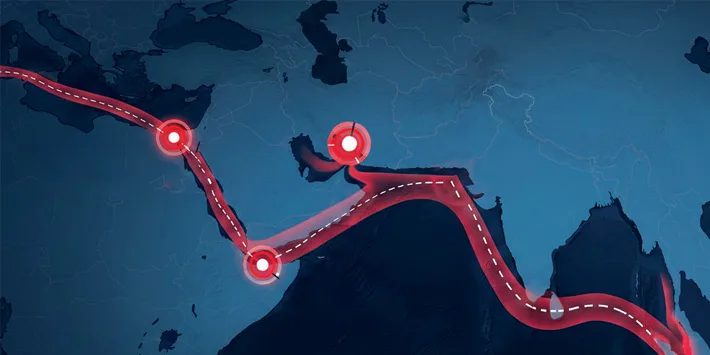
The Strait of Hormuz, a narrow waterway separating Iran from Oman and the United Arab Emirates, is the world’s most critical energy artery. Approximately one-fifth of the world’s liquid petroleum consumption passes through this chokepoint daily, connecting the oil fields of the Persian Gulf to major markets in Asia, Europe, and North America.
When military tensions, drone strikes, state-sponsored ship seizures, or asymmetrical naval threats escalate in a region, the economics of a shipping voyage change instantly. Shipping lines do not operate in a vacuum; their voyages are fundamentally dictated by marine insurance syndicates, most notably those anchored within the Lloyd’s of London market. Once a body of water is designated a “Listed Area” by the Joint War Committee, standard hull and machinery insurance policies are suspended.
Ship owners must then purchase specialised War Risk Insurance. In highly volatile climates, these premiums can skyrocket from a nominal fraction of the vessel’s value to up to 1 per cent or 2 per cent of the hull value per single transit.
For a modern VLCC valued at $120 million, this adds over a million dollars in insurance overhead for a single week-long voyage. If the freight rate offered in a refinery’s tender fails to offset these spiralling surcharges, or if the safety risk to the crew and asset crosses an acceptable threshold, ship owners simply bypass the tender. They choose instead to reallocate their vessels to safer, more predictable trade lanes, leaving the cargo stranded and triggering energy security anxieties for importing nations.
Expensive waters
The maritime transport sector is one of the most volatile, cyclical, and capital-intensive businesses in existence. To successfully navigate its economic landscape, carriers must balance multi-million-dollar operational variables daily.
Carriers generally split their fleet strategies between owned vessels and chartered vessels. Owning a ship requires vast capital expenditure but offers long-term asset appreciation and stability. Chartering vessels on the open market provides operational flexibility, allowing companies to quickly scale down their capacity during economic downturns or ramp it up during consumer demand surges. Shipping rates fluctuate wildly based on global supply and demand imbalances.
One of the most distinctive financial nuances of the global shipping economy is the widespread use of “Flags of Convenience” (FoC). Under international maritime law, every merchant ship must be registered in a specific country, known as its flag state. The flag state holds regulatory jurisdiction over the vessel, enforcing maritime safety, environmental compliance, and crew labour conditions.
However, rather than registering ships in the countries where the owning corporations are actually headquartered — such as Denmark, Germany, or Japan — the vast majority of the global merchant fleet is registered in countries like Panama, Liberia, and the Marshall Islands. This practice allows ship owners to leverage favourable legal frameworks, drastically lower corporate tax rates, and significantly reduce operational costs.
By utilising a Flag of Convenience, a shipping enterprise can legally hire multinational crews from developing nations (such as the Philippines, India, or Ukraine) at local market wages rather than being bound by the strict domestic minimum wage laws and labour union mandates of Western nations. It also minimises regulatory friction, as these open registries often feature streamlined bureaucratic processes.
While this system maximises operational efficiency and lowers freight costs for global consumers, it complicates international accountability during crises. When a vessel is involved in an environmental disaster, an illegal oil trade scheme, or enters a high-risk combat zone, tracing legal liability becomes incredibly complex.
The corporate owner might be a shell company registered in one jurisdiction, the technical manager located in another, the crew sourced from a third, and the vessel itself flying the flag of a nation it has never physically visited. This legal decoupling creates a highly fragmented regulatory ecosystem that makes global enforcement exceptionally difficult.