




Blitz India Business
NEW DELHI: Every kilometre of flexible pavement India lays needs a binder, and a great deal of that binder is bought abroad. Three laboratories of the Council of Scientific and Industrial Research believe they have found the substitute in a material Indian farmers presently burn, and on 5 August 2026 they put the commercialisation case, not merely the chemistry, in front of industry at Dehradun.
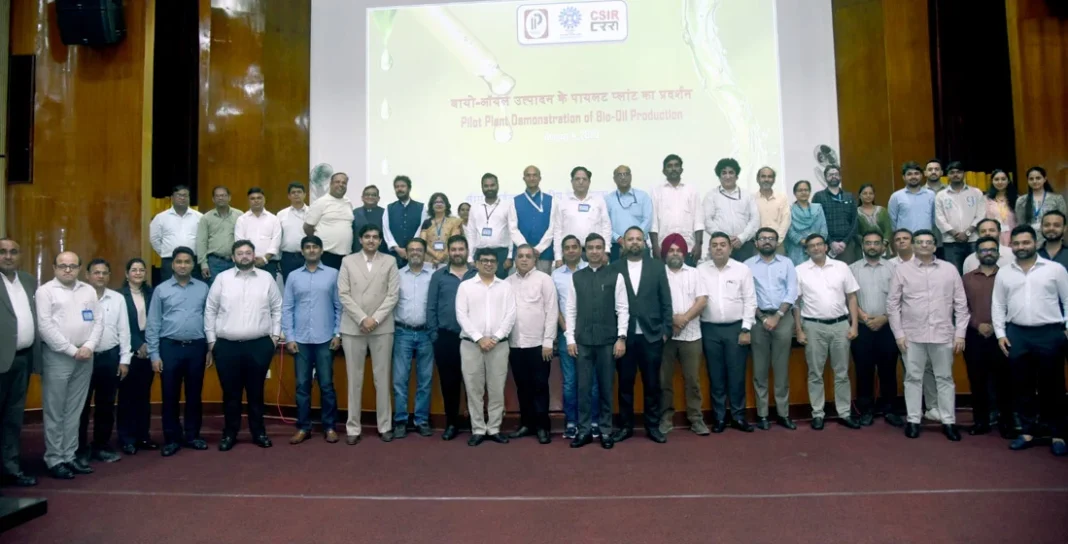
The CSIR-Indian Institute of Petroleum, Dehradun, with the CSIR-Central Road Research Institute and the CSIR-Advanced Materials and Processes Research Institute, demonstrated Bio-Binder Technology at a programme attended by the directors of all three laboratories — Dr Harender Singh Bisht, Dr C. Ravi Sekhar and Dr Thallada Bhaskar — and by the industry partners who would have to build it at scale. The stated purpose of the event was the acceleration of commercialisation.
The import substitution case
Dr Ravi Sekhar put the commercial premise directly: India’s rapidly expanding road infrastructure continues to depend heavily on imported bitumen. The Bio-Binder route runs agricultural residue, principally rice straw and other biomass, through pyrolysis, and yields bio-oil, bio-binder, biochar and biogas. The binder can replace or supplement conventional petroleum-derived bitumen in flexible pavement. For a treasury, that is an import line. For a farm household in the rice belt, it is a buyer for a residue that currently has none.
Dr Bhaskar framed the economics in terms any manufacturer will recognise. Laboratory-scale research and process development, he observed, are relatively straightforward; successful commercialisation requires identifying products that address market demand, support import substitution and deliver strong economic returns. Accordingly the process has been designed as an integrated biorefinery in which every stream earns. The heavy organic fraction becomes the binder; the aqueous fraction has been converted into a patented biological pesticide formulation and further into a stable powder for storage and transport, now under evaluation by national laboratories for commercialisation in agriculture. A second saleable product from what would otherwise be an effluent is what turns a promising process into a plant a bank will finance.
The Commercialisation Path : What exists, and what has been approved
| Parameter / Metric | Details |
|---|---|
| Test section on National Highway-40 near Shillong, long-term evaluation | 100 m · completed |
| Evaluation programme initiated by Government of Andhra Pradesh | 5 km |
| National Bio-Binder Testing Laboratory at CSIR-CRRI, approved by MoRTH | Operational by March 2027 |
| Standards and implementation guidelines, work under way with | MoRTH, NHAI, IRC |
| Second product stream from the aqueous fraction | Patented bio-pesticide |
| Feedstock | Rice straw, biomass waste |
Source: Press Information Bureau, Ministry of Science and Technology, release of 5 August 2026, Release ID 2294669.
What a buyer still needs
Three things stand between a working technology and a purchase order in India, and the release addresses two of them. The first is proof on a real road: a 100-metre section on National Highway-40 near Shillong has completed long-term evaluation, and the Government of Andhra Pradesh has initiated a five-kilometre programme. The second is a specification, without which no engineer can lawfully write the material into a tender; CSIR-CRRI is working with the Ministry of Road Transport and Highways, the National Highways Authority of India and the Indian Roads Congress to produce standardised technical specifications and implementation guidelines. The third is certification, and the Ministry of Road Transport and Highways has approved a dedicated National Bio-Binder Testing Laboratory at CSIR-CRRI, expected to be operational by March 2027, to test, validate, certify and assure quality for commercially manufactured bio-binders.
What the public record does not yet contain, and this desk will not supply from inference, is a delivered price per tonne against imported bitumen, or a published durability result at highway scale across a full seasonal cycle. Until those exist, the investment case rests on the policy direction rather than on a spreadsheet.
What Blitz would add
A certification laboratory arriving in March 2027 sets the clock for private capacity. A manufacturer deciding today whether to build a pyrolysis unit is deciding against a testing facility that does not yet exist and a specification not yet notified. An interim Indian Roads Congress specification, and an indicative offtake signal from one or two State public works departments, would let that decision be taken a construction season earlier. The technology is ready to be bought before it is ready to be certified; the gap between those two dates is where the industry will either form or wait.