


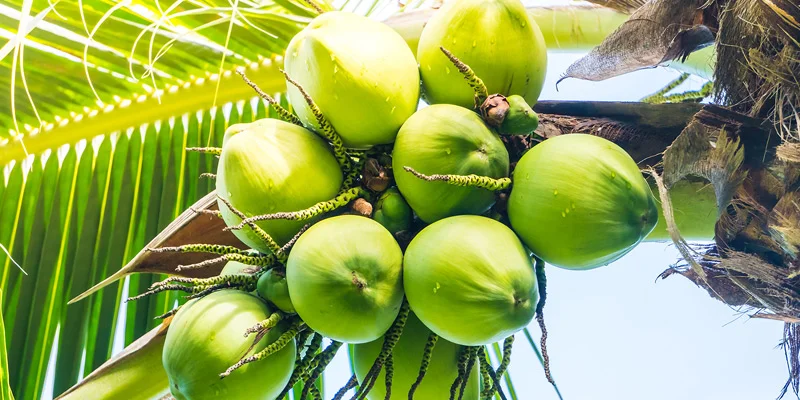


India’s coconut sector supports rural livelihoods, agricultural growth, and cultural traditions. Nearly 30 million people, including around 10 million farmers, depend on the sector. India ranks first in global coconut production, with Keralam leading in area, Tamil Nadu in production, and Andhra Pradesh in productivity.
India’s export basket has expanded from traditional products to value-added products like virgin coconut oil, coconut milk, and activated carbon. The Government, primarily through the Coconut Development Board (CDB), implements a range of schemes to strengthen the coconut ecosystem. During 2025-26, about 2,175 hectares were added under cultivation, while 1,672 hectares were covered under rejuvenation.
The Union Budget 2026-27 further introduced the Coconut Promotion Scheme to strengthen sustainability, exports, and farmer incomes. With continued policy support, India’s coconut sector is steadily advancing across production, value addition, exports, and livelihoods.
A cultural asset
Revered as the “Kalpavriksha,” the tree providing all necessities of life, coconut is rooted in India’s heritage, culture, and agrarian economy. Celebrated across civilizations as a tree of a thousand uses, coconut’s enduring symbolism is rooted in its remarkable versatility. It provides food, drink, medicine, fibre, timber, fuel, and a diverse range of raw materials. These resources sustain households, traditional practices, and a growing ecosystem of value-added industries.
In India, coconut cultivation has a well-documented history spanning nearly three millennia and remains a critical driver of rural employment and economic resilience. Predominantly cultivated by small and marginal farmers, coconut aligns closely with inclusive growth and the strengthening of farmbased economies. One such example of its growing significance can be seen in Chhattisgarh, where farmers have begun adopting coconut cultivation as a viable livelihood option.
In the Bastar plateau of Chhattisgarh, farmers traditionally depended on paddy, millets, maize, and minor floret produce. Through the efforts of the CDB, coconut cultivation has emerged as a promising livelihood option. Farmers have been trained to utilise the vacant spaces between young coconut palms with suitable intercrops. The practice provides income until coconut production commences.
With the help of CDB, a farmer in Chhattisgarh’s Bastar district, adopted a multitier cropping system that integrates high-value fruits and vegetables. In his coconut plantation, he cultivated 4,000 pineapple plants, 800 dragon fruit plants, 1,000 mango trees, 600 citrus trees, along with banana, guava, papaya, litchi, coffee, strawberry, and seasonal vegetables. This diversified model enhanced the productivity of his land and ensured continuous income. His farm generated ₹5-6 lakh annually from coconut cultivation. Intercrops added around ₹10 lakh, making coconut farming highly profitable. His success encouraged many farmers in Bastar to view his coconut-based system as a sustainable, replicable model.
Global coconut economy
India ranks first in production and third in cultivation area of coconut, accounting for 31.24 per cent and 17.90 per cent of global total, respectively. According to the DA&FW statistics, India produced about 20,301.22 million nuts of coconut during 2024-25 from 2.19 million hectares. Average productivity stood at 9,249 nuts per hectare.
Within the country, Keralam has the largest area under coconut cultivation, covering nearly 7.54 lakh hectares and producing about 5,149.87 million nuts. Tamil Nadu leads coconut production, while Andhra Pradesh records the highest productivity, followed by West Bengal and Tamil Nadu.
Beyond primary production, the coconut sector has emerged as an important contributor to agricultural exports, supporting India’s export ambitions. The Government aims to achieve USD 2 trillion in exports by 2030 and USD 21 trillion by 2047.
Supporting these export ambitions, India’s coconut exports have recorded sustained growth in recent years. Coconut product exports reached ₹7,038.35 crore (USD 794.70 million) in 2025-26. This marked a 62 per cent increase over ₹4,349.03 crore recorded in the previous year. The growth highlights the significant progress made since 2001-02, when exports were only ₹25.3 crore and were restricted to traditional products such as coconut shell charcoal, coconut oil, coconut, desiccated coconut, etc.
Over time, India’s coconut export basket has diversified to include a range of value-added products such as virgin coconut oil, coconut milk, and coconut water. India also supplies other application-oriented products in international markets. Market outreach has expanded beyond West Asia, once the primary destination. Exports now reach markets across Europe, the Americas, and Australia.
Over the past five years, the USA, UAE, Sri Lanka, Germany, Russia, Turkey, Belgium, UK, and Netherlands have emerged as major trading partners. Key export products include activated carbon, coconut oil, fresh / frozen / grated coconut, copra, and desiccated coconut. Among these, activated carbon has consistently dominated export volumes.
The Government has adopted a multi-pronged policy approach for the coconut sector. The approach integrates minimum support price for copra, targeted development schemes, and focused initiatives for skill development and enterprise creation across the value chain.
Copra, the dried kernel of coconut, is among the 22 mandated agricultural crops covered under the minimum support price regime.
India primarily produces two types of copra: milling copra and ball copra. Milling copra is primarily used for oil extraction and involves drying the coconut kernel after it is removed from the shell. Ball (edible) copra is consumed as a dry fruit and for religious purposes.
It is prepared by drying whole mature coconuts until the kernel hardens inside the shell.
The Government, primarily through CDB, implements a range of schemes to strengthen the coconut ecosystem. These improve access to quality planting material, expand cultivation, enhance productivity, promote technology adoption, and support market development. Under the scheme, CDB undertakes the establishment of new demonstration cum seed production farms (DSPFs).
These farms demonstrate scientific coconut cultivation practices and commercially produce quality coconut planting materials. Establishment of nucleus coconut seed garden: Supports the establishment of coconut seed gardens to produce high-quality coconut seedlings and improved varieties. During 2025-26, ₹24 lakh was allocated under the scheme, of which ₹20.29 lakh was utilised.
Establishment of small coconut nursery: Promotes production of quality coconut seedlings through the establishment of public and private nurseries. During 2025-26, assistance was provided to establish 12 new nurseries with a combined annual production capacity of 1.06 lakh seedlings. Assistance was also provided to maintain six existing nurseries. Accreditation and rating of coconut nurseries: Ensures the availability of genuine, high-quality planting material through nursery accreditation and quality assessment.
Assistance for quality planting material production in public sector nurseries: Supports coconut seedling production through financial assistance to eligible public sector nurseries. During 2025- 26, ₹239.35 lakh was provided to strengthen nurseries.
The board facilitates participation of entrepreneurs in domestic and international trade fairs. In last five years CDB has facilitated 72 entrepreneurs in 20 domestic trade fairs and also 224 exporters in international trade fairs.
In India, coconut cultivation has a welldocumented history spanning nearly three millennia and remains a critical driver of rural employment and economic resilience. Predominantly cultivated by small and marginal farmers, coconut aligns closely with inclusive growth and the strengthening of farmbased economies.
Development of coco skills
The Coconut Development Board (CDB) implements flagship skill development programmes for the coconut sector. These programmes create a trained, self-reliant, and enterpriseready workforce across harvesting, processing, and value addition.
Cocomitra (Coconut Climbers Task Force): Organises trained climbers into registered units of 6-10 members. These groups are equipped with modern climbing devices, plant protection tools, and mobility support to deliver timely services to farmers.
Kera Kaushal Kendra: Seeks to nurture a network of coconut handicraft centres across India specialising in products made from coconut shell, wood, and fibre. The initiative establishes 15-member handicraft production groups registered as legal entities.
Each approved Kera Kaushal Kendra is eligible for financial assistance of ₹2.67 lakh from 2026-27. The assistance is provided for creating common facilities such as tools and equipment, furniture and fixtures, storage shelves and racks, utilities, and contingencies. The initiative also supports marketing activities for handicraft products.
The programme promotes coconut-based micro-enterprises, rural entrepreneurship, and sustainable livelihoods. Neera tapping and processing technician training programme: Neera, a nutritious zero-percentalcohol health drink, is the unfermented juice tapped from coconut palm inflorescences.
The programme provides structured 7-day field-based training to develop skilled technicians for safe and scientific Neera tapping and processing. The training is conducted through FPOs holding Neera licences.