




Blitz Bureau
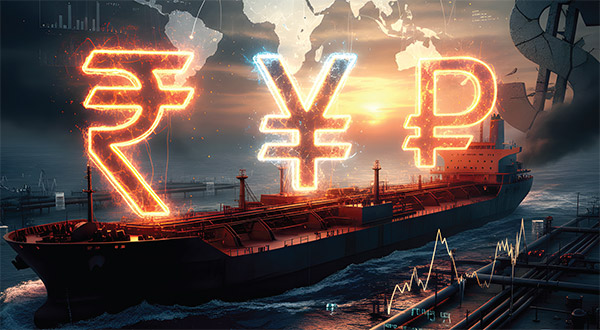
NEW DELHI: A subtle but significant shift is unfolding in the global energy market as India, China and Russia increasingly turn to local currencies for oil and gas trade. The move, driven by concerns over the growing politicisation of the US dollar, marks one of the strongest signals yet that the architecture of international energy payments is being quietly reworked.
A recent paper by the Oxford Institute for Energy Studies (OIES) warns that Washington’s extensive use of sanctions and its willingness to link energy flows with political demands have begun to unsettle major Asian buyers.
The report notes that while the dollar remains the backbone of global pricing and settlement, its frequent deployment as a geopolitical tool is encouraging countries to seek parallel channels of trade insulated from sudden policy shifts in Washington.
The most dramatic adjustments are visible in Russia’s trade with China and India. Moscow and Beijing now settle virtually all bilateral trade — over 99 per cent — in rubles and yuan, a complete reversal from the pre-Ukraine-war period.
Russia’s broader reliance on the yuan has also soared, with the Chinese currency accounting for more than a third of its total foreign trade in 2023, up from almost nothing in 2021.
India, too, has shifted away from the dollar for a large share of its Russian oil imports, using the UAE dirham and the yuan for settlement as Western sanctions complicated traditional payment routes. Russian officials estimate that nearly 95 per cent of their dealings with India and China last year bypassed the dollar altogether.
This trend is not confined to bilateral arrangements. The expanded BRICS grouping is examining alternative payment systems, including blockchain-based platforms, to reduce exposure to Western financial institutions.
Economists describe the energy sector as the most active testing ground for this transition — not as a challenge to the dollar’s supremacy, but as a practical response to sanctions risk, exchange-rate volatility and rising financing costs.
The timing of this shift is striking. Even as Asian buyers explore non-dollar arrangements, the United States is on track to becoming the dominant force in global LNG supply.
According to data from the US Energy Information Administration, North American LNG export capacity is expected to more than double by 2029, establishing the US as the world’s undisputed LNG powerhouse.
Global liquefaction capacity is projected to rise by about 60 per cent by the end of the decade, with nearly half of that expansion coming from American projects.
This growing muscle gives Washington new leverage in global energy markets, but it also raises concerns. The OIES warns that if US LNG exports become entangled in political conditions or trade-related bargaining, major importers in Asia may respond by further diversifying suppliers and exploring long-term contracts priced in non-dollar currencies.
Qatar, the next major growth driver in LNG, is already positioning itself as a stable, commercially focused alternative for buyers wary of geopolitical turbulence.
For India, the recalibration is both strategic and unavoidable. As one of the fastest-growing consumers of energy, India cannot afford prolonged exposure to currency swings or sanctions spill-overs.
While it continues to maintain strong ties with US LNG suppliers, New Delhi is also deepening partnerships with Qatar, Russia and Gulf producers, while cautiously expanding rupee-based and third-currency settlement mechanisms.
The dollar is not on the verge of displacement. But the foundations of its dominance in the energy trade are no longer as unshakable as they once were. What is emerging across Asia is not a rejection of the existing order, but the construction of a parallel pathway — one that offers strategic flexibility in a world where energy and geopolitics are increasingly intertwined.