




Blitz India Business
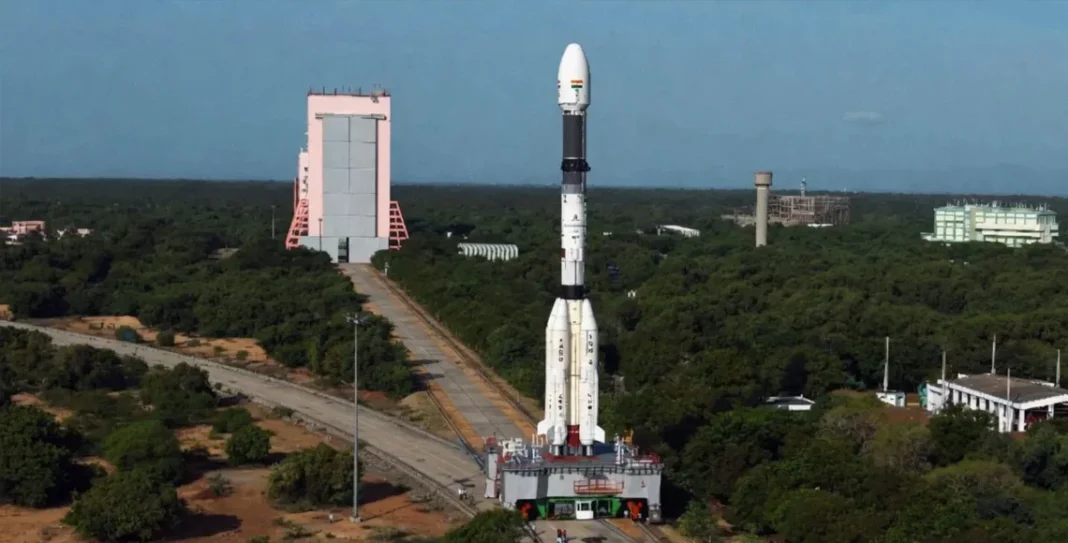
Sriharikota, EOS-05 goes up on 4 September. For the industry that buys Earth-observation data, the product changes shape.
Set aside, for a moment, the rocket. The commercially interesting fact about the GSLV-F17 mission is what ISRO says on its own mission page about the payload: EOS-05 is India’s first imaging satellite from geosynchronous orbit. In the Earth-observation market, that is not an incremental specification. It is a different product.
Data from a low-orbit imaging satellite is sold by the scene: a customer buys a picture of a place, taken on a date the satellite’s orbit decides. Revisit time — how long before the satellite comes back — is the constraint the whole business is organised around, and it is measured in days. Data from a geosynchronous imager is sold differently, because the satellite is always there. The unit stops being the scene and becomes the interval.
The arithmetic makes the point. A geosynchronous satellite goes round the Earth once in twenty-four hours; a low-orbit satellite does it in roughly ninety minutes. That is about sixteen revolutions to one, computed here — and it is precisely because the low-orbit satellite is moving so much faster relative to the ground that it cannot stay. Speed buys resolution and costs continuity. Height buys continuity and costs resolution. EOS-05 is India buying continuity.
Where the money is in continuity
The customers for a continuous watch are not the customers for a weekly photograph. Insurance underwriting of crop and flood risk needs the shape of an event over hours. Disaster response needs a front tracked as it moves. Port and shipping operations need the same stretch of coast at three-hourly intervals, not once a week at whatever hour the orbit dictates. Every one of those is a subscription rather than a purchase, and subscriptions are the better business.
ISRO’s Chairman, V. Narayanan, put it in service terms on 2 September, saying the mission will strengthen India’s Earth-observation capabilities and improve the delivery of Earth-observation services. Delivery is the operative word for anyone costing this.
Blitz Data Card · Sriharikota, 3 September 2026
Why Orbit Height Changes The Product
| Parameter / Metric | Details |
|---|---|
| EOS-05 working orbit | Geosynchronous |
| Orbit delivered by the launch vehicle | Sub-GTO |
| Revolution period, geosynchronous | ~24 hours |
| Revolution period, low polar orbit | ~1.5 hours |
| Launch vehicle | GSLV-F17, 19th GSLV flight |
| Scheduled lift-off | 4 Sept 2026, 02:55 IST |
THE COMPARISON — DRAWN TO SCALE
Revolutions per day — low polar orbit: about 16
Revolutions per day — geosynchronous: 1
THE DIFFERENCE — The low-orbit satellite turns 1,500 per cent more often — sixteen revolutions a day against one. Ratio derived here from the two orbital periods.
WHAT INDIA GAINS
A domestic supply of continuous Earth-observation data for insurers, ports, farm-credit institutions and disaster agencies — imports displaced, and an exportable service in a market where continuity is scarce.