SUKUMAR SAH
NEW DELHI:
The Government has unveiled an ambitious legislative agenda for the Monsoon Session of Parliament that is underway, signalling that economic growth, investment facilitation, judicial efficiency, MSME competitiveness and higher education reforms will dominate its policy priorities. The seven key Bills listed for consideration together reflect an attempt to modernise institutions, improve the business environment and build the policy architecture required to sustain India’s ambition of becoming a developed nation by 2047.
Coming at a time when the global economy remains uncertain, geopolitical tensions continue to disrupt trade and investment flows, and countries are competing to attract capital, technology and talent, the proposed reforms seek to strengthen India’s long-term economic fundamentals. Rather than focusing on isolated policy interventions, the legislative package attempts to address structural bottlenecks across taxation, business regulation, judicial administration, education and governance.
At the centre of the economic agenda is the proposed Income-tax (Amendment) Bill, 2026, which seeks to replace an ordinance exempting specified foreign investors from income tax on income earned from notified government securities. The measure is intended to make India’s sovereign debt market more attractive to global institutional investors, complementing recent efforts to deepen domestic capital markets and integrate Indian government bonds with global financial indices. Easier access for foreign investors could broaden the investor base, reduce borrowing costs over time and strengthen India’s position as a preferred investment destination.
The government’s emphasis on creating a more investment-friendly environment also aligns with its broader objective of improving India’s ease of doing business and expanding private investment, which remains central to achieving sustained high economic growth.
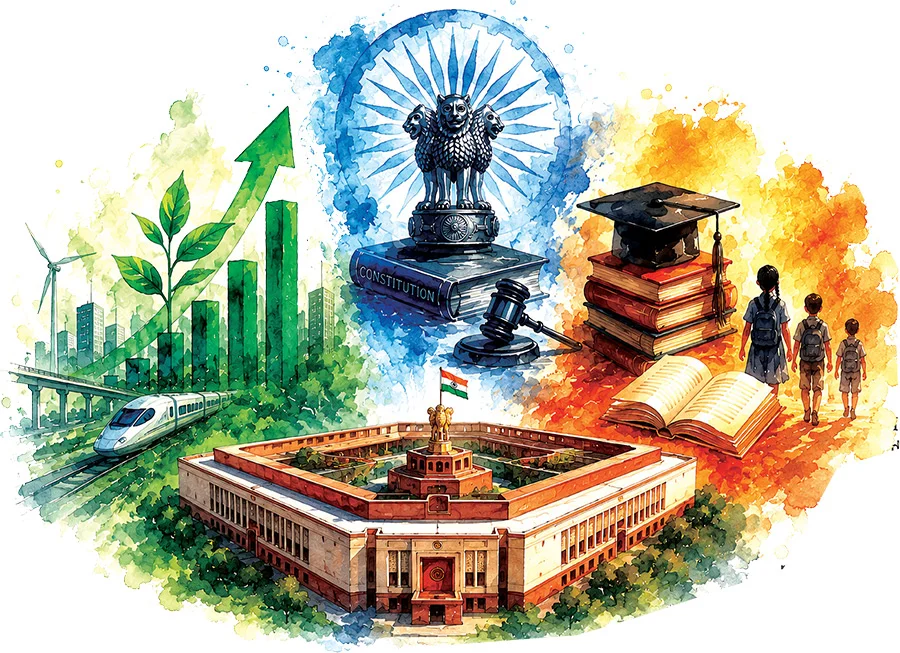
The Bills listed for consideration of Parliament reflect an attempt to modernise institutions, improve the business environment and build the policy architecture required to sustain India’s ambition of becoming a developed nation by 2047
Small businesses, which contribute nearly one-third of India’s GDP and employ millions of people, constitute another major focus area. The MSME Development (Amendment) Bill, 2026 seeks to strengthen the legal framework for addressing delayed payments to micro, small and medium enterprises. Delayed receivables have long constrained the working capital of smaller firms, limiting their ability to invest, expand production and generate employment. By strengthening enforcement mechanisms and empowering MSME Facilitation Councils, the Bill seeks to improve payment discipline and enhance the financial resilience of the sector.
The Government’s governance agenda extends beyond economic reforms. The Supreme Court (Number of Judges) Amendment Bill, 2026 proposes increasing the sanctioned strength of judges to address mounting pendency and improve access to justice. India’s judicial backlog remains one of the country’s biggest governance challenges, with delays affecting businesses, investors and ordinary citizens alike. Faster dispute resolution is increasingly viewed as a critical element of an investment-friendly ecosystem, reducing uncertainty and improving contract enforcement. Expanding judicial capacity could therefore yield benefits that extend well beyond the legal system.
One of the most far-reaching proposals before Parliament is the Viksit Bharat Shiksha Adhishthan Bill, 2025, which has been examined by a Joint Parliamentary Committee and is now pending consideration. The legislation proposes replacing multiple higher education regulators—including the University Grants Commission (UGC), the All India Council for Technical Education (AICTE) and the National Council for Teacher Education (NCTE)—with a unified regulatory framework. The objective is to reduce regulatory overlap, improve institutional governance, simplify approvals and enhance academic quality in line with the goals of the National Education Policy 2020. If implemented effectively, the reform could significantly reshape India’s higher education landscape by creating a more coherent and accountable regulatory architecture.
The legislative programme also includes amendments to the Registration of Births and Deaths Act, aimed at strengthening India’s civil registration system and improving the quality of demographic data that increasingly underpins welfare delivery, digital governance and public policy planning.
Another Bill seeks to amend the Prevention of Insults to National Honour Act, while Parliament is also expected to consider the pending Foreign Contribution (Regulation) Amendment Bill, which proposes a more streamlined framework for managing the assets of organisations that lose FCRA registration and rationalising penalties for certain violations. The changes seek to improve regulatory clarity while maintaining oversight of foreign funding.
Taken together, the Bills suggest that the Government is seeking to move beyond incremental policy changes towards broader institutional reforms. The legislative package also reflects an understanding that sustained economic growth depends not only on infrastructure and investment but equally on efficient courts, responsive regulators, financially healthy MSMEs and a modern education system capable of producing skilled human capital.
The success of the Monsoon Session, however, will depend not merely on the passage of legislation but on Parliament’s ability to build broad political consensus around reforms that carry long-term implications for India’s economy, governance and education architecture.
With the Government determined to sustain the reform momentum despite an uncertain global economic environment, the Monsoon Session has the potential to become one of the more consequential legislative sessions in recent years. If enacted and implemented effectively, these reforms could provide an important foundation for India’s next phase of economic transformation and advance the country’s long-term vision of becoming a Viksit Bharat by 2047.


