Blitz India Business
NEW DELHI: The fallout of the latest US immigration crackdown goes much beyond the cancelled green-card interviews. It strikes at two of the largest pools of skilled migrants to the United States and could alter the flow of talent underpinning America’s technology economy.
The impact will be felt by Indians and Chinese waiting for permanent residency, particularly family-sponsored applicants dependent on consular processing abroad. The larger concern is uncertainty as Washington makes immigration slower and more demanding.
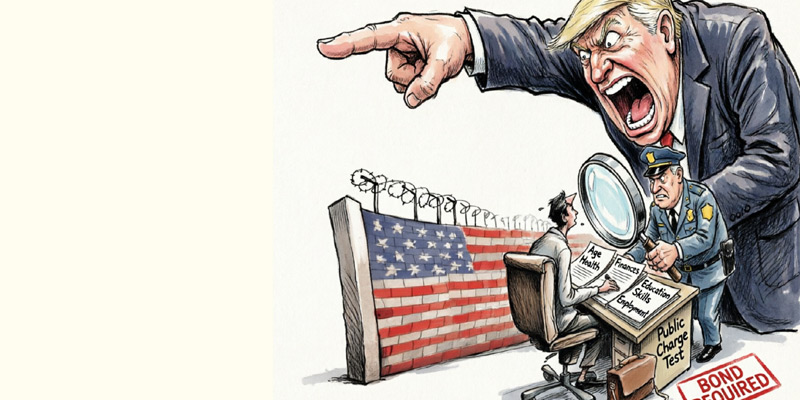
US embassies and consulates have postponed immigrant visa interviews to train officers in tougher application of the “public charge” test — whether an applicant is likely to depend on public benefits. The criteria include age, health, family size, finances, education, skills and employment prospects. What is changing is the intensity of scrutiny, including the possibility of public-charge bonds, i.e. a financial guarantee that an immigrant will not become dependent on certain US government benefits.
The big concern arising out of the latest US immigration crackdown is uncertainty. Washington is making legal immigration slower, more discretionary and more demanding at precisely the moment when both India and China are producing large numbers of globally mobile professionals.
India is among the biggest sources of US international students and H-1B technology workers, while a large backlog of employment-based green-card applicants has created years of uncertainty. More aggressive assessments could affect family applicants and lower-income households, while delays could complicate travel and employment.
The current freeze does not normally cancel an approved green-card petition or erase a priority date. The damage is delay. Applicants may have sold homes, completed medical examinations or booked flights, only to face indefinite wait for a new interview date.
Nor does the freeze apply to non-immigrant visas such as H-1B, student or tourist visas. But these categories also face restrictions. H-1B applicants requiring visa stamping abroad face greater uncertainty, while international students confront tighter rules around their stay and post-study employment.
The most consequential change may be psychological rather than legal. For decades, the bargain was simple: meet the requirements, obey the rules and America remained a predictable destination. That assumption is weakening.
Students now have to track I-94, I-20 and employment authorisation dates carefully. H-1B workers losing jobs may have a 60-day grace period, but those travelling abroad while dependent on obtaining a new visa face another layer of risk.
Citizenship remains more secure. The government cannot revoke the citizenship of a naturalised American because it considers that person undesirable. Denaturalisation requires evidence that citizenship was illegally obtained or secured through concealment of a material fact. Birthright citizenship cannot be taken away because a parent loses immigration status.
If skilled Indians and Chinese increasingly conclude that the US offers opportunity with immigration risk, Canada, Europe, Australia and Asian technology hubs will have a stronger proposition.