




Blitz India Business
NEW DELHI: India’s strategic approach to SDG 14, i.e., life below water, is defined by a dual focus: aggressive scientific exploration of deep-sea resources and rigorous conservation of fragile coastal habitats.
At the centre of this policy is the landmark Deep Ocean Mission (DOM), spearheaded by the Ministry of Earth Sciences. Backed by substantial financial commitments – including a major budgetary push with allocations of Rs 3,650 crore – the mission represents India’s intent to master ocean governance.
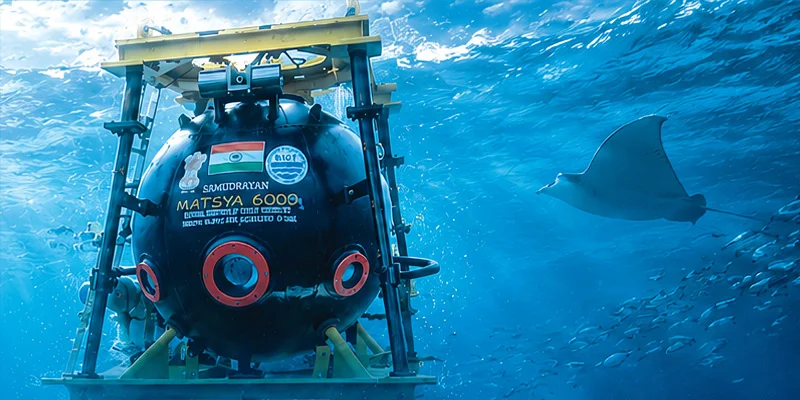
Samudrayaan project
A crowning jewel of this initiative is the Samudrayaan project and the development of Matsya 6000, an indigenous, titanium-alloy manned submersible designed to dive 6,000 meters into the ocean to study marine biodiversity and explore polymetallic nodules rich in critical minerals such as nickel, cobalt, and manganese.
Crucially, unlike historical resource grabs, this mission focuses on research in deep-sea biodiversity to ensure that mineral extraction does not destroy the fragile under-water ecosystems.
Concurrently, India is tackling the crisis closer to shore. Through large-scale coastal mangrove restoration projects, seagrass cultivation, and the expansion of blue flag-certified beaches, the country is building natural shields against rising sea levels (which are increasing at roughly 4 mm annually in the Indian Ocean region) while capturing vital blue carbon. Municipal and central bodies are also clamping down on single-use plastics to reduce the choking debris density plaguing coastal waters.
Capital, policy gap
Despite these visionary steps, massive hurdles remain. Globally, SDG 14 is notoriously recognised as the least-funded of all sustainable development goals, attracting a fraction of the capital required to meet 2030 targets. In India, while Government-led outlays for ocean science are scaling up, private sector capital deployment into marine conservation remains sluggish.
To bridge this gap, India must accelerate three critical transitions:
Scaling up blended finance: Attracting private institutional capital through green bonds and blue-carbon credits to fund coastal restoration and sustainable aquaculture.
Reforming small-scale fisheries: Providing modernised, eco-friendly gear, cold-chain infrastructure, and fair market access to millions of traditional artisanal fishermen whose livelihoods are threatened by depleted near-shore fish stocks.
Strict enforcement of marine protected areas: Expanding protected zones beyond the current baseline and utilising satellite-based monitoring to eliminate illegal, unreported, and unregulated fishing.
India’s maritime destiny hangs in the balance. By marrying cutting-edge deep-tech exploration with grassroots coastal stewardship, the nation has the potential to transform from an observer of marine degradation into a global architect of sustainable ocean governance.
Globally, SDG 14 is notoriously recognised as the least-funded of all sustainable development goals, attracting a fraction of the capital required to meet 2030 targets
A silent emergency
For generations, humanity treated the world’s oceans as an infinite resource basket and an un-chokeable waste dump. Covering over 70 per cent of the earth’s surface, oceans act as the planet’s primary life-support system – absorbing nearly a third of global carbon dioxide emissions and buffering the worst shocks of climate change.
Yet, beneath the sparkling surface, a silent emergency has unfolded. Warming waters, acidifying currents, choking plastic debris, and industrial overfishing have pushed marine ecosystems to a dangerous tipping point.
For India – a nation blessed with a staggering 7,500-kilometer coastline, an exclusive economic zone (EEZ) spanning over 2.37 million square kilometres, and a coastal population numbering in tens of millions – ocean health is not an abstract ecological talking point. It is a matter of immediate national security, food sovereignty, and economic survival.
As India targets an ambitious expansion of its blue economy to contribute 8 per cent to the national GDP by 2030, the paradigm has shifted dramatically: protecting marine life is no longer separate from economic growth; it is the foundation upon which future prosperity must be built.
Crucially, unlike historical resource grabs, the Samudrayaan project focuses on research in deep-sea biodiversity to ensure that mineral extraction does not destroy the fragile under-water ecosystems.