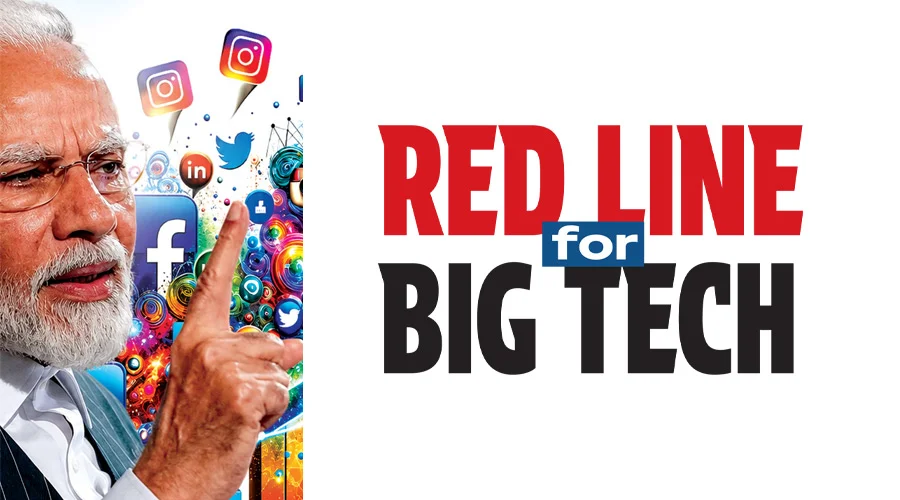
RED LINE for BIG TECH

Meta apology puts spotlight On Govt’s tough stand for digital accountability

Blitz India Business

NEW DELHI: India has sent a powerful message to the world’s technology giants: no social-media platform, however large or influential, can operate beyond the reach of sovereign law or escape accountability for decisions made by its algorithms.

The message acquired global significance after Meta apologised for erroneously restricting a video posted by Prime Minister Narendra Modi on Facebook.

What initially appeared to be a content-moderation error quickly developed into a much larger issue involving digital sovereignty, algorithmic accountability and the extraordinary influence exercised by global technology platforms over public communication.

Instead of accepting the incident as a routine technical glitch, the Narendra Modi Government sought accountability from Meta at the highest levels.

Content restored

Senior global executives of the company were called upon to explain the circumstances surrounding the restriction, while the issue also reached Parliament’s Standing Committee on Communications and Information Technology.

Meta subsequently acknowledged the error and restored the content. Its Chief Global Affairs Officer Joel Kaplan apologised on behalf of the company for the erroneous restriction of the Prime Minister’s post.

The episode has now assumed significance far beyond a single Facebook video. It has highlighted India’s growing determination to establish that global digital platforms operating within the country must comply with Indian laws and remain accountable for the consequences of their technological and algorithmic decisions.

At the heart of India’s response is a display of political will to confront one of the most difficult governance challenges of the digital age.

New Delhi has effectively told the digital world that global reach does not supersede national jurisdiction. Platforms can be global. The law remains sovereign

Social-media platforms have transformed communication, commerce and the exchange of ideas across the world. But their unprecedented expansion has also created an increasingly difficult environment involving misinformation, deepfakes, online abuse, unlawful content, automated manipulation and opaque algorithms capable of determining what billions of people see – or do not see.

India’s position is that innovation and freedom of expression must flourish, but technological power cannot become a licence for unaccountability.

A larger principle

The Government’s firm intervention has, therefore, raised a larger principle: an algorithm cannot become the final, unchallengeable authority over lawful public communication.

If an automated system can mistakenly restrict the communication of the elected Prime Minister of the world’s largest democracy, questions inevitably arise about the safeguards available to ordinary citizens, journalists, institutions and businesses when similar errors occur.

For years, some of the world’s largest technology companies have effectively written and enforced their own rules governing online content. They created community standards, designed algorithms, determined enforcement procedures and established internal mechanisms for deciding what content should be promoted, restricted or removed.

India’s intervention challenges the idea that such enormously consequential decisions can remain exclusively within the corporate domain. The Government has increasingly insisted that companies operating in India must comply with domestic law, fulfil statutory due-diligence requirements and remain answerable when their systems fail.

The principle emerging from New Delhi is simple but consequential: Algorithms may make decisions, but companies remain responsible for them.

Digital sovereignty

India’s stand carries particular weight because it represents one of the world’s largest digital societies and one of the most important markets for global social-media companies. A regulatory message originating in New Delhi, therefore, cannot easily be ignored in Silicon Valley.

India has already been strengthening its regulatory framework governing online intermediaries, unlawful content, deepfakes and synthetic media. It has also emphasised that statutory protections available to digital intermediaries are linked to compliance with prescribed obligations.

The latest confrontation gives that policy a much wider international dimension. New Delhi has effectively told the digital world that global reach does not supersede national jurisdiction. Platforms can be global. The law remains sovereign.

World watches India

The debate is already global. Europe has adopted tougher obligations for major technology platforms through its Digital Services Act. Governments elsewhere are examining online safety, Artificial Intelligence, election interference, child protection, deepfakes and algorithmic transparency.

India, however, brings something distinctive to this international conversation: the combination of democratic scale, technological capability, an enormous digital population and the political willingness to demand compliance from the world’s most powerful technology corporations.

That gives India’s evolving regulatory approach potential influence well beyond its borders. Developing economies across Asia, Africa and Latin America will be watching closely.

Many face the same fundamental question: should the rules governing their digital societies effectively be determined in corporate headquarters thousands of kilometres away, or should technology companies be accountable to the laws of the countries in which they operate?
India’s answer is becoming increasingly unequivocal.

The episode has highlighted India’s growing determination to establish that global digital platforms must comply with Indian laws and remain accountable for the consequences of their technological and algorithmic decisions.

Latest News

Retraction Nation!

K Srinivasan NEW DELHI: This is a toppers list...

No fuel for cooking? Go to ATM

Blitz Bureau NEW DELHI: India's ethanol story is entering a...

Healthy success

Blitz Bureau NEW DELHI: When West Bengal signed its memorandum...

Getting high on hydrogen

Blitz Bureau NEW DELHI: The air around the Jind-Sonepat section...

Cross-examining THE EMPIRE

Deepak Dwivedi NEW DELHI: Some way into his introduction, Rakesh...

Topics

Retraction Nation!

K Srinivasan NEW DELHI: This is a toppers list...

No fuel for cooking? Go to ATM

Blitz Bureau NEW DELHI: India's ethanol story is entering a...

Healthy success

Blitz Bureau NEW DELHI: When West Bengal signed its memorandum...

Getting high on hydrogen

Blitz Bureau NEW DELHI: The air around the Jind-Sonepat section...

Cross-examining THE EMPIRE

Deepak Dwivedi NEW DELHI: Some way into his introduction, Rakesh...

Sixty Grams of Amrit

PUNIT JAIN NEW DELHI: Tamil poet, novelist and lyricist R...

Trump tariffs target India again

Prabhu Chawla NEW DELHI: In the long arc of democratic...

Stronger law, safer exams

Blitz Bureau NEW DELHI: Every year in the country, lakhs...
spot_img