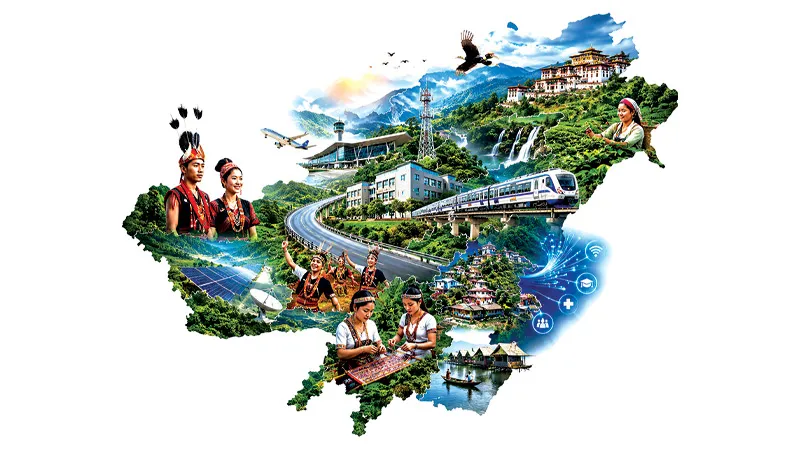
North East at the heart of India’s growth story

Over the last twelve years, a new chapter has unfolded across the region once descried as distant and remote

Blitz Bureau

NEW DELHI: Where hills reach up to meet the clouds, and rivers inspire music, art and literature, India’s North East tells a story of possibility. Each of the eight northeastern states has its own distinctive richness and diversity. Assam, Arunachal Pradesh, Manipur, Meghalaya, Mizoram, Nagaland, Tripura, and Sikkim together form this vibrant region. Their strategic location and rich cultural heritage make the North East central to India’s growth story.

Over the last twelve years, a new chapter has unfolded across this landscape. A region that was once defined as distant and remote, is now shaped by access, connectivity, and expanding opportunity. Roads are reaching farther, rail lines are expanding, and airports and waterways are opening new routes. Improved transport infrastructure has brought better access to water, housing, sanitation, energy, healthcare, and education.

Agriculture and rural livelihoods have gained momentum through focused support and stronger market linkages. At every step, progress has become inclusive, responsive, and grounded in local realities.

Guided by sustained policy support since 2014, this journey reflects a clear and balanced vision. Development aligns with ecological sensitivity, resource efficiency, and long-term sustainability.

Dedicated policy push

Over the past decade, development in the northeast has been supported by a targeted policy architecture. This approach combines dedicated schemes and financial support, ensuring that development is both region-specific and outcome-oriented. The Ministry of Development of North Eastern Region (MDoNER) is providing financial assistance to the eight states. This is being done through five Central sector schemes. A total of 3,746 projects have been sanctioned, out of which 2,730 have been completed.

PM-DevINE: The Prime Minister’s Development Initiative for North East Region (PM-DevINE) represents a major policy intervention aimed at accelerating development through high-impact projects. Forty-eight projects relating to infrastructure, livelihood, and social development and filling developmental gaps are under implementation through the PM-DevINE scheme.

NESIDS – Roads: The scheme focuses on projects that improve access to remote areas and strengthen market connectivity. Seventy projects have been completed for construction and widening of roads while 57 are under implementation.

NESIDS – Other Than Roads Infrastructure (OTRI): The scheme provides financial assistance to all eight northeastern states for infrastructure development. A total of 1,234 projects have been completed among various sectors.

Schemes of the NEC

The North Eastern Council (NEC) is the nodal agency for the economic and social development of the northeastern region. The schemes under NEC aim to support holistic development. A total of 495 projects are under implementation across the schemes of the NEC.

SDPs for Assam, Tripura: The Special Development Packages (SDPs) for Assam and Tripura aim to promote inclusive development and sustain peace in the region. The focus is on generating employment through infrastructure and livelihood projects. Youth and women will benefit through skill development and entrepreneurship initiatives. There are 40 ongoing projects under this.

Act East Policy: The Act East Policy has been a key pillar of India’s external engagement since 2014. The policy places the northeast at the centre of India’s engagement with Southeast Asia. It recognises its strategic location and economic potential. Over the past decade, the policy has focused on connectivity, trade, cultural linkages, and border infrastructure.

Cross-border connectivity: A central focus of the Act East Policy has been the development of cross-border connectivity infrastructure. This links the northeast with neighbouring countries. The India-Myanmar-Thailand Trilateral Highway is a flagship project under this framework.

Enhancing trade: The policy has also strengthened trade linkages between the northeast and Southeast Asia. Border trade points and infrastructure are being developed to facilitate smoother movement of goods.

Connectivity revolution

Road infrastructure: Road connectivity forms the backbone of mobility in the Northeast. The expansion of the National Highways network reflects this shift. The total length has increased from 10,905 km in 2014 to 16,207 km as of April 1, 2025.

Rail connectivity: Railways have emerged as a transformative mode of connectivity in the northeast. Historically limited to parts of Assam, the network is now expanding into hill states through some of the most complex engineering projects in the country.

Bridges and tunnels: The northeast geography is defined by major river systems and mountainous terrain. The past decade has seen a decisive shift towards permanent, high-capacity engineering solutions in the form of bridges and tunnels. Some of these include: Bogibeel Bridge, Dhola-Sadiya Bridge, Noney Bridge and Sela Tunnel.

Air connectivity: The UDAN (Ude Desh ka Aam Nagrik) scheme has been instrumental in expanding regional aviation. The northeast has witnessed the development of eight new airports and around 90 regional routes have been operationalised.

Inland waterways: Brahmaputra, identified as National Waterway-2, serves as the region’s primary inland transport corridor. It connects key locations in Assam and links the northeast with mainland India through the Indo-Bangladesh Protocol route. River-cruise tourism is also being promoted through dedicated terminals at Guwahati, Neamati, Biswanath Ghat, Silghat, and Guijan.

Enabling next phase

Connectivity in the northeast is now expanding beyond physical infrastructure. Multiple Government-funded projects, including BharatNet and those supported by Digital Bharat Nidhi, have enhanced digital connectivity. As of December 2025, 6,355 Gram Panchayats have been made service-ready for high-speed internet services. During the same period, 3,718 mobile towers have been commissioned.

The region has transitioned from limited access to integrated infrastructure. Investments across transport modes have reduced isolation and improved economic opportunities. The region is now better connected, more accessible, and positioned for long-term growth and regional integration.

Development in the northeast has been supported by a targeted policy architecture. This approach combines dedicated schemes and financial support, ensuring that development is both region-specific and outcome-oriented

Latest News

Retraction Nation!

K Srinivasan NEW DELHI: This is a toppers list...

No fuel for cooking? Go to ATM

Blitz Bureau NEW DELHI: India's ethanol story is entering a...

Healthy success

Blitz Bureau NEW DELHI: When West Bengal signed its memorandum...

Getting high on hydrogen

Blitz Bureau NEW DELHI: The air around the Jind-Sonepat section...

Cross-examining THE EMPIRE

Deepak Dwivedi NEW DELHI: Some way into his introduction, Rakesh...

Topics

Retraction Nation!

K Srinivasan NEW DELHI: This is a toppers list...

No fuel for cooking? Go to ATM

Blitz Bureau NEW DELHI: India's ethanol story is entering a...

Healthy success

Blitz Bureau NEW DELHI: When West Bengal signed its memorandum...

Getting high on hydrogen

Blitz Bureau NEW DELHI: The air around the Jind-Sonepat section...

Cross-examining THE EMPIRE

Deepak Dwivedi NEW DELHI: Some way into his introduction, Rakesh...

Sixty Grams of Amrit

PUNIT JAIN NEW DELHI: Tamil poet, novelist and lyricist R...

Trump tariffs target India again

Prabhu Chawla NEW DELHI: In the long arc of democratic...

Stronger law, safer exams

Blitz Bureau NEW DELHI: Every year in the country, lakhs...
spot_img