




Blitz India Business
NEW DELHI: Six months after the tariff on Indian goods entering the United States was cut to 18 per cent, India has posted its best July on record for merchandise exports. The two facts are related — but not in the way the totals suggest.
Merchandise exports reached $44.24 billion in July 2026, the highest figure recorded for any July and comfortably past the previous high of $38.34 billion set in 2022, on growth of 19.63 per cent over the $36.98 billion of July 2025. That performance follows the trade understanding announced on 2 February 2026, under which the United States reduced its reciprocal tariff on Indian goods to 18 per cent from 25 per cent and withdrew a further 25 per cent punitive duty, taking the effective rate down from close to 50 per cent.
The number that decides how much of this endures is not 18 but the spread. Vietnam and Bangladesh face 20 per cent; China is in the 30 to 35 per cent band. India therefore holds a two-point advantage over its nearest low-cost competitors and a double-digit advantage over the largest. In sectors where net margins are in the low single digits — textiles and apparel, gems and jewellery, engineering goods, and a large part of the generics pharmaceutical book — a two-point tariff differential is not a rounding error. It is frequently the entire difference between winning and losing a buyer’s order for a season.
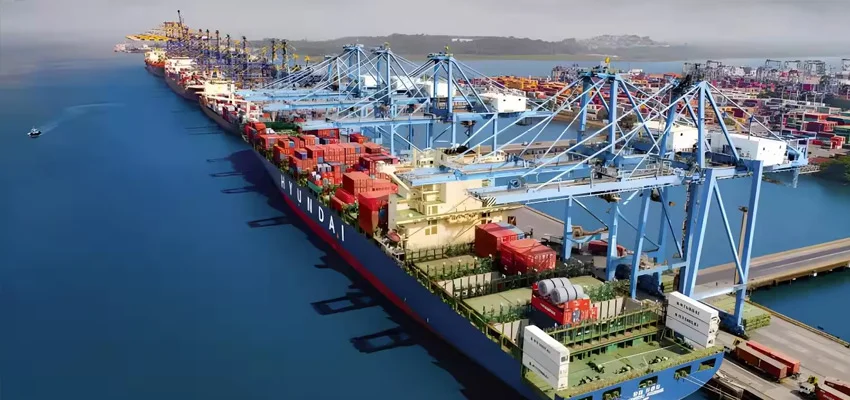
Where the advantage is realised: a tariff differential shows up as container volume months after it is announced, because apparel and engineering orders are placed a season ahead of shipment.
Eighteen is not the number that matters. Two is — the points that separate India from Vietnam and Bangladesh on the same shelf.
At a Glance
• US reciprocal tariff on India: 18 per cent, from 25
• Announced: 2 February 2026
• Additional punitive duty: 25 per cent, withdrawn
• Effective rate before: close to 50 per cent
• Vietnam and Bangladesh: 20 per cent
• China: 30 to 35 per cent band
• July merchandise exports: $44.24 bn, a record for the month
• Previous July high: $38.34 bn, in 2022
• Growth: 19.63 per cent year on year
• Sectors most exposed to the spread: apparel, gems, pharma, engineering
Two cautions belong alongside the record. The first is attribution: a single month’s export figure reflects orders placed a season earlier, festive-quarter restocking in Western retail, and a base effect from a weaker July 2025. Isolating the tariff’s contribution requires several quarters of line-level data, and anyone claiming to have done it from one monthly release has not. The second is durability. A tariff differential that was set administratively can be reset administratively, and the same is true for competitors — a two-point edge is worth exactly as much as the policy that created it, for exactly as long as it lasts.
The constructive use of a window like this is to convert a price advantage into a capability advantage while it exists. That means the things a tariff cannot deliver: compliance certification that Western buyers increasingly require before they place an order, lead times that make an Indian supplier the default rather than the second source, and the move up the value chain from cut-and-sew to design-and-supply. Exporters who use these quarters to build that will still hold the customer when the differential closes. Those who use them only to sell more of the same at a slightly better price will find out how quickly a two-point edge disappears.