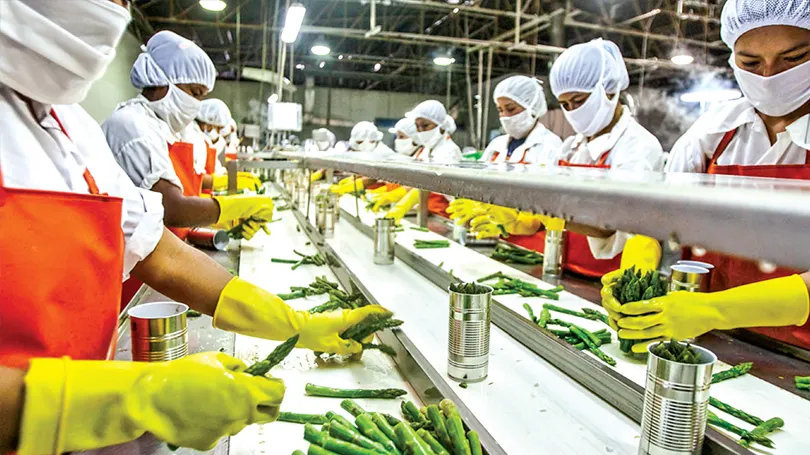
Farming for transforming

Efficient processing of food can yield several benefits, shows World Bank initiative

Blitz Bureau

NEW DELHI: The Ministry of Food Processing Industries (MoFPI), in collaboration with the World Bank Group-led South Asian Policy Leadership for Improved Nutrition and Growth (Sapling) initiative, inaugurated a regional high-level policy dialogue titled “Unlocking Value: Advancing Food Processing for Employment Generation and Sustainable Growth in South Asia” in Ahmedabad recently.

The dialogue underscored that the future of South Asia’s food economy lies beyond production alone. By transforming food systems from farm to market, the region can generate millions of jobs, reduce food losses, improve nutrition, attract investments, strengthen exports, and drive inclusive economic growth for decades to come.

The two-day regional dialogue brought together around 200 participants including policy makers, industry leaders, development partners, innovators, researchers, start-ups, and representatives from South Asian countries to deliberate on strengthening food processing ecosystems and building resilient, inclusive, and sustainable food systems in the region.

Participants highlighted the importance of coordinated action by governments, businesses, investors, and development institutions.

Investors were encouraged to support cold chains, warehousing, logistics hubs, processing clusters, agro-industrial parks, and emerging agri-enterprises. Companies were urged to build integrated value chains, adopt digital technologies for traceability and quality assurance, and invest in workforce skills and capacity building.

Need to preserve

South Asia stands at a critical moment in its development journey. With millions of young people entering the workforce every year, creating sustainable jobs has become one of the region’s most pressing priorities. The World Bank Group highlighted that transforming food systems beyond the farm can unlock significant opportunities for employment, investment, economic growth, and poverty reduction.

The region’s agriculture sector is valued at over $700 billion annually and employs nearly 43 percent of the workforce. However, despite its scale, agriculture contributes only around 16 percent of the region’s GDP. More than 30 per cent of food produced in South Asia is lost or wasted every year — enough to feed nearly 300 million people.

The next phase of agricultural transformation lies not merely in increasing production but in expanding food processing, storage, logistics, marketing, and value addition. These activities can create millions of productive jobs while reducing food losses and increasing farmers’ incomes.

Experts emphasised that the next phase of agricultural transformation lies not merely in increasing production but in expanding food processing, storage, logistics, marketing, and value addition. These activities can create millions of productive jobs while reducing food losses and increasing farmers’ incomes.

In India, food grain production has increased from 51 million tonne in 1950-51 to more than 330 million tonne today. Processed food exports have also more than doubled over the past decade, rising from approximately $4.9 billion to over $10 billion. The food processing sector contributes around 9 per cent of manufacturing value added and nearly 13 per cent of India’s exports.

India’s experience demonstrates that strategic policy interventions can transform agricultural value chains. Key initiatives such as the Pradhan Mantri Kisan Sampada Yojana, the Pradhan Mantri Formalisation of Micro Food Processing Enterprises scheme, and the Production Linked Incentive (PLI) scheme for food processing industries have strengthened infrastructure, modernised enterprises, attracted investments, and improved competitiveness.

Despite this progress, significant opportunities remain. Food processing accounts for only a small share of total employment and a large proportion of agricultural produce still remains unprocessed. Strengthening cold chains, storage facilities, logistics networks, and market linkages can substantially increase value creation across the sector.

Scope in South Asia

South Asia possesses strong fundamentals to emerge as a global leader in food systems. Rapid urbanisation, a growing middle class, rich agro-biodiversity, and rising demand for safe and high-quality processed food are creating new opportunities for investment and innovation.

To accelerate this transformation, the World Bank Group is advancing a combined approach through AgriConnect and Sapling.

AgriConnect, a global platform, aims to connect 300 million farmers to markets by 2030 through investments in infrastructure, policy reforms, and private capital mobilization. The initiative is already supporting projects and reforms across countries including India, Bangladesh, and Sri Lanka.

Sapling serves as a regional platform that brings together governments, investors, development partners, and innovators to promote policy reforms, develop investment pipelines, and scale successful solutions across the region.

Policy makers can accelerate progress by promoting food processing zones, improving logistics infrastructure, simplifying food safety and certification systems, strengthening public-private partnerships, and creating a more investment-friendly business environment.

International financial institutions can play a catalytic role by expanding blended finance mechanisms, supporting policy reforms linked to investment opportunities, and reducing risks associated with private sector investments in food systems.

Latest News

Carbon looms over cotton

Blitz Bureau NEW DELHI:In Tiruppur, the southern cluster that has...

From white revolution to white elephants

Blitz Bureau NEW DELHI:On a sweltering June afternoon in Jaipur,...

Data centre for searching minerals

Blitz Bureau NEW DELHI:The Geological Survey of India will establish...

$35-$40 bn can be raised via deposit scheme: PNB

Blitz Bureau NEW DELHI:Punjab National Bank expects the banking sector...

RBI bans misleading sales tactics in lending

Blitz Bureau NEW DELHI: The Reserve Bank of India on...

Topics

Carbon looms over cotton

Blitz Bureau NEW DELHI:In Tiruppur, the southern cluster that has...

From white revolution to white elephants

Blitz Bureau NEW DELHI:On a sweltering June afternoon in Jaipur,...

Data centre for searching minerals

Blitz Bureau NEW DELHI:The Geological Survey of India will establish...

$35-$40 bn can be raised via deposit scheme: PNB

Blitz Bureau NEW DELHI:Punjab National Bank expects the banking sector...

RBI bans misleading sales tactics in lending

Blitz Bureau NEW DELHI: The Reserve Bank of India on...

India deploys nuclear weapons

Blitz Bureau NEW DELHI: Marking a significant shift in nuclear...

Short sight

Myopia is known as a vision condition related to...

Jio enters top league in patents

Blitz Bureau NEW DELHI: Jio Platforms Limited (JPL), the technology...
spot_img