




Blitz India Business
NEW DELHI: India’s kharif acreage is running below last year. Almost the entire gap sits in one crop, and pulses — sown on a comparable scale — have barely moved. That contrast is the most durable fact in Indian agriculture, and it is a policy instruction.
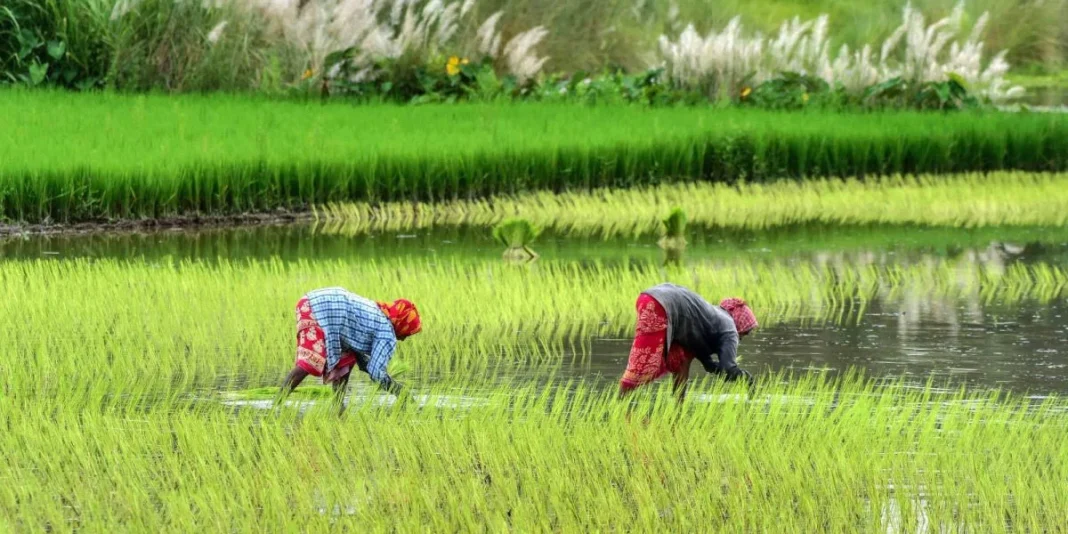
The area sown under kharif crops reached 1,016.57 lakh hectares as on 14 August 2026, against 1,037.52 lakh hectares in the same period a year earlier — a shortfall of 20.95 lakh hectares, or about 2 per cent. Inside that aggregate, rice covered 379.07 lakh hectares against 393.44 lakh a year earlier, a gap of 14.37 lakh hectares. Rice therefore accounts for 68.6 per cent of the entire national sowing shortfall. Pulses such as urad and moong stood at 108.14 lakh hectares against 108.49 lakh — a difference of 0.35 lakh hectares, which on a base of that size is no difference at all.
68.6 per cent of the gap, one crop: rice accounts for 14.37 lakh hectares of the 20.95 lakh-hectare kharif sowing shortfall to 14 August. Pulses are almost exactly level with last year.
Rice is 37 per cent of the kharif area and 69 per cent of the shortfall. Pulses, on a base of 108 lakh hectares, moved by 0.35. The difference between the two numbers is water.
At a Glance
• Kharif area, as on 14 August 2026: 1,016.57 lakh hectares
• Same period 2025: 1,037.52 lakh hectares
• Shortfall: 20.95 lakh hectares, about 2%
• Rice 2026: 379.07 lakh hectares · 2025: 393.44 lakh hectares
• Rice shortfall: 14.37 lakh hectares — 68.6% of the national gap
• Rice share of total kharif area: about 37%
• Pulses (urad, moong and others) 2026: 108.14 lakh hectares · 2025: 108.49 lakh
• Pulses variance: 0.35 lakh hectares — effectively flat
• Source of the divergence: water requirement per hectare
The mechanism is not mysterious and it is not new. Transplanted paddy is among the most water-intensive uses of a hectare in Indian agriculture, and its sowing window is tightly coupled to the arrival and continuity of rainfall in the sowing districts. A farmer with an uncertain first flush of monsoon delays transplanting, and if the delay runs long enough, does not transplant at all. Urad and moong need materially less water, tolerate a later start and can be sown on residual moisture, which is why their acreage barely registers a monsoon that rice registers sharply. The result is that a national kharif number which is only 2 per cent below last year conceals a rice number that is 3.7 per cent below, and the country’s headline foodgrain risk is concentrated in the crop least able to absorb a poor season.
This is a structural fact, not a 2026 event, and it is why it belongs in a longer view than a sowing bulletin. India’s cropping pattern in the kharif season carries its water risk in a single basket, and every policy lever that touches it — procurement at minimum support price, free or subsidised power for tubewells, canal allocation, the crop-insurance premium schedule — currently pushes in the direction of more paddy rather than less. That is not a criticism of any one instrument; each was designed for a real purpose, most of them food security, and paddy has delivered on it. But the incentives were built for a period when the binding constraint was calories, and the binding constraint in the eastern and north-western paddy belts is now groundwater.
The constructive path is already visible in this year’s own data, which is what makes it worth arguing. Pulses held their acreage in a below-par monsoon without any emergency intervention, and India still imports pulses at scale while running surplus rice stocks. Aligning procurement certainty and insurance terms for kharif pulses closer to what paddy enjoys — not by reducing anything available to the paddy farmer, but by extending comparable assurance to the farmer who chooses moong — would let the cropping pattern move with the water table instead of against it. The 2026 sowing sheet has run the experiment for free: given the same monsoon, the low-water crop held and the high-water crop did not. Policy that reads that result will make the next deficient monsoon cost the country less.