




PUNIT JAIN
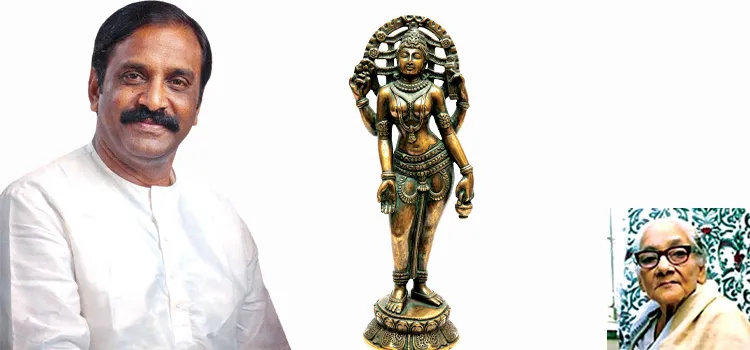
NEW DELHI: Tamil poet, novelist and lyricist R Vairamuthu received the 60th Jnanpith Award, for 2025, from the scholar and former Union minister Karan Singh, in New Delhi last month. The award – Rs 11 lakh, a citation and a bronze Vagdevi – came on his 73rd birthday. “The 60th Jnanpith has, as if, gifted me a vial containing 60 grams of amrit,” Vairamuthu said, speaking in Tamil with its essence relayed in Hindi. “But this amrit is not mine alone. It belongs to all the great literary figures who came before me.”
The honour makes him the third Tamil writer to receive India’s highest literary award, after the novelists Akilan in 1975 and Jayakanthan in 2002, and the first from the language honoured principally as a poet. “My school taught me the alphabet, while poverty gave me the light of wisdom,” he told the gathering. “Together, they made me a servant of literature.”
Origin of the award
The Jnanpith began as a present. In May 1961, on the fiftieth birthday of Sahu Shanti Prasad Jain – who with his wife Rama Jain founded Bharatiya Jnanpith in 1944 – the idea of a national literary prize was placed before him. Rama Jain convened writers at her Kolkata home that November, and close to 300 met in Delhi on April 2, 1962 to settle the scheme.
President Rajendra
Prasad was to chair the first selection board in March 1963, but died weeks earlier; Kaka Kalelkar took the chair. The first award, for 1965, went to the Malayalam poet G Sankara Kurup for Odakkuzhal – ‘The Bamboo Flute’. For seventeen years the Jnanpith honoured a single outstanding work; from the eighteenth award, in 1982, the board began weighing an author’s entire body of writing. English was admitted in 2013, and Amitav Ghosh became its first English laureate in 2018.
A submerged village
Vairamuthu was born on July 13, 1953 at Mettur, a hamlet of about sixty households in what was then Madurai district and is now Theni. In 1957, the family moved to Vadugapatti after the Vaigai dam project took their village – a submergence that became the subject of his best-known novel, Kallikkaattu Idhigasam, which won the Sahitya Akademi Award in 2003 and has since travelled into 22 languages.
He studied at Pachaiyappa’s College, Chennai, and began as a translator with the Tamil Nadu Official Language Commission. His first collection appeared in 1972, when he was 19. Bharathiraja brought him to films with Nizhalgal in 1980; more than 7,500 songs and poems later, he holds seven National Film Awards for Best Lyrics, more than any lyricist in the country, with the Padma Shri in 2003 and the Padma Bhushan in 2014.
Literature University
Reflecting on five decades of work, Vairamuthu placed four questions before the gathering: how to build a reading culture among the young, how to win Indian literature its global due, how to keep mother tongues alive in a technological age, and how to bind literature to everyday life. India has a university for every technology, he said; it should have one for literature.
Karan Singh, himself a former chairman of the selection board, called the award a symbol of India’s unbroken literary tradition and urged the young towards Indian languages. Board chairperson Pratibha Ray said Vairamuthu’s words were “deeply rooted in the soil of Tamil culture, yet they speak to universal human experiences”.
For seventeen years the Jnanpith honoured a single outstanding work; from the eighteenth award, in 1982, the board began weighing an author’s entire body of writing
THE AWARD AT SIXTY
In sixty awards since 1965 the Jnanpith has honoured 66 writers in 16 languages; six awards were shared, which is why the counts differ. Hindi leads with 12 laureates, Kannada follows with eight, Bengali and Malayalam have six each, Urdu five, and Marathi, Odia and Gujarati four each. Telugu, Assamese and Tamil have three each; Punjabi, Sanskrit and Konkani two; Kashmiri and English one.
Seven Eighth Schedule languages – Bodo, Dogri, Maithili, Manipuri, Nepali, Santali and Sindhi – await a first laureate. Ashapoorna Devi was the first woman honoured, in 1976; eight women have received it.
What the winner gets
The Jnanpith carries Rs 11 lakh, a citation and a bronze replica of Vagdevi, the goddess of learning, cast after the eleventh-century image from Dhar in Madhya Pradesh that now stands in the British Museum, London. The cash prize began at Rs 1 lakh in 1965. The award goes only to living Indian citizens, is never conferred posthumously, and no writer receives it twice.