




Blitz India Business
NEW DELHI: Measured by export value, the UAE dwarfs Mauritius. Measured by how much a trade deal widened the range of Indian products going out, Mauritius did three times as well — 20.9 per cent against 6.7.
Commerce Ministry data published on 18 August tracks a metric that rarely gets reported: the number of tariff lines on which India actually exports to a partner market, before and after an agreement. To the UAE, exported tariff lines rose from 7,546 in 2021-22 to 8,053 in 2025-26 — a 6.7 per cent widening. To Australia, from 5,396 in 2020-21 to 5,668 — 5.0 per cent. To Mauritius, from 3,593 in 2021-22 to 4,345 — 20.9 per cent. And to Oman, from 2,879 in May 2026 to 3,371 in June, the first month of the CEPA — 17.08 per cent.
Export value and export breadth are different things, and they reward different firms. Value concentrates: a handful of large exporters in petroleum products, gems and engineering goods can lift a country’s total without a single new business entering the market. Breadth is what tells you whether the agreement reached anyone new.
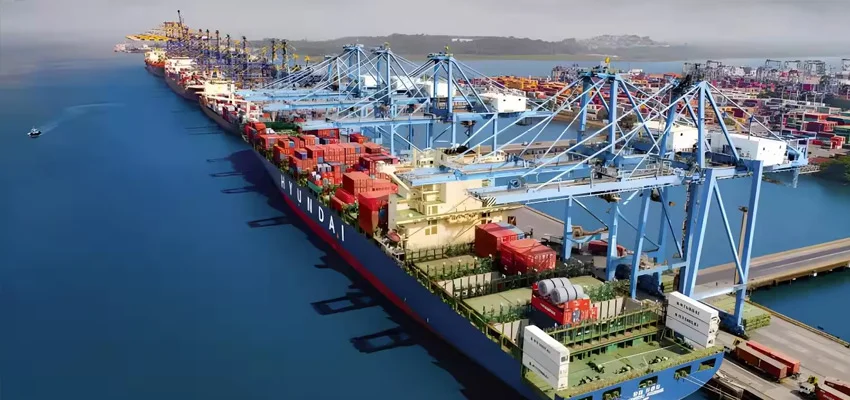
Where the basket is loaded: container handling at Jawaharlal Nehru Port, Nhava Sheva. A widening tariff-line count means more distinct products leaving — which usually means more distinct exporters, not larger ones.
A small market with a broad basket is a better test of an agreement than a large market with a narrow one. Mauritius is the small market that passed it.
At a Glance
• Source: Ministry of Commerce & Industry, published 18 August 2026
• Mauritius: 3,593 lines (2021-22) → 4,345 — up 20.9 per cent
• Oman: 2,879 (May 2026) → 3,371 (June 2026) — up 17.08 per cent
• UAE: 7,546 (2021-22) → 8,053 — up 6.7 per cent
• Australia: 5,396 (2020-21) → 5,668 — up 5.0 per cent
• Mauritius CECPA: preferential access on 310 Indian product lines
• Certificates of origin: EFTA TEPA 7,885 since October 2025 · Oman CEPA 783 since June 2026
Two mechanisms explain the spread, and both are administrative rather than commercial. The first is the base effect: a market that started from 3,593 lines has more room to widen proportionally than one starting from 7,546, and the Mauritius figure should be read with that caution. The second is genuinely instructive — the newer agreements were written with smaller exporters in mind. The India-EFTA TEPA and India-UK CETA both allow origin to be established by self-declaration rather than a chamber-issued certificate. CETA additionally accepts importer’s knowledge and waives origin documentation entirely on consignments below £1,000. The India-Australia ECTA permits multiple qualifying products on a single certificate of origin. Each of those provisions removes a fixed cost, and fixed costs are what keep small consignments out of preferential trade.
Behind them sits e-CoO 2.0, which issues preferential and non-preferential certificates end-to-end digitally, with Aadhaar-based electronic signatures and QR-code verification, on a common platform for exporters, issuing agencies and chambers. Trade Connect’s Tariff Explorer completes the set by letting an exporter see the applicable schedule before committing to a shipment. For an MSME, the practical question is no longer whether preference exists but whether claiming it costs less than the duty saved — and on a small consignment that calculation has only recently turned positive. The disclosure that would settle the matter is a utilisation rate: preferential exports as a share of eligible exports, by agreement and by exporter size. Until that is published, breadth is the best proxy available — and by that proxy, the newest and smallest agreements are outperforming the largest.