





Rail capex of ₹20,804 cr buys 74 MTPA
New Delhi, 9 September For anyone costing a warehouse on the Bilaspur–Katni run or a container terminal near Kazipet, the number that matters from 9 September 2026 is not the headline outlay. It is 74 million tonnes per annum — the additional freight capacity the Cabinet Committee on Economic Affairs bought that afternoon for ₹20,804 crore across eight multitracking projects.
The approvals came in two decisions. The first, in the Cabinet Committee on Economic Affairs release of 9 September 2026, covers three projects at ₹10,783 crore — the Kharagpur–Jharsuguda (Bagdehi) fourth line, the Katni–Pendra Road fourth line and the Bilaspur (Uslapur)–Pendra Road third line — adding about 656 kilometres across fourteen districts of West Bengal, Jharkhand, Odisha, Madhya Pradesh and Chhattisgarh, and 27 MTPA of freight capacity. The second covers five projects at ₹10,021 crore adding about 540 kilometres across seventeen districts of Tamil Nadu, Andhra Pradesh, Karnataka and Telangana, and 47 MTPA: Arakkonam–Renigunta third and fourth lines (77 km), Whitefield–Bangarpet third and fourth lines (47 km), Hosur–Omalur doubling (147 km), Salem–Karur–Dindigul doubling (159 km) and Secunderabad (Ghatkesar)–Kazipet multitracking (110 km). Both packages are planned for completion by 2029-30.
Blitz has summed the legs, because neither release does. Total outlay ₹20,804 crore; total track 1,196 kilometres; thirty-one districts; nine states. The legs sum exactly to the announced whole — worth recording, since a two-document approval is precisely where a rounded figure travels unnoticed from one release into a headline on the other.
The unit economics are the story. At ₹20,804 crore for 1,196 kilometres the sanction prices at ₹17.39 crore per kilometre. Read that against what the same money buys as greenfield line and the case for capacity augmentation on existing alignment makes itself: no fresh land acquisition, no new rehabilitation liability, no fresh environmental clearance chain, and traffic already proven on the corridor. The corridors carry coal, cement, iron and steel, containers, automobiles, grain, petroleum products and fertiliser — the freight that sets input costs for the manufacturing sector rather than the freight that follows it.
Two more figures belong in the working. The two packages together are expected to reduce oil imports by about 20 crore litres and carbon dioxide emissions by about 104 crore kilograms, which the Railways scores as equivalent to planting 4.48 crore trees. For a corporate buyer of rail freight, that emissions figure is not decoration — it is scope-3 accounting that becomes reportable as customers move goods off road.
Briefing the media after the meeting, the Information and Broadcasting Minister, Shri Ashwini Vaishnaw, said the Cabinet had also approved four-laning of seven high-density corridors including Delhi–Mumbai, Mumbai–Chennai, Chennai–Kolkata and Kolkata–Delhi, which carry about forty per cent of railway traffic, and that four-laning of about two thousand kilometres has already been completed, as reported by Akashvani News on 9 September 2026.
BLITZ DATA CARD
- Eastern package — ₹10,783 crore · 656 km · 14 districts · 27 MTPA
- Southern package — ₹10,021 crore · 540 km · 17 districts · 47 MTPA
- Completion target — 2029-30 · framework: PM Gati Shakti National Master Plan
- The comparison — Freight capacity added, drawn to scale: Southern (47 MTPA)
- Eastern (27 MTPA)
- Derived difference: The southern package adds 74.1 per cent more freight capacity than the eastern (47 − 27 = 20; 20 ÷ 27 = 74.1%) — on 17.7 per cent
- Combined outlay: ₹10,783 crore + ₹10,021 crore = ₹20,804 crore
- Combined track: 656 km + 540 km = 1,196 km
- Cost per kilometre: ₹20,804 crore ÷ 1,196 km = ₹17.39 crore per km
- Cost per MTPA of freight capacity: ₹20,804 crore ÷ 74 MTPA = ₹281 crore per MTPA
- Southern package cost per MTPA: ₹10,021 crore ÷ 47 = ₹213 crore; Eastern: ₹10,783 crore ÷ 27 = ₹399 crore
- What India gains: Freight capacity at ₹281 crore per million tonnes a year on corridors already carrying coal, steel and cement — capacity that lands in 2029-30 without a single fresh land acquisition, and cuts an estimated 20 crore litres from the oil import bill.
India joins twenty nations on 6G
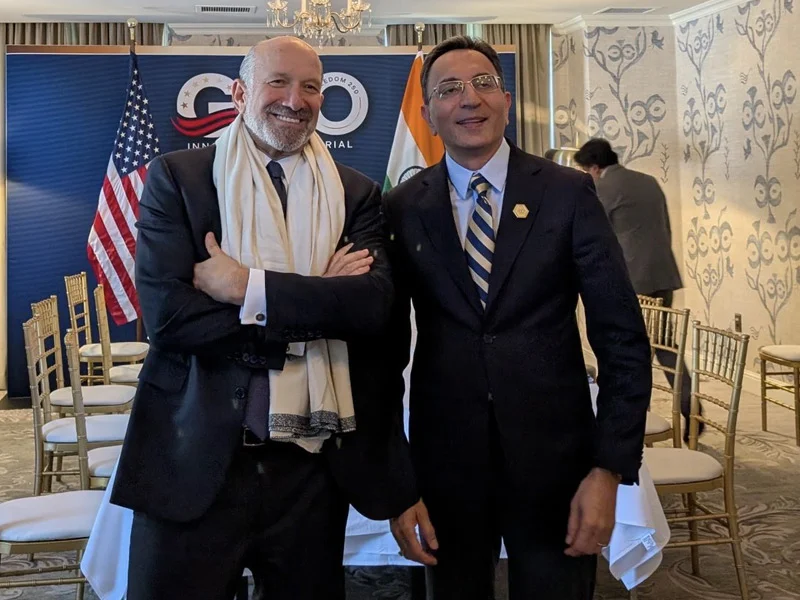
New Delhi, 9 September India has endorsed the Call to Action for 6G Leadership and Security, joining more than twenty like-minded governments, the Ministry of Communications said on 9 September 2026, with the Department of Telecommunications to carry the commitment forward. The number in that release with a rupee value attached to it is the target: ten per cent of global 6G standards and patents.
That is a royalty position, not a policy aspiration. Standard-essential patents are the mechanism by which a share of every handset and every base station sold worldwide is collected by whoever holds them, and India has historically been on the paying side of that ledger. The endorsement was announced on the margins of the G20 Innovation Ministerial at Chapel Hill, North Carolina, on 1–2 September 2026. Governments named in the release as having affirmed the Call to Action include Canada, Czechia, Denmark, Estonia, France, Germany, Greece, Italy, Japan, Latvia, Norway, the Republic of Korea, Romania, Sweden, the United Kingdom and the United States. Each participating government must within one month name 6G expert points of contact, designate a coordinating agency and list its industry and academic stakeholders.
Palghar firm to print bone grafts
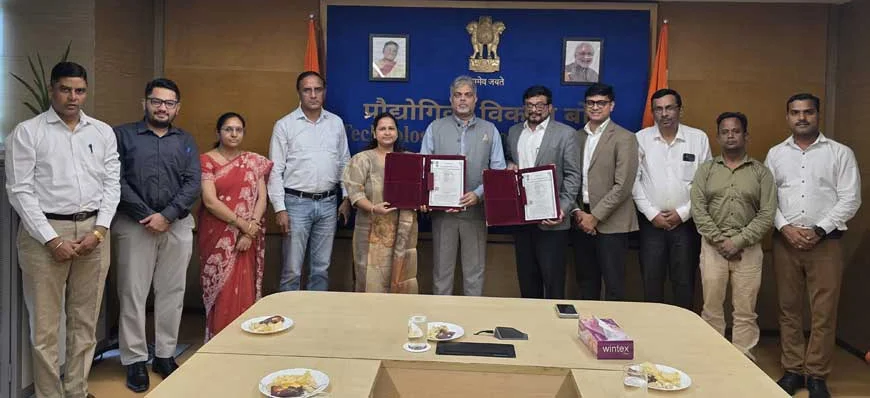
New Delhi, 9 September The Technology Development Board under the Department of Science and Technology has funded Ceramat Private Limited of Palghar, Maharashtra, to commercialise 3D-printed calcium phosphate bone grafts, both standard and patient-specific, the Board announced on 9 September 2026.
The commercial logic is import substitution in a high-margin niche. According to the release, a significant share of advanced bone graft products available in India is currently imported; Ceramat already makes grafts and granules by conventional processes, and the funded project adds digital light processing and extrusion-based 3D printing on indigenous bioceramic raw material — hydroxyapatite, beta-tricalcium phosphate, biphasic calcium phosphate and bioactive glass. Custom grafts matched to a patient’s anatomy are the harder manufacturing problem and the better-priced product. The Board’s Secretary, Shri Rajesh Kumar Pathak, framed the wider point: moving from technology consumer to technology developer requires indigenous capability precisely in the specialised, high-value corners of healthcare.
UPI now runs in eleven countries
Mumbai, 9 September At the Global Fintech Fest 2026 in Mumbai, which opened on 8 September 2026, the Prime Minister said the Unified Payments Interface is now live in eleven countries and put August’s volume at over 24 billion UPI transactions, as reported by Akashvani News on 9 September 2026. He asked the industry to integrate UPI with the domestic payment systems of partner countries, as has been done with Singapore, wherever large Indian populations live or substantial trade occurs.
For payment companies the addressable market in that instruction is remittance, not retail. India is the world’s largest remittance-receiving economy, and cross-border transfer costs remain a multiple of domestic ones. Every basis point taken out of that spread is value that stays with the household, and volume that moves onto rails India owns rather than rails it rents.
India enters eleven new WorldSkills trades
Bureau New Delhi, 9 September India will compete in eleven skill categories for the first time at the 48th WorldSkills Competition in Shanghai from 22 to 27 September 2026, entering 63 of the 64 skills with about seventy competitors, the Ministry of Skill Development and Entrepreneurship said on 9 September 2026.
The list reads as a labour-supply signal rather than a medals table: dental prosthetics, digital interactive media design, intelligent security technology, landscape gardening, optoelectronic technology, retail sales, unmanned aerial systems, industrial mechanics, software testing, heavy vehicle technology and aircraft maintenance. The preparation partners are largely private — Titan Company Limited–Tanishq, Croma, Shoppers Stop, Reliance Trends, Sany Heavy Industry India, Bennett University, NAMTECH Gandhinagar and the Government Tool Room and Training Centre, Karnataka — which is the more interesting fact: employers are certifying the standard they will later hire against. India ranked 29th at WorldSkills in 2015 and 13th in 2024.
India launches own ocean research vessel
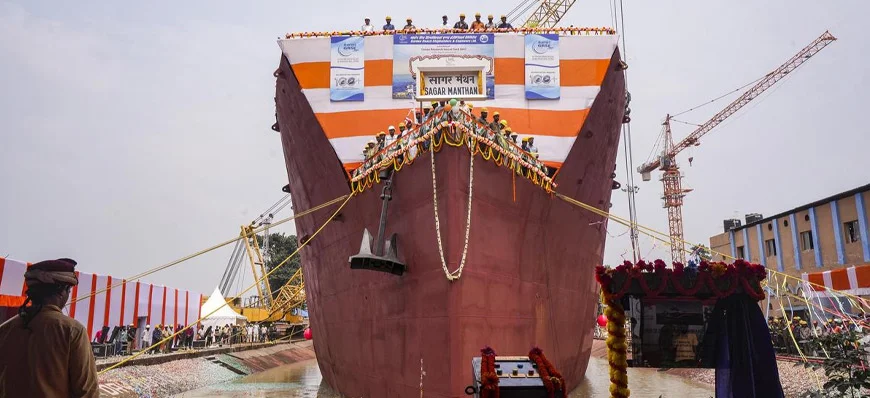
Kolkata, 9 September : ORV Sagar Manthan, India’s first advanced ocean research vessel designed, engineered and built in the country, was launched at the Rishi Bankim shipyard, Kolkata, on 9 September 2026 by Garden Reach Shipbuilders and Engineers, for the National Centre for Polar and Ocean Research under the Ministry of Earth Sciences.
Built at about ₹840 crore under Vertical-4 of the Deep Ocean Mission, the all-weather vessel is rated for a thirty-year service life and designed for extreme seas including the Southern Ocean. The delivery record is the part a shipyard is judged on: the Union Minister, Dr Jitendra Singh, noted the launch came within two years of contract signature and five months of keel laying. It will progressively replace ORV Sagar Kanya, bought from Germany in 1983. The Secretary, Dr T. Srinivasa Kumar, said the vessel will carry multibeam survey, geophysical profiling, atmospheric observation and water-column sampling at sea, and that building it at home places India among the few countries able to design such a platform.
Amino acid brightens green hydrogen route
Bengaluru, 9 September : The cost problem in solar hydrogen is the catalyst. Almost every working photocatalyst depends on an inorganic semiconductor or a precious metal — expensive to buy, complex to fabricate, and traded in markets where India holds no position. A team at the Centre for Nano and Soft Matter Sciences, Bengaluru, an autonomous institution under the Department of Science and Technology, has demonstrated a metal-free alternative.
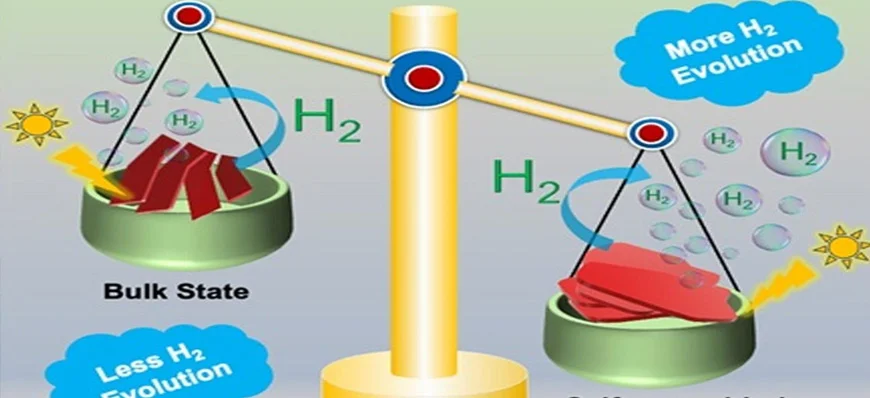
According to the Department of Science and Technology release of 9 September 2026, the researchers linked a naturally occurring amino acid, aspartic acid, to a light-absorbing organic molecule, perylene diimide, and allowed supramolecular self-assembly to organise the result in water into ordered two-dimensional nanosheets. Without any change to the molecule’s chemical structure, the self-assembled form delivered about eighteen per cent more photocurrent than the bulk material during solar-driven water splitting — through wider light absorption, better charge separation, lower energy losses and greater catalytic surface area.
The work was led by Dr Gautam Ghosh and Dr Ashutosh K. Singh with Shri Sourav Moyra, Shri Kumar Shubham and Ms Athira Chandran M., published in the Journal of Materials Chemistry A of the Royal Society of Chemistry (https://doi.org/10.1039/d6ta04378j). This is a laboratory photocurrent measurement, not a plant, and it should be read as one. But the commercial reading is clear enough: if organisation rather than composition can be made to do the work, the green hydrogen cost curve stops running through platinum and iridium — which is where the import bill on any Indian electrolyser programme currently sits.
NHAI ties completion to surviving saplings
New Delhi, 9 September 2026 : Concessionaires and EPC contractors on national highway projects have a new condition precedent to their completion certificate, and it is a horticultural one. The National Highways Authority of India issued comprehensive guidelines on 9 September 2026 making median and avenue plantation an integral part of highway development and of project completion.
The Authority states its own finding in the release: plantation along medians and avenues, though a contractual obligation, was often not given due weight when provisional completion certificates were issued. The remedy is a threshold. A provisional completion certificate or provisional commercial operation date now requires that at least eighty per cent of the right of way earmarked for plantation has been planted and that survival is at least ninety per cent at inspection. Shortfalls above the eighty per cent line must be flagged with a specific timeline, and appropriate financial deductions under the contract or concession agreement apply until the balance is complete.
The exposure continues into operations. Release of O&M or annuity payments in EPC, hybrid annuity and BOT-annuity projects, and assessment of maintenance compliance in BOT-toll projects, will depend on maintaining at least ninety per cent survival through the O&M period, with dead saplings replaced by plants of similar age and growth. NHAI will take technical assistance from an appointed environment and plantation expert to verify field compliance before certifying maintenance or processing annuity. The underlying requirements are not new — the Green Highways Policy of 2015 and IRC:SP:21-2009 already applied. What is new is the number at which money is withheld, and that changes how the obligation is priced into a bid.