





Gauba calls for end to Licence Raj
New Delhi, 10 September For a manufacturer, the cost of regulation is not the rule. It is the renewal: the same permission sought again every year, at a counter, with a fee and a wait. Shri Rajiv Gauba, Member of NITI Aayog, addressed exactly that on 10 September 2026 at the Global Fintech Fest 2026, in a fireside chat the NITI Aayog release of that date titles “From Regulation to Transformation: Building India’s Next-Generation Reform Architecture”.
The next-generation reform architecture, he said, should be defined by deregulation, with the focus on “nuts-and-bolts” reform — doing away with the licence, approval and permission regime and its frequent renewals, which prevails in different avatars — and on a systematic review of laws, regulations and administrative processes. That review is being carried out by a High-Level Committee, guided by the philosophy of trust-based governance.
The structurally important part of the argument is about jurisdiction. Many important reforms, Shri Gauba noted, fall in the domain of States and municipal governments, and a Deregulation Task Force is carrying trust-based governance principles down to State and city level. He characterised the Centre’s approach, citing the scheme for Special Assistance to States for Capital Investment and the Urban Challenge Fund, as “cooperative federalism with a competitive edge” — scheme incentives linked to reform milestones, projects selected in challenge mode. Read as a financing instrument, that is conditionality: a State that clears a reform milestone unlocks capital.
Looking back, he cited the Goods and Services Tax, the Insolvency and Bankruptcy Code and a liberalised foreign investment regime as measures that reshaped the economy and opened sectors once off-limits to private enterprise — defence, space and now nuclear energy.
For the fintech audience the message was about regulatory design. India’s digital public infrastructure — Aadhaar, UPI, DigiLocker, the account aggregator framework — was described as a model in which government lays open, secure and interoperable rails and private enterprise builds on them. Regulation in technology-driven sectors, he said, should be principles-based, technology-neutral and proportionate to risk, promoting competition, ensuring non-discriminatory access to underlying infrastructure and improving information symmetry. He called for greater coordination among financial regulators, simpler and more predictable compliance, and continued work on frictions and interoperability gaps. On capital, he pointed to fair treatment, predictable policy, data governance, cybersecurity and room for innovation as what long-term domestic and foreign investors are actually buying.
What India gains is compliance cost taken out of the cost base of every firm too small to keep a compliance department.

PMMSY approval pipeline tops ₹21,000 cr
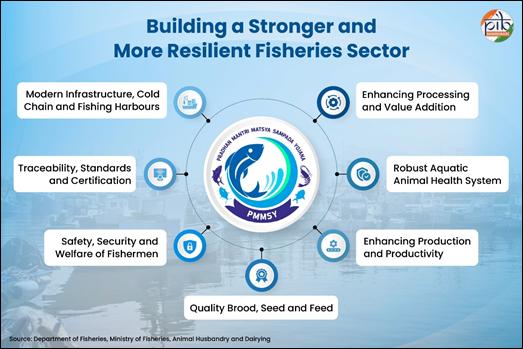
New Delhi, 10 September The Pradhan Mantri Matsya Sampada Yojana completes six years on 10 September 2026. The Press Information Bureau backgrounder of that date carries the operating numbers, and the ratio worth extracting is one it does not print.
The scheme’s outlay since 2020-21 is ₹20,750 crore. Projects approved from 2020-21 to 2025-26, as of 11 August 2026, total ₹21,394.88 crore, of which the Central share is ₹9,510.89 crore. Blitz has taken the two ratios: the Centre is carrying 44.45 per cent of the approved cost, leaving ₹11,883.99 crore to States, Union Territories, implementing agencies and beneficiaries; and total approvals now stand at 103.11 per cent of the scheme’s own outlay. For a lender or an equipment supplier, that second figure is the useful one — the co-financing is real, and the pipeline is larger than the Union line item suggests.
On output: fish production rose from 141.64 lakh tonnes in 2019-20 to 197.75 lakh tonnes in 2024-25, an increase of 56.11 lakh tonnes or 39.6 per cent, which compounds at about 6.9 per cent a year. Exports rose from ₹46,663 crore in 2019-20 to ₹73,890 crore in 2025-26 — up ₹27,227 crore, or 58.3 per cent. Export value has therefore grown faster than volume, which is the direction a value chain is supposed to move.
The infrastructure lines: ₹2,797 crore approved for cold-chain and marketing infrastructure, and 2,195 Fish Farmer Producer Organisations supported through projects worth ₹544.86 crore — about ₹24.8 lakh per organisation, a ticket size that indicates working assets rather than working capital. The Budget Estimate for 2026-27 is ₹2,500 crore, a record for the scheme. The sector sustains nearly three crore livelihoods, and the scheme records employment for 58 lakh — a fifth of the total.
The unit economics show up best in a single case the backgrounder carries. In Porbandar, Mr Pravinbhai Babulal Masani received a ₹48 lakh subsidy in 2021-22 and built a 30-tonne-a-day ice plant. Ice is the binding constraint on marine value realisation: without it the catch is sold at the landing price, with it the catch reaches a market.
What India gains is a resource that renews itself earning ₹73,890 crore abroad, and a coastal capital stock being built with State and private money alongside Union money.
BLITZ DATA CARD: THE RECORD
- Outlay since 2020-21: ₹20,750 crore
- Approvals to 11 August 2026: ₹21,394.88 crore
- Central share: ₹9,510.89 crore
- BE 2026-27: ₹2,500 crore
- Cold chain: ₹2,797 crore
- FFPOs: 2,195 through ₹544.86 crore
- Production 2019-20: 141.64 lakh t
- 2024-25: 197.75 lakh t
- Exports 2019-20: ₹46,663 crore
- 2025-26: ₹73,890 crore
- Employment: 58 lakh
- Sector livelihoods: about 3 crore
THE COMPARISON
Central share — ₹9,510.89 crore
States, agencies and beneficiaries — ₹11,883.99 crore
Difference: the non-Union share is 24.9 per cent larger.
WHAT INDIA GAINS
₹73,890 crore of export earnings and 58 lakh jobs from a renewable resource, built on capital that is majority non-Union.
India takes the BRICS chair into a summit this weekend
New Delhi, 10 September India hosts the 18th BRICS Summit in New Delhi on 12 and 13 September 2026 under the theme “Building for Resilience, Innovation, Cooperation and Sustainability”, its fourth chairship, according to the Press Information Bureau backgrounder of 10 September 2026.
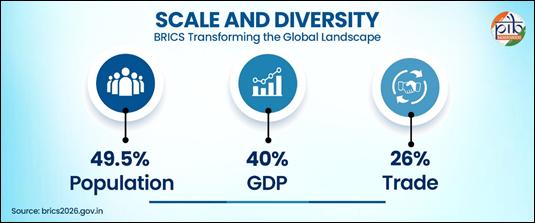
The bloc’s weight, as the backgrounder records it: eleven members — Brazil, China, Egypt, Ethiopia, India, Indonesia, Iran, Russia, Saudi Arabia, South Africa and the United Arab Emirates — holding 49.5 per cent of world population, 40 per cent of global gross domestic product and 26 per cent of global trade.
Blitz has taken the ratios the document does not. BRICS trade is 0.65 of its output share and 0.53 of its population share. Fourteen percentage points separate what these economies produce from what they trade. For an Indian exporter that gap is not a statistic; it is a set of markets in the same bloc that are not yet buying — and the standard reasons are the ones a summit can actually move: payment rails, certification recognition, shipping and customs.
The membership itself is a trade fact. The expansion drew in oil producers (Iran, Saudi Arabia, the UAE), African economies (Egypt, Ethiopia) and a South-East Asian partner (Indonesia), which is to say it added energy suppliers and transhipment geography to a grouping that began as four large emerging markets. The backgrounder’s own history notes the acronym was coined in 2001 in an investment bank’s economics paper, with South Africa joining in 2010 to make BRICS.
What India gains from the chair is the agenda. The backgrounder places development, sustainability, innovation and the aspirations of the Global South at the centre of the presidency — and the chair decides which of the four gets the drafting time.
LPG booking rule made uniform
New Delhi, 10 September The Ministry of Petroleum and Natural Gas has prescribed a uniform inter-refill booking gap of 25 days for all domestic LPG consumers, including rural consumers, effective immediately, according to its release of 10 September 2026.
The measure it replaces was introduced in February 2026, when, the Ministry records, in view of the outbreak of conflict in West Asia it prescribed booking timelines of 25 days in urban areas and 45 days in rural areas as a temporary demand-management step. The Ministry states that the revision follows from the present LPG supply position and a considerable reduction in refill backlogs compared with the position when the measure was introduced.
For the distribution business, the operative variable is the backlog. A booking interval is a demand-throttling instrument: lengthening it defers refill demand into a later period without formally rationing. Withdrawing the rural differential signals that the bottling and last-mile logistics position has normalised enough to carry the deferred volume, and distributors serving rural territories should expect refill demand to normalise on a 25-day cycle rather than a 45-day one.
What India gains is the demonstration that a temporary supply measure was administered as temporary, and withdrawn when the position allowed.
NIELIT expands industry partnerships
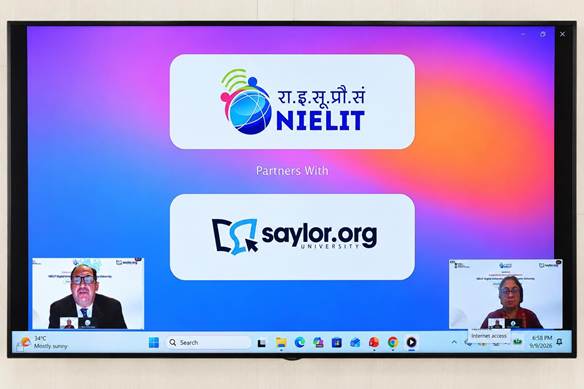
New Delhi, 10 September The National Institute of Electronics and Information Technology integrated Saylor University’s digital learning resources into its NIELIT Digital University platform, and exchanged memoranda with eight organisations, at an event at the Ministry of Electronics and Information Technology in New Delhi, according to the Ministry’s release of 10 September 2026. Shri S. Krishnan, Secretary of the Ministry, was Chief Guest and inaugurated the collaboration.
The partner list is the commercially interesting part: the Confederation of Indian Industry, NASSCOM, the Electronics Sector Skills Council of India, Pearson India Education Services, Stemlore Innovators, Dassault Systèmes, ABES Engineering College, and Kavayitri Bahinabai Chaudhari North Maharashtra University at Jalgaon. Read as a supply chain, that covers demand signalling (CII, NASSCOM), standards and certification (ESSCI), content and assessment (Pearson), engineering software the employer actually uses (Dassault Systèmes), and two delivery institutions, one private and one State-run.
For an employer, a national platform that carries an internationally recognised course library alongside Indian certification lowers the cost of verifying what a candidate knows. Shri Krishnan described the collaborations as steps towards strengthening India’s digital skilling ecosystem, fostering industry–academia linkages and expanding access to technology-enabled, industry-relevant learning.
What India gains is a single verification point for digital skills, which is what a hiring manager is really buying when they ask for a certificate.
Basmati centre tackles export compliance
Pilibhit, 10 September Jitin Prasada, Union Minister of State for Commerce and Industry and for Electronics and Information Technology, laid the foundation stone of the BEDF Basmati and Organic Training Centre cum Demonstration Farm at Tanda Bijeshi, Pilibhit, according to the Ministry of Commerce and Industry release of 9 September 2026. It is a joint project of the Agricultural and Processed Food Products Export Development Authority and the Basmati Export Development Foundation.
The export economics are the reason it exists. Basmati is rejected at destination on residue limits and varietal compliance rather than on price, and a rejected consignment is a total loss borne somewhere in the chain. The centre is to demonstrate notified basmati varieties and production technologies, insect-pest and disease management, organic cultivation and organic inputs, and integrated pest and nutrient management. Shri Abhishek Dev, Chairman of the export authority, said it would give farmers access to improved seeds, quality standards, testing facilities, packaging and export procedures.
Uttar Pradesh is a prominent basmati-producing State and a key contributor to basmati exports; the release places it seventh nationally in organic production and eighth in area under organic cultivation. The organic ranking sitting below the basmati position is where the margin opportunity lies, since organic certification is the premium most readily available to a basmati grower already meeting export standards.
What India gains is fewer rejected consignments — which is the cheapest possible way to raise realised export value.
Mapping deep-sea life before mining
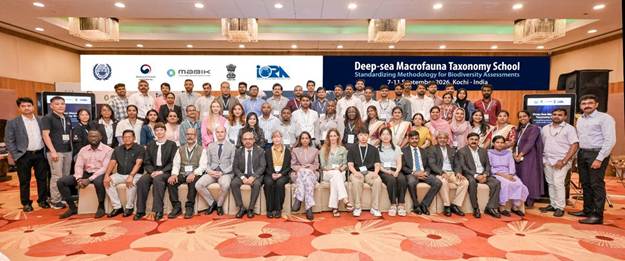
Kochi, 10 September The Centre for Marine Living Resources and Ecology, under the Ministry of Earth Sciences, is running the “Deep-sea Macrofauna Taxonomy School: Standardizing Methodologies for Biodiversity Assessments” in Kochi from 7 to 11 September 2026, according to the Ministry’s release of 9 September 2026. It is held under the Sustainable Seabed Knowledge Initiative of the International Seabed Authority, with the Indian Ocean Rim Association and the National Marine Biodiversity Institute of Korea.
The commercial subtext of seabed taxonomy is deep-sea mining. Any future licensing regime for seabed minerals will rest on baseline biodiversity assessments, and an assessment is only usable if the method behind it is one the regulator accepts. Whoever trains the assessors influences the method, and the method sets what a mining application must prove.
About 30 early-career researchers from member states in the Indian Ocean region are taking part, including from South Africa, Kenya, Bangladesh, Mauritius, Malaysia, Indonesia, Singapore and Sri Lanka. Ms Leticia Carvalho, Secretary-General of the International Seabed Authority, was Chief Guest. Dr R. Maheskumar, Head of the Centre, gave the welcome address; Dr G. Dharani, Scientist-G and Head of the Marine Biotechnology Division at the National Institute of Ocean Technology, Chennai, lectured on biodiversity work under the Deep Ocean Mission; and Dr Baban Ingole, formerly of the National Institute of Oceanography, Goa, gave a keynote on benthic studies in the Indian Ocean.
What India gains is standard-setting influence in a resource frontier that has not yet been allocated.
Green Mission lacks carbon measurement
New Delhi, 10 September The Comptroller and Auditor General’s Performance Audit Report No. 4 of 2026 on the Green India Mission was tabled in Parliament on 12 August 2026. The auditor’s own press release of 13 August 2026 records that the audit examined planning, implementation and monitoring across the 16 States and Union Territories for which the Ministry of Environment, Forest and Climate Change approved physical and financial targets between 2015-16 and 2024-25.
The finding that carries an actionable lesson concerns measurement. No State except Madhya Pradesh and Chhattisgarh conducted any assessment of carbon sequestration between 2015 and 2025 — two of sixteen, or 12.5 per cent, a share the auditor’s release does not compute. In those two States, the auditor records, improper planning by the Indian Council of Forestry Research and Education for the maintenance and upkeep of the installed flux towers led to the infrastructure idling, after expenditure of ₹3.50 crore.
For anyone financing nature-based carbon, that is the sentence that matters. A carbon credit is only saleable if the sequestration behind it is measured to a standard a buyer accepts, and flux towers are the measuring instrument. Capital expenditure on the tower is a fraction of the value of the measurement stream it produces; without an operations-and-maintenance line, the asset produces nothing.
On funding, the auditor records that against ₹2,000 crore approved by the Cabinet Committee on Economic Affairs from the 12th Plan for the scheme’s first four years, together with ₹400 crore from 13th Finance Commission grants towards the States’ share, ₹1,149.14 crore was received through budgetary support over ten years — put at 47.88 per cent. Blitz has recomputed it: ₹1,149.14 crore of ₹2,400 crore is 47.88 per cent, and the two legs sum to the published total. The release also records that the lack of convergence with CAMPA, MGNREGS and other afforestation work meant ₹10,600 crore of proposed funding support was not secured. The report is before Parliament, where the Ministry’s response forms part of the process; Blitz presents no finding in it as settled.
What India gains is a costed lesson: the measurement infrastructure exists and works, and what it needs is an upkeep budget rather than fresh capital.