




Blitz India Business
NEW DELHI: Bharat Taxi’s unit economics were published in detail today. For once, a zero-commission claim comes with the ledger attached.
A government research backgrounder issued this afternoon sets out the financial architecture of Bharat Taxi, India’s first cooperative-led ride-hailing platform, registered under the Multi-State Cooperative Societies Act, 2002 and established on 6 June 2025 by eight national cooperative institutions — NCDC, IFFCO, NABARD, KRIBHCO, Amul’s GCMMF, NAFED, NDDB and NCEL. The model: no commission, no surge pricing, and no platform or convenience fee in the app. Of the cooperative’s earnings, 20 per cent is credited into Bharat Taxi as the driver-members’ own capital and 80 per cent is distributed among them on the basis of kilometres run. A 7 per cent service charge applies only at prepaid booths that Bharat Taxi itself operates at airports, to meet operating costs.
The ownership arithmetic is equally explicit. Shares are ₹100 each and ₹500 buys ownership rights, so the entry ticket to becoming a member-owner is the price of roughly a day’s fuel. Board seats are reserved for driver-members. As on 25 July 2026 the platform reported about 8 lakh registered drivers — called Sarathis — and about 41 lakh registered customers, operating in Delhi-NCR, Gujarat, Lucknow, Chandigarh, Mumbai, Jaipur, Kanpur and Pune. Jaipur is the density test case, with more than 30,000 Sarathis and about 7 lakh customers in a single city. Ranchi, Patna, Guwahati, Bhopal, Kolkata, Indore and Nagpur are named for the coming months, with nationwide coverage targeted by 2029.
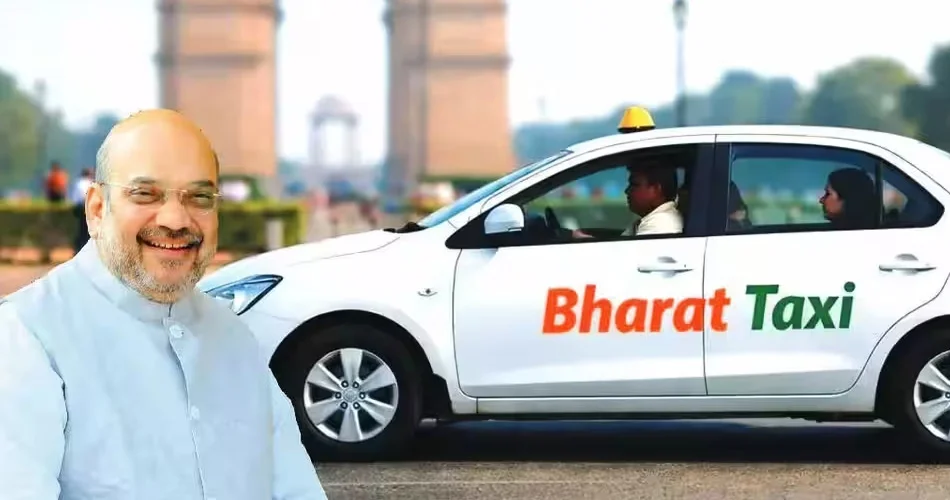
The contested market: taxis and autorickshaws in an Indian city. Bharat Taxi’s categories span two-wheeler, autorickshaw, economy cab, premium sedan, XL SUV, rentals, outstation and scheduled rides.
No surge revenue is a promise to the driver and a constraint on the balance sheet. Peak pricing is how venture-funded platforms pay for market entry.
At a Glance
• Established: 6 June 2025, Multi-State Cooperative Societies Act, 2002
• Founders: NCDC, IFFCO, NABARD, KRIBHCO, GCMMF (Amul), NAFED, NDDB, NCEL
• Commission: nil · Surge pricing: none · App fees: none
• Earnings split: 20 per cent to driver capital, 80 per cent by kilometres run
• Service charge: 7 per cent, airport prepaid booths only
• Share price: ₹100 · Ownership entry: ₹500
• Governance: board seats reserved for driver-members
• As on 25 July 2026: about 8 lakh Sarathis, about 41 lakh customers
• Jaipur: over 30,000 Sarathis, about 7 lakh customers
• Cities live: Delhi-NCR, Gujarat, Lucknow, Chandigarh, Mumbai, Jaipur, Kanpur, Pune
• Cities next: Ranchi, Patna, Guwahati, Bhopal, Kolkata, Indore, Nagpur
• Nationwide target: 2029
• Social security: e-Shram linkage; AB-PMJAY cover to ₹5 lakh; ₹5 lakh accident cover via IFFCO Tokio
The commercially interesting question is how a zero-commission, surge-free platform funds growth. Conventional ride-hailing pays for city entry out of platform commission and peak pricing; strip both out and the capital has to come from somewhere else. Bharat Taxi’s answer is institutional: eight national cooperatives as promoters, an internal capital pool built from the 20 per cent retention, and a partnership stack that substitutes for spend — Delhi Traffic Police, Delhi Metro Rail Corporation, Airports Authority, IFFCO Tokio, State Bank of India and Paytm, plus a National e-Governance Division agreement enabling DigiLocker, UMANG and API Setu integration for paperless onboarding. Agreements with Delhi Tourism and Transportation Development Corporation and Delhi Airport Parking Services allow white cab operations at Indira Gandhi International Airport terminals.
The driver-side proposition is where the model is strongest, and it is worth costing. Sarathis are helped onto the e-Shram portal, which makes the driver and family eligible for treatment up to ₹5 lakh under Ayushman Bharat-PM Jan Arogya Yojana; ₹5 lakh personal accident cover is available at nominal rates through IFFCO Tokio; and group health cover is supported through Paytm. For a driver comparing platforms, the correct calculation is not the commission saved alone but commission plus insurance plus the retained capital claim — and on that basis a ₹500 share is a low-cost option on a growing book. The honest constraint remains funding the run to 2029 in cities where incumbents will defend share on price. The metric that will tell the story is not registered Sarathis but active Sarathis per city per month, and it is the number the cooperative would do well to publish.