




Blitz India Business
NEW DELHI: India exported US$441.8 billion of goods and US$421.3 billion of services in 2025-26. Services are 48.8 per cent of the total — and almost none of it moves through a port.
The record export figure for 2025-26 is US$863.1 billion, combining merchandise and services. Split it and the composition is the story: merchandise US$441.8 billion, services US$421.3 billion. Services account for 48.81 per cent of everything India sold to the world last year, and for close to 30 per cent of Indian employment. On current growth the two halves will cross.
Trade policy has not caught up with that arithmetic, for an understandable reason: goods trade is measurable at a customs frontier and services trade largely is not. A container is counted. A software deliverable, a remote radiology read, a design review or an architect’s stamp crosses no frontier that anyone weighs.
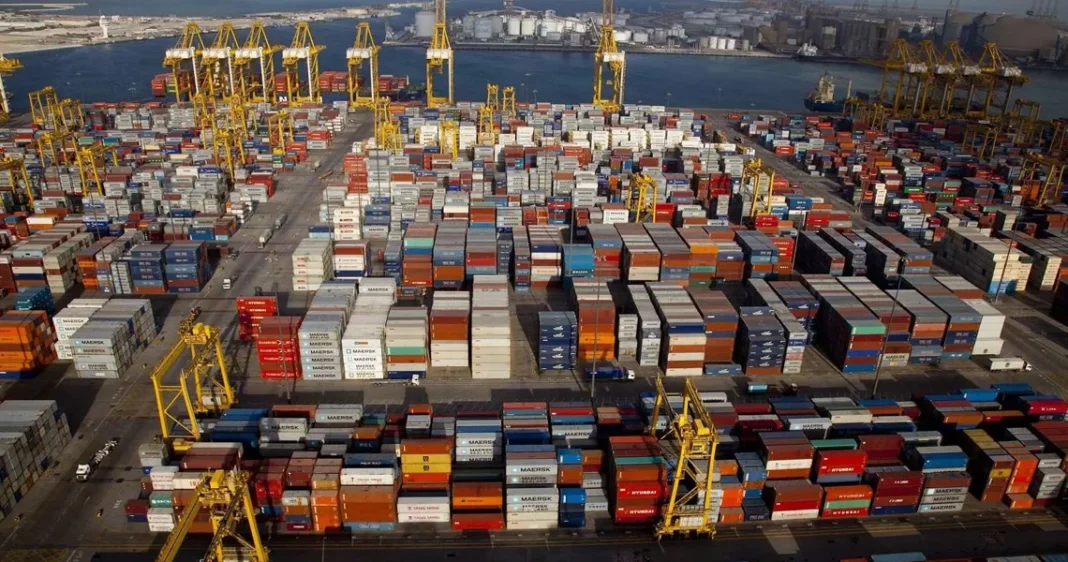
The half that gets photographed: container operations at Jebel Ali Port. Merchandise was US$441.8 billion of India’s US$863.1 billion export year — the other US$421.3 billion left the country without a bill of lading.
A tariff schedule is negotiated line by line and published. A services commitment is a list of sub-sectors, and nobody publishes how many firms actually used it.
At a Glance
• Total exports 2025-26: US$863.1 billion — a record
• Merchandise: US$441.8 billion (51.2 per cent)
• Services: US$421.3 billion (48.8 per cent)
• Employment: services are nearly 30 per cent of Indian employment
• Q1 FY27: combined exports US$232.73 billion, up 11.37 per cent
• Services commitments: EU FTA 144 sub-sectors · Australia ECTA ~135 · New Zealand 118 · Mauritius ~115 · UAE ~111
• Mobility: New Zealand FTA provides a pathway for up to 5,000 skilled Indians for up to three years
Read India’s recent agreements as a services portfolio and a pattern emerges. The EU text commits 144 services sub-sectors and adds work rights for dependants, student mobility and post-study work; Australia commits around 135 with most-favoured-nation treatment in 120; New Zealand commits 118 with MFN across 139, plus a named pathway for up to 5,000 skilled Indians to stay up to three years across fields from engineering and healthcare to AYUSH, yoga and culinary arts. EFTA adds mutual recognition in nursing, chartered accountancy and architecture. Each of these is worth more to an Indian services exporter than a tariff line — and none of them shows up in the trade statistics that get reported monthly.
The structural gap is measurement, and it has a cost. Because services utilisation is unmeasured, it is also unmanaged: nobody can say what share of the 111 UAE sub-sectors or the 128 Swiss ones Indian firms have actually entered, which means nobody can say where the binding constraint is — visa processing, qualification recognition, or simply the absence of information. Building a services-utilisation series, even a survey-based one covering the largest agreements, would be the single highest-return piece of trade statistics India could commission this decade. Half of India’s export economy is currently steered by anecdote.