




Blitz India Business
NEW DELHI: The Department of Commerce briefed about a hundred exporters on the EU’s carbon border mechanism this week. The rupee value of what is exposed is on the public record, and it is not small.
On Tuesday 18 August, the Department of Commerce, in collaboration with the National Accreditation Board for Certification Bodies and the Engineering Export Promotion Council, held an awareness session on European Union Carbon Border Adjustment Mechanism regulations for exporters at Vanijya Bhawan in New Delhi. Around 100 participants attended. The technical sessions covered the CBAM framework, its applicability and covered products, the obligations it places on exporters, and practical case studies drawn from the iron and steel and aluminium sectors. The session was structured as an interactive platform for exporters to seek clarification on compliance and reporting.
The choice of case studies is the number to follow. Ministry of Steel data placed before Parliament, sourced to the Joint Plant Committee, gives the value of India’s finished-steel exports to the European Union across five financial years: ₹10,692 crore in 2019-20, ₹14,144 crore in 2020-21, ₹32,149 crore in 2021-22, ₹22,482 crore in 2022-23 and ₹29,534 crore in 2023-24. The five-year average is ₹21,800 crore a year. The 2021-22 peak was three times the 2019-20 base — a 200.7 per cent increase in two years — and 2023-24 came in 31.4 per cent above the previous year.
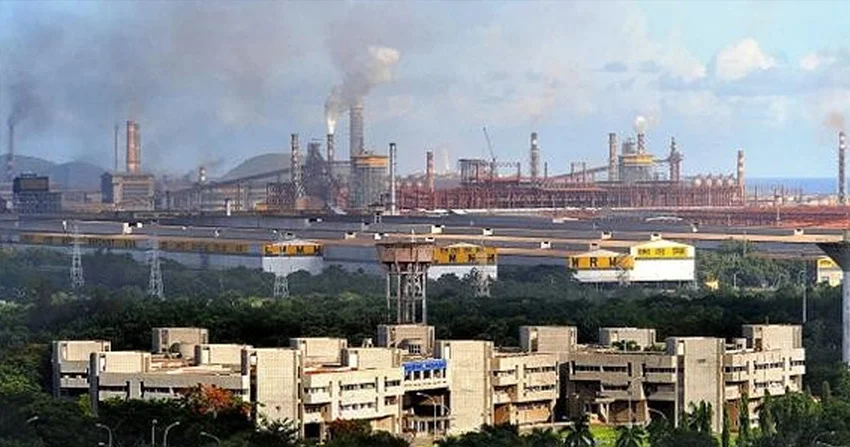
The exposed capacity: An integrated steelworks at Visakhapatnam. Iron and steel is one of the two sectors the Department of Commerce used as a worked case study at this week’s CBAM session, alongside aluminium — the two most emissions-intensive lines in India’s engineering export basket.
₹21,800 crore a year is the five-year average of India’s finished-steel exports to the European Union. A per-tonne carbon charge applies to a base of that order — which is why an awareness session for a hundred exporters is not a small event.
At a Glance
• Session: 18 August 2026, Vanijya Bhawan, New Delhi
• Organisers: Department of Commerce, with NABCB and EEPC
• Attendance: about 100 exporters and industry stakeholders
• Case-study sectors: iron and steel; aluminium
• EU finished-steel exports (JPC): FY20 ₹10,692 cr · FY21 ₹14,144 cr · FY22 ₹32,149 cr · FY23 ₹22,482 cr · FY24 ₹29,534 cr
• Five-year average: ₹21,800 crore a year
• FY22 vs FY20: up 200.7 per cent
• FY24 vs FY23: up 31.4 per cent
For a finance function, CBAM changes the unit of account. Under a carbon border mechanism, the charge is calculated on embedded emissions per tonne of product, which means an exporter must be able to attribute emissions to a specific consignment from a specific plant, and have that attribution verified by a body the importing regulator recognises. That is a data problem before it is a cost problem. A firm that cannot produce plant-level emissions data has no way to price a contract, hedge an exposure, or argue that its actual intensity is lower than a default value applied in its absence — and default values, wherever they are used, are rarely generous to the supplier.
This is why the presence of the accreditation board in the room matters more than the attendance figure. Verification capacity has to exist somewhere. If Indian certification bodies are accredited to a standard that European regulators accept, the cost of an emissions audit stays in rupees and stays domestic. If they are not, every exporter buys verification abroad in hard currency, and the compliance burden compounds fastest on precisely the mid-sized firms with the thinnest margins. Building the accreditation chain is therefore an export-competitiveness measure, not a regulatory one.
India has been building on the production side in parallel. The Production Linked Incentive scheme for speciality steel anticipates additional investment of ₹27,106 crore with downstream capacity creation of around 24 million tonnes; basic customs duty on ferro-nickel and molybdenum ores and concentrates was reduced to nil in the 2024-25 Budget; and the exemption on ferrous scrap and specified raw material for cold-rolled grain-oriented steel has been continued. The Domestically Manufactured Iron and Steel Products policy anchors government procurement. Newer capacity carries lower embedded emissions, so each of those measures quietly improves the CBAM position too. The constructive priority now is to push emissions accounting down the vendor chain to the mid-sized supplier, and to keep making the case internationally for verified Indian certification to be accepted without duplicate audit. Both are achievable, and both are cheaper than losing the ₹21,800 crore a year that is already there.