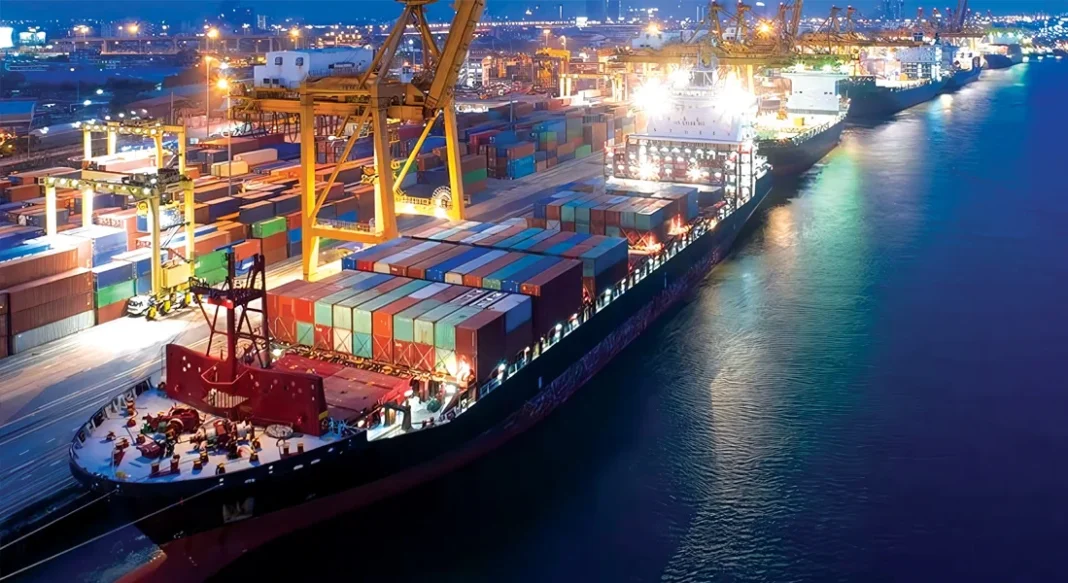
SEA CHANGE : India emerging as a master of the ocean through tech adoption and port-led development

The salt-crusted air at Mundra Port in Gujarat carries a new scent these days: the smell of a global shift. In February this year, Mundra did what many thought impossible a decade ago — it clocked an annual cargo volume of over 200 million metric tonne (mmt).

But this isn’t just a story about one port; it is the headline of a national transformation. From the rocky shores of Vizhinjam to the strategic outposts of the Andaman and Nicobar Islands, India is no longer just “looking” at the sea; it is reclaiming it.

For decades, India’s maritime sector was a sleeping giant, tethered by aging infrastructure and red tape. Today, under the matured Sagarmala Programme, that giant has not only woken up — it has started sprinting. As global supply chains decouple from traditional hubs, India is positioning itself as the indispensable “logistics nerve center” for the Indo-Pacific.

From vision to velocity

When Sagarmala was launched, it was an ambitious blueprint for port-led development. By March 2026, it has become the bedrock of the Indian economy. With over 315 projects completed and a dedicated financing arm — the Sagarmala Finance Corporation Limited (SMFCL) — the programme has successfully decoupled maritime growth from the traditional bottlenecks of the national budget.

The numbers tell a story of ruthless efficiency. The average turnaround time (TRT) for ships, once a staggering 96 hours, has been slashed to 49.5 hours. In the world of shipping, where every hour at berth costs thousands of dollars, this 50 per cent reduction is the difference between being a “stopover” and being a “hub.”

The Pacific pivot

Can India truly become a logistics hub for the Pacific? In 2026, the answer is moving from “perhaps” to a resounding “yes.” The strategy is a two-pronged “pincer movement” designed to capture the massive trade flowing through the Malacca Strait.

To the south, Vizhinjam International Trans-shipment Deepwater Multipurpose Seaport is now fully operational. With its 24-meter natural draft, it is one of the few ports in the region capable of hosting “megamax” container ships.
For the first time, Indian exporters don’t have to send their goods to Colombo or Singapore to be loaded onto larger vessels. They are doing it at home.

“We aren’t just building ports; we are building a corridor of certainty,” says a senior official at the Ministry of Ports, Shipping, and Waterways. “When a ship sails from the Pacific toward India, the captain knows they are entering a high-speed digital ecosystem, not a bureaucratic maze.”

To the east, the development of the Eastern Seaboard — specifically the ports of Chennai, Vizag, and Paradip — has turned India into a “bridge” for the Pacific. As Southeast Asian manufacturing explodes, these ports are serving as primary gateways for the “China+1” supply chain, linking the Pacific markets directly to the burgeoning consumer base in West Asia and Europe.

“We aren’t just building ports; we are building a corridor of certainty,” says a senior official at the Ministry of Ports, Shipping, and Waterways. “When a ship sails from the Pacific toward India, the captain knows they are entering a high-speed digital ecosystem, not a bureaucratic maze.”

The net-zero maritime frontier

In 2026, “green shipping” is no longer a corporate social responsibility (CSR) buzzword; it is a competitive requirement. The “Maritime India @ net zero” initiative has turned the country’s coastline into a laboratory for the future of energy.

The designation of Deendayal, Paradip, and VO Chidambaranar as dedicated green hydrogen hubs is a masterstroke. By producing green hydrogen at a target cost of $1.50 per kg, India is positioning itself as the world’s refuelling station.

The green tug transition: Under a new national mandate, all major ports are replacing diesel-guzzling harbour tugs with electric or green-methanol-powered versions.

Renewable mandates: By the end of this year, major ports are on track to source 30 per cent of their total power from solar and wind, heading toward a 60 per cent goal by 2030.

This “green premium” is attracting global shipping lines like Maersk and MSC, who are under immense pressure to decarbonise. By offering zero-emission bunkering (refuelling), Indian ports are becoming the preferred stops for the next generation of eco-friendly fleets.

Smart ports and digital twins

The most invisible yet impactful change is the digital one. The era of paper-heavy clearances is dead. In its place is the unified logistics interface platform, which provides a single-window “truth” for every piece of cargo moving through the country.

Cargo Traffic at Major Ports

In early 2026, the VO Chidambaranar Port made history by launching India’s first full-scale digital twin. This virtual replica uses AI and IoT sensors to simulate port operations in real-time, allowing port authorities to predict congestion before it happens.

Similarly, the Haldia terminal has become a beacon of automation, using robotic arms and automated guided vehicles to handle dry bulk cargo with zero human intervention.

As India celebrates this shipping boom, the focus remains on the long game. The goal is to reach the top five global shipbuilders list by 2047. By incentivising domestic container manufacturing and creating a “maritime special economic zone,” India is ensuring that the wealth generated by the sea stays within its borders.

The “blue renaissance” of 2026 is proof that geography is not destiny — policy is. India has successfully pivoted from a nation that merely sits beside the ocean to a nation that masters it.

Galathea Bay: The ‘Singapore Killer’ in the Nicobar
Galathea Bay

For decades, the “Transshipment Leak” was a wound in India’s maritime economy. Roughly 75% of Indian transshipped cargo was handled at foreign ports, costing the country nearly $220 million annually in lost revenue and extra logistics costs.

Enter Galathea Bay.

Located on Great Nicobar Island, Galathea Bay is the crown jewel of the 2026 maritime strategy. Its location is its superpower: it sits a mere 40 nautical miles from the Malacca Strait, the world’s busiest maritime chokepoint.

Why Galathea Bay Changes Everything:

The Proximity Factor: Vessels moving from the Pacific to the Suez Canal currently deviate to Singapore or Colombo. Galathea Bay offers a zero-deviation alternative, saving shipping lines thousands of miles and millions in fuel.

The “Major Port” Status: Notified as a Major Port in early 2026, it has received an initial investment of over ₹18,000 crore.

Natural Depth: With a natural draft of over 20 meters, it can accommodate the world’s largest container ships (20,000+ TEUs) without expensive dredging.

Strategic Sovereignty: Beyond economics, the port cements India’s role as the “Net Security Provider” in the Indo-Pacific, offering a logistics base for both trade and maritime surveillance.

By 2027, when the first phase of the container terminal becomes fully operational, Galathea Bay won’t just be a port; it will be a statement. India is no longer content watching the world’s trade sail past its shores. It is inviting the world to stop, refuel, and trade.

Latest News

Pills progress : From purely synthetic & chemical generics to biosimilars, Indian pharma entering a new realm

For four decades, the global healthcare narrative regarding India...

Of digital Dr & silicon steths : Tech revolution has turned India into the world’s hospital

Blitz Bureau NEW DELHI: In a sun-drenched clinic in the...

IBC: Reform sans speed: Time-bound resolution of non-viable ventures still remains elusive

Blitz Bureau NEW DELHI: India’s ease-of-doing-business story was never meant...

The jewel of NCR gets a new airport in Noida; PM inaugurates UP’s upcoming mega logistics hub

MANOJ SAXENA NEW DELHI: In a historic moment for India’s...

Trust deficit widens at Tata Trusts: Srinivasan quits

Blitz Bureau NEW DELHI: The power struggle within the Tata...

Topics

IBC: Reform sans speed: Time-bound resolution of non-viable ventures still remains elusive

Blitz Bureau NEW DELHI: India’s ease-of-doing-business story was never meant...

Trust deficit widens at Tata Trusts: Srinivasan quits

Blitz Bureau NEW DELHI: The power struggle within the Tata...

DUNKED IN: Jubilant Food gives up on Dunkin’; will not renew its franchise licence

Blitz Bureau NEW DELHI: Dunkin’ (formerly Dunkin’ Donuts) is preparing...

Adani Ports targets 1 bn tn cargo by 2030 Crosses 500 mn tn milestone

Blitz Bureau NEW DELHI: Chairman of Adani Group Gautam Adani...

The long road from 17 to 25

Blitz Bureau NEW DELHI: For decades, global manufacturing operated on...
spot_img