




Blitz India Business
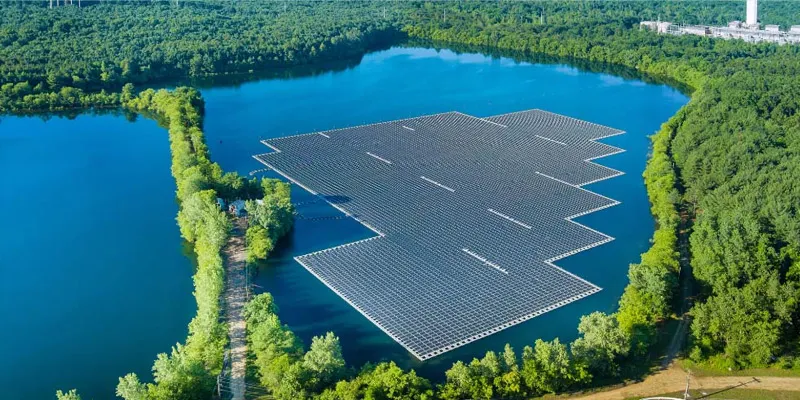
NEW DELHI: The headline capacity is 5,000 MW. The commercially important clauses are the storage mandate and the payment trigger. The Cabinet has approved the Pradhan Mantri Surya Sarovar Yojana with a total outlay of ₹5,070 crore, covering 5,000 MW of floating solar photovoltaic capacity with co-located energy storage of at least two hours per project — 10,000 MWh in aggregate.
Central financial assistance is ₹1 crore per MW, disbursed post-commissioning, with up to ₹50 lakh available for feasibility studies. Projects will be sanctioned between FY 2026–27 and FY 2030–31, with disbursement of support continuing to FY 2032–33. The government’s projections are around 10 million tonnes of carbon dioxide avoided annually and 16,000–17,000 jobs created. Context for scale: India had 288.58 GW of installed renewable capacity as of June 30, of which solar was 162.15 GW, wind 57.44 GW, large hydro 57.24 GW and bio power 11.75 GW, with total non-fossil capacity at 297.36 GW including 8.78 GW of nuclear.
Viability gap, not capital subsidy: assistance is set at ₹1 crore per MW and paid only once a project is commissioned, shifting execution risk to the developer.
A subsidy paid on announcement funds intentions. A subsidy paid on commissioning funds electricity. The difference shows up in the completion rate.
At a Glance
• Outlay: ₹5,070 crore total
• Capacity: 5,000 MW floating solar PV
• Storage: minimum two hours per project; 10,000 MWh in total
• Central assistance: ₹1 crore per MW, post-commissioning
• Feasibility support: up to ₹50 lakh per study
• Sanction window: FY 2026–27 to FY 2030–31; disbursement to FY 2032–33
• Projected impact: ~10 million tonnes CO₂ avoided a year; 16,000–17,000 jobs
• Sector base: renewables 288.58 GW; solar 162.15 GW; non-fossil 297.36 GW (June 30)
The payment structure is the clause developers will price first. Assistance released only after commissioning means the developer carries construction and execution risk in full and recovers support at the end — which raises the cost of the interim financing but sharply improves the quality of the pipeline, because a scheme that pays on completion does not accumulate announced-but-unbuilt megawatts. At ₹1 crore per MW against a floating solar capital cost meaningfully higher than ground-mounted, the assistance functions as a viability gap contribution rather than a headline capital subsidy. That is the right instrument for a technology whose cost premium is real but narrowing.
The storage mandate is where the value sits for the grid and for the developer’s revenue model. Two hours of co-located storage converts a plant that sells only into the midday market into one that can supply into the evening peak, when Indian tariffs and system value are highest. It also avoids the land, evacuation and interconnection costs of building storage as a separate asset. For equipment suppliers the read-across is to battery systems, power conversion, mooring and anchoring systems, and the specialist marine engineering required for reservoir installations subject to seasonal drawdown. The main execution risks are equally identifiable: reservoir level variation, which anchoring design must accommodate; maintenance access on water, which affects operating cost assumptions; and the environmental clearance pathway for water-body siting, which is the item most likely to determine schedule. The provision for funded feasibility studies is a sensible attempt to front-load exactly those questions.