




Blitz India Business
NEW DELHI: ₹642.58 crore of rural Wi-Fi, ₹3.09 lakh of revenue, and the maintenance clause that a fresh audit has put back on the table.
Three balance-sheet facts sit at the centre of this story, and they were established by three different institutions across three years.
BSNL commissioned 24,333 of a sanctioned 25,000 rural Wi-Fi hotspots at a revised project cost of ₹642.58 crore. Across 2017-18 to 2021-22 they earned ₹3.09 lakh, against a revenue target of ₹75 crore for 2018-19 alone. Over the same period the enterprise bore ₹60.71 crore in downtime penalties and levied ₹81.84 lakh in liquidated damages on its vendors.
On the enterprise’s own evidence, its vendors carried a 20% cap on penalty exposure and BSNL carried none. That asymmetry is the single most expensive line in the project and the cheapest to correct.
THE RECOMMENDATION, AND THE REPLY
Paragraph 4.2 of the Comptroller and Auditor General’s Report No. 16 of 2023, tabled on 9 August 2023, asked for three things: a pre-sanction evaluation mechanism, a revenue model that makes the assets self-sustaining with technology upgrade and maintenance, and impact assessment aimed at reducing the downtime penalty. The same paragraph recorded that 13.77% of sites were later closed or relocated, that 700 hotspots were commissioned late by up to 790 days, and that penalties came to 9.45% of the revised project cost.
The Committee on Public Undertakings took the paragraph up and presented its Fourteenth Report to Lok Sabha on 12 August 2025, having had 957 sites physically verified.
BSNL contested the first limb. It told the Committee it had submitted the proposal “after due diligence and approval” and that “the use of landline got reduced leading to rural exchanges becoming non-viable” during execution. On revenue it recorded that the “public perception of rural users is that Wi-Fi service is free or complimentary service”; its Chairman and Managing Director put it more directly in evidence: “if you are going to only target Wifi as a revenue source, it is not really going to be a wining situation.”
On the second and third limbs it did not argue. About 1,600 hotspots were converted to Public Data Office revenue-sharing arrangements, and the capital programme moved to 4G saturation and fibre-to-the-home under the amended BharatNet programme.
THE NUMBER A LENDER WOULD ASK FOR
The Comptroller and Auditor General returned in Report No. 19 of 2026, a BharatNet performance audit tabled on 12 August 2026. Of 1,04,675 Wi-Fi connections installed, 6,293 were active in March 2024 — 6.01%. By March 2025, 766 were functional, or 0.7%.
Read as an asset base, BharatNet is built and under-used. Expenditure stands at ₹39,888 crore against an approved ₹42,068 crore. Of 2.26 lakh Gram Panchayats in scope, 2.19 lakh are service-ready — but only 33.20% of those are operational, and bandwidth utilisation is 17.91%. Audit also records 16,271 Gram Panchayats, 39% of the total in six States, dropped on cost-cutting grounds.
The operating cost sits in a single mechanism. About 48% of downtime traces to fibre cuts, and the mean time to restore a fibre fault is 17 days. The Fibre Fault Localisation System that would automate detection was planned in April 2014 and was not installed as of July 2024. Twelve years of manual fault-finding is the recurring cost that no revenue model was ever going to cover.
The Ministry has applied contractual discipline: its reply of March 2025, recorded in the audit, notes a “penalty of ₹34.77 crore has been deducted from BSNL claims”. On the ₹2,001.43 crore of Phase-II funds BSNL had applied to establishment costs and other projects, the Ministry said in November 2025 that BSNL “had since recouped entire amount”.
WHAT THE ACCOUNTS NOW SHOW
The enterprise that has to fund maintenance is in a different position from the one that sanctioned the hotspots. Debt fell from ₹32,978 crore in March 2022 to ₹19,568 crore in September 2023. Asset monetisation reached ₹812.27 crore in 2024-25 against a ₹800 crore target, with ₹1,000 crore a year projected from 2026-27. Net profit was ₹262 crore in the third quarter of 2024-25 and ₹280 crore in the fourth.
Capacity has moved with it. BSNL had 97,068 4G sites installed and 93,511 on air as of 31 October 2025, all upgradable to 5G. Fibre-to-the-home went from 3.35 lakh connections in March 2019 to 41.12 lakh by 31 January 2025; BharatNet carried 13,92,767 such connections by 30 November 2025. Wi-Fi provisioning is under way at about 5,200 Gram Panchayats under Phase-II.
The committee cycle closed on the wider BSNL report: Action Taken Notes filed by the Ministry of Communications on 23 May 2025 against 23 recommendations, of which the Committee accepted 17 replies.
AT A GLANCE
● Project: 25,000 rural Wi-Fi hotspots, sanctioned December 2016 from the Universal Service Obligation Fund; 24,333 commissioned at ₹642.58 crore
● Revenue 2017-22: ₹3.09 lakh against a ₹75 crore single-year target
● Penalties: ₹60.71 crore borne, uncapped; vendor exposure capped at 20%
● BharatNet Wi-Fi active March 2024: 6.01%; functional March 2025: 0.7%
● BharatNet capital: ₹39,888 crore spent of ₹42,068 crore approved; utilisation 17.91%
● Operational share of service-ready Gram Panchayats: 33.20%
● BSNL debt: ₹32,978 crore (March 2022) to ₹19,568 crore (September 2023)
● BSNL quarterly net profit 2024-25: ₹262 crore and ₹280 crore
WHAT IT AMOUNTS TO
The commercial reading is straightforward. A capital programme has been substantially funded and substantially built; the operating layer that turns it into revenue has not been. Utilisation at 17.91% on ₹39,888 crore of deployed capital is the number that decides whether the next tranche earns anything, and it is an operations question rather than a construction one.
BLITZ RECOMMENDS
Move disbursement from installation to availability. Payment against a commissioned asset buys commissioning. Payment against measured uptime buys uptime. Audit’s own threshold — above 95% availability written into partner incentives — is where to set it.
Automate fault detection before adding capacity. The Fibre Fault Localisation System with remote fibre monitoring, integrated with a geographic information system and a central network operations centre, is the largest recoverable item inside the 17-day restoration figure, and it reduces recurring operating cost rather than adding to it.
Cap the downtime penalty symmetrically. A vendor capped at 20% and an enterprise uncapped is a contracting position no board would approve if it were priced. ₹60.71 crore has already paid for the lesson.
Sell anchor tenancy before retail. Health, education and agriculture departments taking dedicated capacity at tiered rates is committed demand against a fixed-cost network. It moves utilisation faster than any village retail proposition in a market where the expectation is that Wi-Fi is free.
Ring-fence the BharatNet function. Audit proposes a specialised division with independent leadership, separate financials and defined performance indicators under independent-director oversight. Separate accounts are what make the utilisation number auditable, and they answer the competitive-neutrality question about infrastructure and service sitting inside one enterprise.
SOURCE: https://cag.gov.in/uploads/media/Report-No-16-of-2023-Compliance-Audit-06541f4b085aa59-76188086.pdf
RRB profit climbs to ₹10,176 crore
Consolidated net profit of ₹10,176 crore, gross bad loans at 5.3%, and a comparison base that changed under the numbers.
Regional Rural Banks reported a consolidated net profit of ₹10,176 crore for 2025-26, against ₹6,820 crore in 2024-25 — a rise of ₹3,356 crore, the Department of Financial Services said on 25 August 2026.
Total business crossed ₹13.5 lakh crore. Gross non-performing assets were 5.3% and net non-performing assets 2.1%, both the lowest the department records for the system. The credit-deposit ratio reached 75.2%, its highest, across 22,273 branches in 26 States and three Union Territories covering about 700 districts. The system added 54.98 lakh Pradhan Mantri Jan Dhan Yojana accounts in the year.
The comparison needs a footnote before it is used. 2025-26 is the first full year after the 2025 amalgamation that cut the system to 28 banks, so the year-on-year figure sets a smaller set of larger institutions against a larger set of smaller ones. The system aggregate holds; the entity-level read-across does not.
A second reading point for anyone modelling the sector: a credit-deposit ratio is a measure of deployment, not of profitability or of safety. At 75.2% the system is lending more of its deposit base than before, which raises both earnings and the sensitivity of those earnings to asset quality.
BLITZ RECOMMENDS
The aggregate hides the dispersion, and the dispersion is what a sponsor bank and a State government need. Bank-wise profit, gross and net non-performing assets and credit-deposit ratio, published for all 28 institutions as the Reserve Bank does for scheduled commercial banks, would show which amalgamated entities are carrying the system average and which are being carried by it.
SIDBI takes co-lending to all 28 rural banks
A digital origination platform replaces the paper file, and the pilot’s numbers stay unpublished.
The Small Industries Development Bank of India convened the heads of all 28 Regional Rural Banks on 25 August 2026 to expand its MSME co-lending facility from a three-bank pilot, the Ministry of Finance said in a release on 26 August 2026.
The commercial mechanism is the Co-Lending Origination Platform: the loan file moves end to end without paper, an in-principle sanction is returned once documents are submitted, and funds are credited directly to the borrower’s account. For a co-lending structure, origination cost and turnaround are the two variables that decide whether the arrangement is viable at rural ticket sizes, and the platform is aimed at both.
The distribution it would use is the network’s 22,273 branches — the reason a development bank with no rural counter reaches for a Regional Rural Bank in the first place.
What the release does not disclose is the pilot’s performance: no sanctioned amount, no disbursement, no borrower count, no non-performing asset experience and no target for the expanded arrangement.
BLITZ RECOMMENDS
Scale should follow disclosure, not precede it. Publishing the three-bank pilot’s sanctioned and disbursed amounts, median ticket size, turnaround time and early delinquency would let the Department of Financial Services and the participating boards price the expansion instead of authorising it. Quarterly reporting on the same four measures after rollout would keep that discipline in place.
SOURCE : https://pib.gov.in/PressReleasePage.aspx?PRID=2303447
₹37.11 lakh crore on the project register
The July flash report: 51.91% of the money spent, 38% of projects near physical completion, and a cost base that is already revised.
The central government’s ongoing infrastructure project book runs to 1,775 projects of ₹150 crore and above, at a total revised cost of ₹37.11 lakh crore, on the Ministry of Statistics and Programme Implementation’s flash report for July 2026, released on 25 August 2026. Cumulative expenditure is ₹19.26 lakh crore, or 51.91%.
The concentration is worth holding. Transport and logistics carries 1,246 projects worth ₹19.81 lakh crore — more than half the value of the whole book. Energy carries 205 projects worth ₹10.66 lakh crore, water and sanitation 53 worth ₹2.05 lakh crore. The Ministry of Road Transport and Highways alone accounts for 993 projects at a revised cost of ₹9.62 lakh crore. By size, 735 mega projects of ₹1,000 crore and above carry ₹28.77 lakh crore between them; 1,040 major projects of ₹150 crore to ₹1,000 crore carry ₹4.93 lakh crore.
The pairing that matters for anyone forecasting order flow sits in two of the report’s own columns. Some 675 projects, about 38%, are at 80% or more physical progress; 305, about 17%, are at 80% or more financial completion. Money is running ahead of concrete.
One caution on the headline. ₹37.11 lakh crore is revised cost — already escalated. Growth in that number is not by itself growth in the asset base, and reading it as new sanctioning is the commonest error made with this series.
BLITZ RECOMMENDS
The project-level detail behind this report is the single best forward indicator of central capital expenditure available in India, and it is published as a summary release. Putting the underlying table on the open data platform under the Government Open Data Licence would give lenders, contractors and State planning departments the same view the ministry has, instead of the reconstructed versions they build by hand.
Steel: output up, and a net import position
April-July production against a trade balance running the other way, and prices across four product grades.
Crude steel production was 56.2 million tonnes over April to July 2026, up 2.4% on the same four months a year earlier; hot metal 31.9 million tonnes, up 2.7%; finished steel 54.7 million tonnes, up 4.7%, the Ministry of Steel said on 25 August 2026.
Over the same period finished steel imports were 2,766.2 thousand tonnes against exports of 2,292.3 thousand tonnes — India was a net importer by 473.9 thousand tonnes. China accounted for 855.8 thousand tonnes, or 30.9% of imports; Vietnam took 354.0 thousand tonnes, or 15.4% of exports.
That combination is the operating context for domestic mills: demand growing at a mid-single-digit rate, and imports still setting the marginal price in several grades.
August 2026 prices: TMT bar ₹58,003 a tonne, hot-rolled coil ₹70,448, cold-rolled coil ₹76,463, galvanised plain sheet ₹86,668.
On decarbonisation, 98 producers across 15 States hold Green Steel Certificates. That is a count of certifications, not certified tonnage, and the distinction matters to any buyer trying to source against a specification.
These are four-month cumulative figures and are not an annual rate.
BLITZ RECOMMENDS
A certificate count is not a market. Publishing certified tonnage by star rating and by producer, alongside the producer count, would give public procurement — the first and largest buyer of low-emission steel in any economy that has built this market — a specification it can tender against. Without volume data the certificate remains a label rather than a price signal.
A $75 billion freight bill, and 100 ships
The cost premium on the Indian flag is 16% to 20%, and nothing announced changes it.
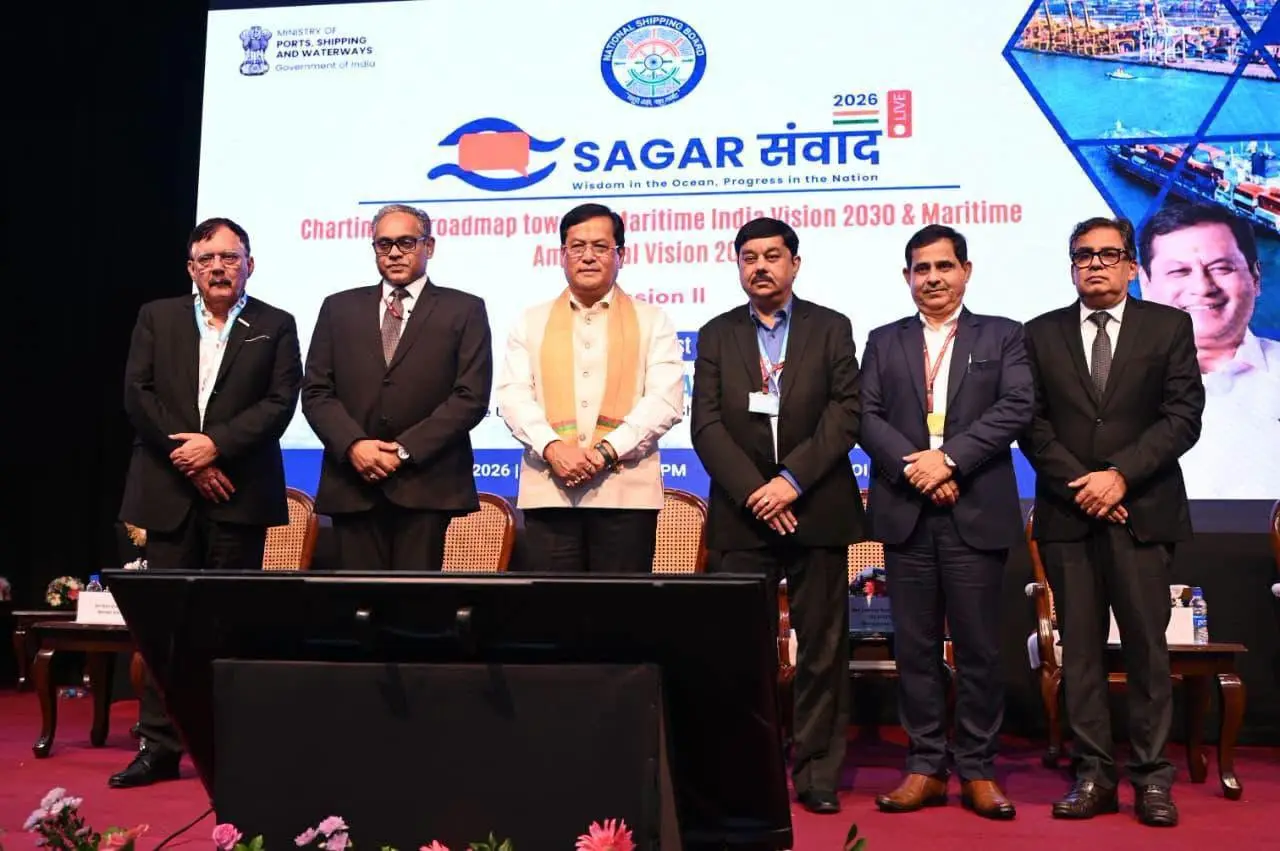
India pays foreign shipping lines about $75 billion a year to carry its cargo, Minister of State Shantanu Thakur said at the first Sagar Samvad of the National Shipping Board on 25 August 2026. A five-pillar roadmap proposed there could add 100 vessels to the Indian merchant fleet within five years.
The economics are stated in the same release and they are the whole story. An Indian-flagged ship costs 16% to 20% more to operate than a foreign-registered vessel, on import taxes, seafarer wage deductions, freight taxes and higher capital costs.
That premium is why tonnage owned by Indian interests registers elsewhere. No vessel target removes it, and no lender discounts it away.
Ports Minister Sarbananda Sonowal put port capacity at a target of 10,000 million tonnes a year by 2047, and the ₹10,000 crore Container Manufacturing Assistance Scheme was on the agenda.
For anyone sizing the opportunity: 100 vessels is a potential outcome of a proposed roadmap, with no order book, no shipyard allocation, no tonnage and no financing structure attached. The $75 billion is a gross freight outgo, not a saving that 100 ships would capture.
BLITZ RECOMMENDS
Publish the arithmetic of the premium before setting the fleet target. A line-by-line reconciliation of the tax treatment of Indian-flag tonnage — vessel and stores import duty, seafarer wage treatment, the freight tax position — against the registries Indian owners actually use would show how much of that premium is within the Government’s own gift. Owners cannot be asked to absorb a gap that has not been measured, and lenders will not finance against one.
India-Canada dialogue opens, UPI on the table
A first standing finance channel with a G7 economy, $110 billion of existing Canadian exposure, and a payments rail offered as the next instrument.
The inaugural India-Canada Finance Ministers’ Economic and Financial Dialogue takes place on 27 August 2026, hosted by Canadian Finance Minister François-Philippe Champagne. Canadian direct and indirect investment in India passed $110 billion in 2024, on the media advisory issued by the Department of Finance, Government of Canada, on 21 August 2026.
That figure needs reading carefully before it is compared with anything. It bundles direct and indirect investment — portfolio and fund-routed holdings alongside foreign direct investment — so it is not comparable with the Department for Promotion of Industry and Internal Trade’s FDI equity series.
Addressing Indian community and business leaders in Toronto on 26 August 2026, Finance Minister Nirmala Sitharaman set a two-way trade target of C$70 billion by 2030 and put India’s real growth for 2025-26 at 7.6%, according to Business Standard’s report of the address. She cited the C$2.6 billion Cameco uranium supply agreement concluded earlier in 2026, and offered the Unified Payments Interface as a rail for India-Canada digital finance.
The interface’s tenth-year numbers give that offer its weight. It carried 24,162 crore transactions worth ₹314 lakh crore in 2025-26, with 703 banks live against 44 in 2016-17, the Ministry of Finance said on 24 August 2026. July 2026 was the peak month at 2,366 crore transactions worth ₹29.88 lakh crore. The ministry put the interface’s share of global real-time payment volume at 49% in 2025, on the International Monetary Fund’s recognition, and its operating footprint at 11 countries.
Both of those last figures carry qualifications the ministry itself supplies. The 49% is volume, not value, and 86% of merchant transactions on the interface are micro-payments below ₹500. Operating in 11 countries mostly means merchant acceptance for Indian travellers, not a domestic payments system abroad.
BLITZ RECOMMENDS
Canadian pension and institutional capital is the specific pool this dialogue is aimed at, and it does not move on communiqués. The single deliverable that would matter is a defined route for that capital into Indian infrastructure — the tax treatment, the vehicle, the exit — settled at official level between the two finance ministries and published with the next meeting’s date attached. A dialogue that ends without a second date is an event; one that ends with an agenda is an institution.
First 15-metre sleeper bus clears certification
A type approval that adds berths per departure, and a State permit question it does not settle.
The International Centre for Automotive Technology has issued India’s first compliance certificate for a 15 metres multi-axle sleeper bus, under automotive standards AIS-119 and AIS-153 and the applicable provisions of the Central Motor Vehicles Rules, the Ministry of Heavy Industries said on 26 August 2026. Testing covered structural strength, emergency safety, fire safety and passenger comfort.
The commercial content is in the layout. A fully sleeper variant carries 42 berths; a hybrid carries 21 berths with 42 seats. On a long intercity route, berths per departure is the operator’s revenue line, and the extra length raises it without adding a driver, a permit or a slot.
This is a type approval for one manufacturer’s model, not a production figure or an order. Nor does it settle whether a State transport authority will permit a 15 metres vehicle on a given route.
BLITZ RECOMMENDS
A central certification that State permit rules do not recognise creates a certified vehicle nobody can run, and the cost of that gap falls on the first operator to order one. The Ministry of Road Transport and Highways and the States should settle route and permit treatment for 15 metres multi-axle coaches now, alongside the certification, rather than after a fleet has been financed against it.
The Grant That Went Unspent
Oversight Desk. A station-amenities audit where budget under-utilisation of 36% to 44% sits beside works running one to four years late.
Report No. 31 of 2026 of the Comptroller and Auditor General, tabled on 12 August 2026, sampled 512 non-suburban railway stations across 16 Zonal Railways — 187 Amrit Bharat stations and 325 others — covering funds and amenity works from 2019-20 to 2023-24.
Two of its own columns, read together, rule out the explanation everyone reaches for first. Budget grants ran 36% to 44% under-utilised across those five years, while of 395 amenity works examined, 59% ran late and 41% finished on time. A programme cannot simultaneously be short of money and unable to spend the money it has.
What that leaves is planning and sequencing, and the report is specific about where the machinery stopped. In no Zonal Railway were the Zonal and Divisional Railway Users’ Consultative Committee meetings held at the prescribed frequency during 2022-24. Service Improvement Group inspections were not conducted at numerous A1 and A category stations. As of March 2024 no Zonal Railway had operationalised the station-wise webpages on amenities and sanitation it had been instructed to publish.
The outcome measures follow. Audit found 458 of 512 stations, or 89%, short of one or more Minimum Essential Amenities, with 54 showing no shortfall; 42% of stations short of fans, 40% of water coolers, 27% of drinking-water taps; 379 without platform shelter over the general second-class boarding area; and 491, or 96%, with neither bio-toilets nor waterless toilets. On accessibility, 227 stations — 44% — were deficient in ramps for Divyangjan and 128 had no wheelchair; of 374 Divyangjan passengers interviewed, 131, or 35%, reported the amenities inadequate.
THE MINISTRY’S REPLY
The Ministry of Railways replied in September and November 2025 and its replies are carried in the report. It acknowledged the deficiencies, described the deviations as “temporary in nature” and traced them to “re-categorisation and upgradation of stations, yard remodeling”, saying “substantial compliance is generally ensured” while accepting that completion is affected by “statutory clearances and brownfield challenges, including shifting of utilities, speed restrictions”. On accessibility it said amenities are “being provided in a phased manner” under the Rights of Persons with Disabilities Act, 2016, “subject to priority and availability of funds”.
It also recorded delivery: as of 30 September 2025, 1,673 escalators at 419 stations and 1,889 lifts at 714 stations. Audit’s objection is not that nothing was done but that no action plan or timeline was furnished against which the work can be measured.
STATUS
These are final audit findings laid before Parliament, not draft paragraphs, and the Ministry has replied on the record. No parliamentary committee has yet examined the report — it was tabled on 12 August 2026 and no Action Taken Note is due — so nothing here carries a committee’s view.
BLITZ RECOMMENDS
Treat the under-utilisation as a procurement problem and audit it as one. Five consecutive years of 36% to 44% under-spend alongside 59% late works points at tender cycles, sanction thresholds and clearance sequencing rather than at allocation. Zonal Railways should publish, for each amenity work, the date of sanction, the date of tender award and the date of completion — three fields that would locate the delay inside a quarter.
Restore the consultative calendar. It is the cheapest of the seven recommendations audit makes and the one that would have surfaced the other six. It costs a diary, not capital.
Publish the station webpages that were already ordered. Station-wise publication of the amenity entitlement turns an audit finding into a check any passenger can run, at no incremental cost.
Put water first. Audit detected total coliforms and Escherichia coli, and its fifth recommendation asks only for compliance with the Uniform Drinking Water Quality Protocol that already exists. It is the most actionable item in the report and the most urgent.
The Import Line India Left Open
Research Desk. Three indigenous gas turbines reach the table, one of them at production readiness since 2022, and no manufacturing partner named.
CSIR-National Aerospace Laboratories showed three indigenous gas turbine engines at CSIR headquarters in New Delhi on 25 August 2026 — the NJ-05 at 5 kg thrust, the NJ-50 at 50 kg and the NJ-100 at 100 kg. These are the propulsion units inside jet-powered target drones, loitering munitions, drone interceptors and compact missiles, turning at around a hundred thousand revolutions a minute inside a casing about the width of a coffee mug. The Ministry of Science and Technology issued its account the same day.
The commercial fact is in the laboratory’s own datasheet rather than the release. The NJ-5 — the same engine the release designates NJ-05, 50 newtons being about 5.1 kilograms-force — is recorded at technology readiness level 9: development complete, flight tested, production ready. It was developed between 2019 and 2022. Commercialisation is listed as “under progress”.
Four years at production readiness with no named manufacturer is the gap this story is actually about, and it is a procurement question rather than a technical one.
The specification, from the same datasheet: 50 newtons design thrust and 75 newtons maximum, 1,00,000 revolutions a minute, pressure ratio 2.0, mass flow 0.20 kilograms a second, specific fuel consumption 0.234 kilograms a newton-hour, 116 millimetres diameter, 1.2 kilograms. For the NJ-50 and NJ-100 no readiness level, test record or endurance figure is stated in any document the desk could open, and the production-ready claim does not travel to them. The laboratory’s 50 newtons-class valveless pulsejet, developed in 2023, sits at readiness level 5.
THE MARKET BEING ADDRESSED
CSIR-NAL states the gap on its own technology page: no indigenous micro gas turbines are available in the Indian market.
The policy position created the demand and left it unmet. DGFT Notification No. 54/2015-2020 of 9 February 2022 prohibited drone imports in built-up, completely-knocked-down and semi-knocked-down form, with research and defence carve-outs, while expressly permitting the import of drone components. Airframes stopped coming in; propulsion continued to.
The customer base is countable. PIB’s backgrounder of 17 February 2026 records 38,575 civil drones on the DGCA register as of 9 February 2026, 39,890 certified remote pilots, 244 approved training organisations and a ₹120 crore production-linked incentive outlay for drones.
The incumbent supplier is identifiable and sells here. PBS of the Czech Republic markets the TJ40-G2 through PBS India: 395 to 425 newtons, 3.80 kilograms, a 9,000 metres ceiling and a time between overhaul of up to 50 hours, on its own product page. The NJ-50, at roughly 490 newtons, addresses that class directly.
WHAT A BUYER WOULD STILL ASK
No funding scheme or amount is stated in any source. No patent application, grant, technology transfer or licensee appears anywhere; the laboratory’s “commercialisation under progress” is the only entry on the record. No manufacturing partner, order or timeline is named.
And no service life is stated for any of the three. Time between overhaul is the specification on which an expendable-class engine is actually procured — the imported comparator publishes up to 50 hours — and its absence, not the thrust rating, is what keeps a purchase order pointed at Velká Bíteš.
BLITZ RECOMMENDS
Publish time between overhaul. It is the single number that converts a laboratory demonstration into a procurable item, and it costs a test campaign the laboratory has largely already run for the NJ-5.
Publish the readiness ladder for all three engines. Readiness level, hours run, altitude and endurance tested, engine by engine. An airframe integrator designs against a datasheet, not against a press release, and CSIR-NAL already does this well for the smallest engine.
Name the manufacturing partner and put an order behind it. The Gas Turbine Research Establishment’s route with a private precision-engineering firm on its expendable turbojet is the working template — national laboratory designs, private precision engineering builds. Potential to manufacture is not a contract, and the distance between the two is where a readiness level 9 from 2022 has been waiting.
Then phase the component rule. With an engine family at readiness, the Department of Defence Production and the Ministry of Civil Aviation have the basis to introduce a propulsion-content requirement into procurement — sequenced with enough notice for a named partner to build the line, which is the order in which the 2022 airframe restriction was got right.
A Diagnostic Aimed at the Missing Scanner
Research Desk. A Bengaluru probe and a smartphone reader, funded by ICMR and ANRF, with no human validation study yet on the record.
The market failure in Indian dementia care is not the absence of a diagnosis. It is the absence of the machine that gives one: confirming amyloid build-up in a living person means a positron emission tomography scan or a magnetic resonance image, and those exist in a few dozen Indian hospitals.
A group at the Jawaharlal Nehru Centre for Advanced Scientific Research, Bengaluru, has published a molecule aimed at that gap. TZ-48 is dark until it binds amyloid-beta fibrils, then glows — and it changes its fluorescence lifetime, a decay signature independent of dose or photobleaching. It crosses the blood-brain barrier. On top of it the group built ADxFluor, a smartphone reader that converts the response in a serum sample into a figure for amyloid load.
The paper is in ACS Chemical Neuroscience, online on 18 June 2026 and in print on 5 August 2026, under six authors all at the Bengaluru centre, with T. Govindaraju as corresponding author. The Ministry of Science and Technology issued its account on 25 August 2026.
WHAT HAS BEEN DEMONSTRATED
The published abstract reports a dissociation constant of 41 nanomoles a litre, a limit of detection of 68 nanomoles a litre, selectivity over off-target species, blood-brain barrier passage, and imaging that stages amyloid burden — in Alzheimer’s-model mouse brains. Serum detection distinguishes Alzheimer’s-model mice from healthy mice.
No human patients, no human cohort, no sensitivity or specificity against a clinical reference standard, and no comparison against amyloid imaging appear in the abstract. Every in-vivo result is in mice.
The 68 nanomoles a litre limit is where the commercial question sits. Amyloid-beta circulates in human blood at far lower concentrations, and the abstract claims no human serum sensitivity. The comparator is instructive on positioning, not only on performance: when the United States cleared its first blood-based Alzheimer’s test on 16 May 2025 — for adults aged 50 and over already showing signs and symptoms — the Alzheimer’s Association’s statement was that no single stand-alone test diagnoses the disease. Blood-based tests sell as an adjunct inside a work-up, not as a verdict.
THE ADDRESSABLE PROBLEM
The US National Institutes of Health’s Fogarty International Center, reporting a nationwide study published on 13 January 2023, put 8.8 million Indians aged 60 and over as living with dementia — a prevalence of 7.4% in that age group — from clinical consensus ratings for 2,528 participants in the Longitudinal Aging Study in India, modelled onto 28,949 seniors.
FUNDING AND INTELLECTUAL PROPERTY
The paper names four funders: the Indian Council of Medical Research, the Anusandhan National Research Foundation, the Council of Scientific and Industrial Research and the Bengaluru centre. No amounts are stated. An award from the Anusandhan National Research Foundation appearing on a published result is worth noting in its own right — this is the new apex funder’s money reaching an output.
No patent application or grant, technology transfer or licensee for TZ-48 or ADxFluor is stated anywhere. Nor is any human validation study, clinical partner, hospital cohort, regulatory pathway or timeline. An in-vitro diagnostic in India needs a Central Drugs Standard Control Organisation licence under the Medical Devices Rules; no application is on the record. The same laboratory’s therapeutic candidate TGR63 is described on its faculty page as under clinical study with a pharmaceutical company — a different molecule, but evidence the group has a translation route.
BLITZ RECOMMENDS
Fund the human validation cohort as a separate line, now. One properly powered human serum study benchmarked against an accepted reference standard stands between this result and a licensable product. It is a smaller ask than the discovery was, and it is where the value is either realised or lost to whoever runs it first.
Attach a memory clinic. Banked serum with clinical staging is what a validation study consumes, and the institutions holding it already exist. A named hospital partner shortens the timeline by years at no cost to the funders.
Settle and disclose the intellectual property position. A diagnostic platform published with no stated filing status is a platform another jurisdiction can build on. It is also the first question any licensing partner asks, and the answer belongs on the record alongside the paper.