The impossibility of life without pi

Blitz Bureau

NEW DELHI: The world celebrated another Pi Day last week, reminding us that this number is the ultimate bridge between the physical and the abstract. It is found in the pupils of our eyes, the coils of our DNA, and the ripples in a pond. It is the number that rules the universe, defines it and explains it.

Math nerds and dessert enthusiasts, of pie, unite every year to celebrate Pi Day on March 14, the date that represents the first three digits of the mathematical constant pi.

Representing the ratio of a circle’s circumference to its diameter, pi is approximately equal to 3.14159 — but its digits go on forever. In school, one would have used it to calculate the area of a circle or the volume of a cylinder. But the applications of pi are endless and part of every corner of our world.

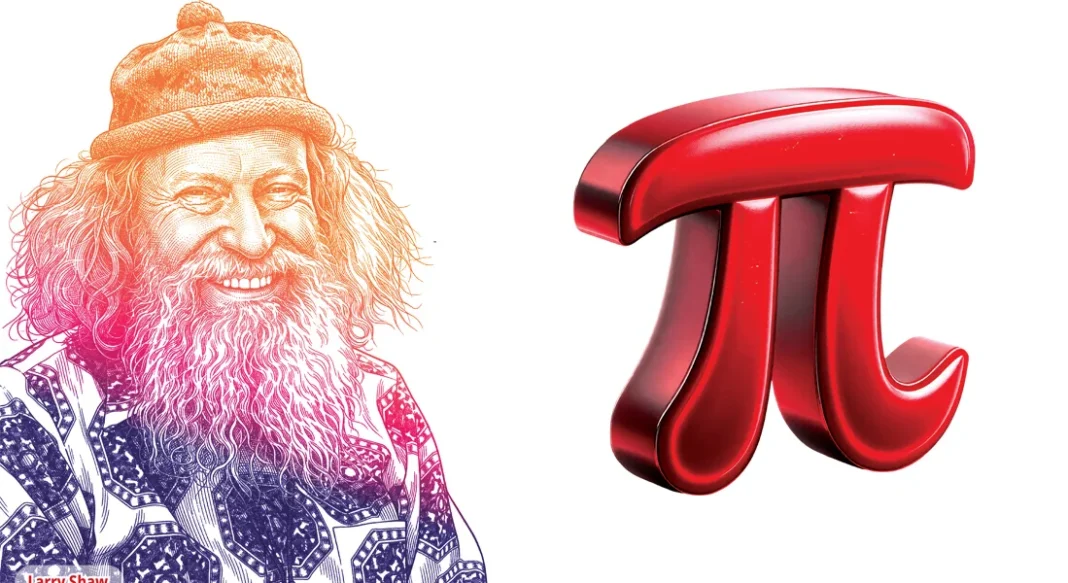
Phys.org writes that Pi Day was established in 1988 by Larry Shaw, a physicist at the Exploratorium Science Museum in San Francisco.

“He had a very open and expansive view of the world and saw an opportunity with this number, mathematical concept, to invite people into the joy of mathematical learning,” says Sam Sharkland, programme director of public programmes at the museum, who worked with Shaw before he died in 2017.

While it began as a small staff celebration featuring pie, it soon turned into a grand procession where hundreds of visitors marched around the pi shrine, each carrying a digit. Attendees often show up early to claim their favourite digit for the parade.

The celebration begins at 1:59 p.m., signifying the next three digits of pi.
Here are a few ways pi is being used on the cutting edge of science.

Pi in outer space

Artur Davoyan, a professor at the University of California, Los Angeles, says pi is so fundamental that it would be hard to pinpoint one use case for it.

Pi is part of “literally every single formula that you would use to do any calculation, like for spacecraft motion, for materials and how they work, or propulsion systems,” he says.

Anything that is round or has cyclical or repeating properties — such as radio waves —involves pi. Even squares or irregular blobs can be broken down into a series of progressively smaller circles and calculated using pi, he explains.

Talking of numbers, this one takes the cake and eats it too – March 14 – which is written as 3-14 in the West and celebrated globally as Pi Day

Davoyan’s research looks at how to create new propulsion systems to send spacecraft more quickly to the far reaches of the solar system to gather and send back information to Earth.

Pi in tiny droplets
Pi also comes up frequently when studying small amounts of fluids.

Dino Di Carlo, chair of the bioengineering department at the UCLA Samueli School of Engineering, in the US, conducts research that involves creating little particles out of polymers that act as tiny test tubes for cells. This is used as an important tool to examine cells closely and learn about their functions and what’s inside them.
The pi constant is used in calculating how to form those droplets, surface tension calculations that define how droplets can break up, and how researchers can control the size of those volumes, says Di Carlo.

Pi is also an important part of calculations when looking at how liquids flow through tubes and barriers. One example is when the fluid sample slowly flows sideways in a take-home Covid-19 test.

Representing the ratio of a circle’s circumference to its diameter, pi is approximately equal to 3.14159 — but its digits go on forever. In school, one would have used it to calculate the area of a circle or the volume of a cylinder. But the applications of pi are endless and part of every corner of our world.

Whether used for space or for bioengineering, the fact is that 3.14159… is more than just a lab tool. It is the hidden “source code” of our reality. If pi were to suddenly change its value, our cell phones would go silent, our rivers would stop flowing correctly, and the very bridges we drive across might crumble. Beyond the stars and the microscope, pi is the silent architect of our daily lives.

Pi in the wild
Perhaps the most poetic use of pi isn’t in a computer, but in the winding path of a river. Geologists and mathematicians have discovered a startling phenomenon called the “meander ratio.”

If we take a river — any river that flows across a gentle slope — and measure its actual length (all the twists and turns) and then divide that by the straight-line distance from its source to the sea, the average ratio tends to be approximately 3.14.

Hans-Henrik Stølum, a renowned earth scientist, proved that while rivers start straight, the slightest chaos causes them to bend. As the bends become more extreme, the river eventually loops back on itself, creating “oxbow lakes” which reset the path. This constant battle between the order of the straight line and the chaos of the curve settles, almost spookily, on the value of pi. Nature, it seems, has a favourite number.

Secret in the smartphone
One might not see a circle when one looks at one’s smartphone, but our device is essentially a pi-calculating machine. Every time we make a call, stream a video, or use wifi, we use “signal processing.”

Signals — whether they are sound waves or radio waves — are measured in frequencies. These frequencies are represented by sine and cosine waves. In the world of mathematics, a wave is just a circle unfolded over time. Because pi defines the circle, it is the fundamental constant used in the “fourier transform.”

This is the mathematical formula that allows our phone to distinguish our voice from background noise or turn digital data into the sound of a song. Without pi, there would be no Spotify, no TikTok, and no “bars” on phones. We are living in a digital world built entirely on the back of a circular constant.

Pi in architecture

Long before we had computers, pi was the “master mason” of the ancient world. If one looks at the Great Pyramid of Giza, the ratio of its perimeter to its height is roughly equal to 2\pi. Whether the Egyptians did this on purpose or by some divine geometric accident is still debated, but the result provided a stability that has lasted 4,500 years.

In modern engineering, pi is the difference between a bridge that stands and one that snaps. For any arched bridge or domed stadium, engineers must calculate the “hoop stress.” This is the force exerted circumferentially (in a circle) around the structure.

If the calculation is off by even a fraction of a decimal, the tension will distribute unevenly, leading to catastrophic cracks. Every time we walk under a grand archway or sit in a stadium, we entrust our life to the accuracy of pi.

Pi in the pocketbook

Even if one hates math, pi affects one’s money. If one has ever looked at a “normal distribution” graph — the famous Bell Curve used by banks to calculate insurance risks, by teachers to grade exams, or by doctors to track child growth — one will find pi hidden in the formula.

The “Gaussian distribution” (the math behind the Bell Curve) requires the square root of pi to calculate the area under the curve. This means that whenever an insurance company decides our premium, or a pollster predicts an election, they are using pi to determine the probability of our life’s events. It is the number that governs “luck” and “averages.”

Ultimate stress test for computers

In the world of high-tech, pi is the “treadmill” for supercomputers. Because pi is irrational (it never ends and never repeats), calculating its digits is the perfect way to test a computer’s processing power and memory.
In 2025, a computer in Switzerland calculated pi to 62.8 trillion digits. Why? Not because that many digits are needed to build a bridge (Nasa only needs about 15 digits for interplanetary navigation), but because it pushes the hardware to its absolute limit.

If a computer has a single “glitch” in its cooling system or a tiny error in its circuitry, it will fail the pi test. In this way, pi acts as the ultimate quality-control officer for the world’s most powerful technology.

The sound of music

Next time you pick up a guitar or sit at a piano, remember that pi is in the strings. The physics of a vibrating string is governed by the “wave equation.” The harmonics — the beautiful overtones that make a violin sound different from a trumpet — are all multiples of frequencies that rely on pi.

Even the way sound bounces off the walls of a concert hall (acoustics) is calculated using pi to ensure that the “sweet spot” in the center of the room isn’t a “dead zone.” Music is simply pi made audible.
It is a number that cannot be captured as a simple fraction, yet without it, our world would literally fall out of shape. We may never find the ‘end’ of pi, but we see its results every time we look at a rainbow, turn on a light, or marvel at the bend of a river.

The number that never ends
The record: The current world record for memorising digits of Pi is held by Rajveer Meena, who recited 70,000 digits while blindfolded in 2015. It took him nearly 10 hours.

The mirror: If you write 3.14 on a piece of paper and hold it up to a mirror, it looks like the word “pie.”
The birthday: Pi Day, i.e., March 14, also happens to be Albert Einstein’s birthday. Coincidence? Or the universe showing off?

How much pi do we actually need?

While we know trillions of digits, we don’t use them or even need them.

4 digits (3.1415): Good enough for stuff that can be bought at a hardware store or to create hobby projects.
10 digits: Enough to calculate the Earth’s circumference to within a fraction of an inch.

40 digits: Enough to calculate the size of the observable universe with an error no greater than the width of a single hydrogen atom.

Latest News

Don’t use Swadeshi as an excuse for protectionism

Blitz Bureau NEW DELHI: The return of Swadeshi to India’s...

Between ambition and reality, comes judiciary Nation’s prosperity hinges on pace of judicial reforms

Blitz Bureau NEW DELHI: India’s ambition to become a major...

AsiaSat sends notice to India: Contesting denial of right to operate due to Chinese ownership issue, breach of contract

Blitz Bureau NEW DELHI: Hong Kong-based satellite operator AsiaSat has...

Big boost to manufacturing push: Cabinet clears Rs33,660 crore BHAVYA scheme

Blitz Bureau NEW DELHI: Calling it a “big boost to...

Topics

Don’t use Swadeshi as an excuse for protectionism

Blitz Bureau NEW DELHI: The return of Swadeshi to India’s...

Big boost to manufacturing push: Cabinet clears Rs33,660 crore BHAVYA scheme

Blitz Bureau NEW DELHI: Calling it a “big boost to...

Four-lane highway project to link Barabanki, Bahraich

Blitz Bureau NEW DELHI: A 4-lane access-controlled National Highway-927...

Govt set to revise PAN application rules

Blitz Bureau NEW DELHI: The Centre has announced changes to...

US envoy, Doval discuss ‘critical security issues’: Extremely fruitful meeting, says Gor

Blitz Bureau NEW DELHI: Sergio Gor, US Ambassador to India,...
spot_img