Tech’s field day: Drones, nano particles, genome editing & biologicals helping farmers rewrite the rules of the soil

ANIMESH SRIVASTAVA

The image of the Indian farmer, once defined by the whims of a capricious monsoon and the weight of ancestral debt, has been fundamentally reimagined. The “agritech revolution” has moved beyond flashy urban pilots and into the very marrow of rural life.

What we are witnessing is not just a technological upgrade, but a systemic overhaul of the nation’s primary economic engine. With the domestic agritech sector now hitting a valuation of $24 billion, technology has become the central nervous system of a sector that once relied on intuition and prayer.

AgriStack and the 7-crore milestone

The primary catalyst for this shift is the digital agriculture mission. The Government recently announced a historic milestone: the creation of 7.63 crore unique farmer IDs.

This infrastructure, known as AgriStack, serves as a unified digital ecosystem where land records, crop surveys, and financial histories converge.

By linking these IDs to satellite-based “geotagging,” the chronic “trust deficit” in rural banking has vanished. Historically, smallholders were excluded from formal credit because banks couldn’t verify their assets.

Now, a bank can use real-time satellite health reports of a specific plot to approve a crop loan in minutes. This digital financial inclusion has unlocked billions in liquidity, allowing farmers to invest in the very technology that now defines their survival.

From drones to agentic AI

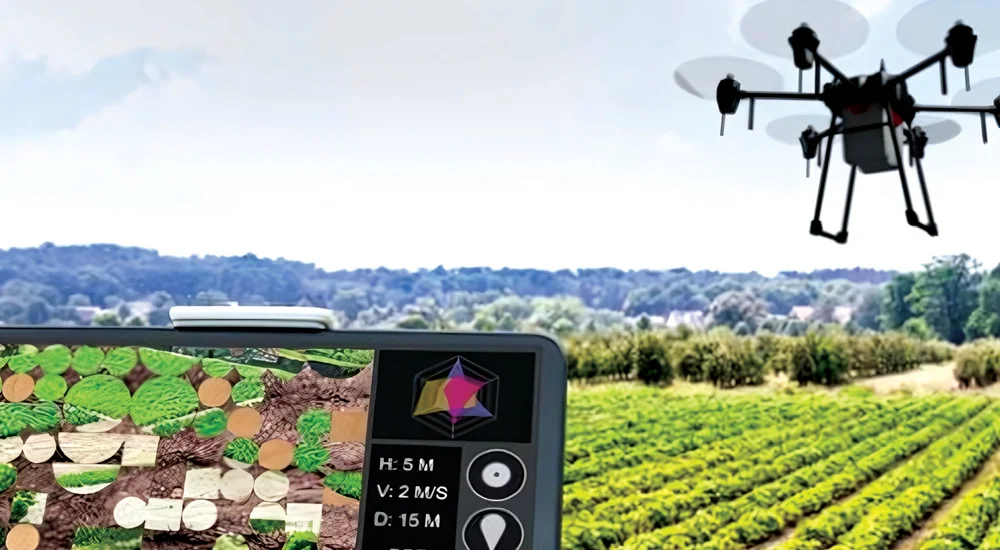
In the skies above the Indo-Gangetic plains, the “kisan drone” is no longer a curiosity — it is a coworker. However, the drone is far more advanced than its predecessors.

Integrated with agentic AI systems, these drones perform “surgical agriculture.” Equipped with multispectral sensors, they detect pest infestations and nutrient deficiencies three to five days before they are visible to the human eye.

This has allowed for a 50 per cent reduction in chemical usage, slashing costs for the farmer while significantly improving soil health.

The recent launch of Bharat-Vistaar, a multilingual generative AI advisory, has finally bridged the digital divide. A farmer in rural Maharashtra can now “speak” to a voice-activated AI in Marathi, receiving hyper-local weather alerts and site-specific irrigation schedules.

This isn’t just “predictive” technology; it is “decision-grade” intelligence that informs a farmer exactly when to sow to avoid the unseasonal hailstorms that have already damaged over 627,000 hectares of crops across 13 states this year.

The rise of genome editing

Perhaps the most significant leap has occurred in the laboratory. India has successfully asserted its technological sovereignty through the TnpB gene-editing tool. By developing indigenous Crispr-like capabilities, Indian researchers are no longer beholden to expensive foreign patents.

This has led to the rapid rollout of “speed bred” varieties. On April 4, the Government officially notified two indigenous genome-edited rice varieties: DRR Dhan 100 (Kamala) and Pusa DST Rice 1.

These are not “GMOs” in the traditional sense; they are precision-tweaked to survive 15 days of submergence or extreme heat without a drop in yield. This scientific breakthrough is the pillar of the “Minus 5 and Plus 10” formula — a national strategy to reduce rice acreage by 5 million hectares (to save water) while increasing total production by 10 million tonne through high-yield varieties.

Precision and sustainability

The revolution is also visible underground. There is a massive shift away from synthetic NPK fertilisers toward agricultural biologicals. These are microbe-based inputs that enhance a plant’s natural immunity against thermal stress.

Start-ups are now deploying nanoparticle-based nutrient delivery systems that improve soil water retention by 30 per cent. By nurturing the soil’s microbiome, farmers are seeing improved yields even in saline soils that were previously considered unproductive.

The “Drone-as-a-Service” (DaaS) model has democratised this technology. Smallholders who cannot afford a ₹5 lakh drone can now “book” a spraying or mapping session via a mobile app for as little as ₹200 per acre.

This sharing economy is ensuring that the benefits of the agritech revolution are not restricted to wealthy “landed gentry” but are accessible to the marginal farmer holding less than two hectares.

India’s Agritech Revolution Transforms Farming

A future of supply assurance

The overarching goal of the 2026 agritech landscape is supply assurance. As global markets become more volatile due to climate shifts and geopolitical disruptions, India’s ability to secure its food supply through data is its greatest strategic asset. Large agribusinesses are moving away from reactive buying to proactive procurement, using AI to simulate microclimate shifts before they happen.

The Indian farmer is no longer a victim of the elements or the middleman. They have become a techno-entrepreneur, a manager of a complex data-driven enterprise where every sunrise brings a “next-best-action” recommendation.

From farm to QR code

From farm to QR code

The traditional Indian supply chain was historically a story of “leaks,” with post-harvest losses once draining $18 billion from the economy annually. Now, the “farm to fork” (F2F) model has successfully plugged these gaps using AI-driven logistics and blockchain.

Start-ups like Ninjacart and WayCool have evolved their operations into fully automated pipelines. By utilising predictive demand forecasting at the retail level, these platforms connect farmers directly to urban markets, bypassing the congested APMC (mandi) queues.

This has reduced transit times by 30 per cent, enabling a “12-hour freshness” cycle for perishables.
Central to this is blockchain-based traceability. Every crate of produce now carries a digital “passport.” Consumers can scan a QR code to see the farm’s location, the harvest date, and a certified record of fertiliser inputs.

This transparency has unlocked the global export market, allowing Indian smallholders to meet stringent European residue standards and earn a 15–20 per cent price premium.

Logistics is no longer a bottleneck; it is a value-multiplier, ensuring that the wealth generated in the field actually reaches the farmer’s pocket, while consumers receive safer, fresher food.

Climate-proofing farms

Climate-proofing farms

2026 has served as a stark reminder of the “climate tax” on Indian agriculture. By April 9, unseasonal rains and hailstorms had damaged over 6 lakh hectares of crops, while March saw record-breaking heat stress in the wheat belt.

To counter this “new normal,” India has pivoted toward aggressive climate-resilient innovation.

The breakthrough of the year is the mainstreaming of genome-edited staples. Varieties like DRR Dhan 100 utilize Crispr technology to provide high heat and salinity tolerance without using foreign DNA.

Parallel to this is the deployment of “scuba rice,” which can survive submerged for two weeks, protecting farmers in flood-prone eastern regions.

The Government’s BioE3 Policy has also accelerated the use of microbial biologicals — soil additives that help plants retain moisture during heatwaves. Additionally, “speed breeding” facilities now allow researchers to produce up to six generations of a crop per year, halving the time to bring resilient seeds to market.

By combining 5,000-year-old traditional knowledge with 21st century genomics, India is building a “climate-proof” pantry capable of withstanding the increasingly erratic pulse of a warming planet.

Latest News

Nagpur airport updgrade cleared

Blitz Bureau NEW DELHI: The Union Cabinet chaired by Prime...

Credit boost: Airlines get Rs 5,000-crore lifeline as jet fuel prices soar

Blitz Bureau NEW DELHI: The Centre has approved a Rs...

SHIFTING GEARS: Auto industry traversing from combustion engines to smart mobility ecosystem

Blitz Bureau NEW DELHI: India’s automobile industry is entering a...

Topics

Nagpur airport updgrade cleared

Blitz Bureau NEW DELHI: The Union Cabinet chaired by Prime...

Credit boost: Airlines get Rs 5,000-crore lifeline as jet fuel prices soar

Blitz Bureau NEW DELHI: The Centre has approved a Rs...

SHIFTING GEARS: Auto industry traversing from combustion engines to smart mobility ecosystem

Blitz Bureau NEW DELHI: India’s automobile industry is entering a...

A global reference model

Blitz Bureau NEW DELHI:India’s digital payments ecosystem has not only...

From QUEUE to QR Code -India’s Payment Revolution: Faster, simpler, and more inclusive transactions for all

India’s Payment Revolution: Faster, simpler, and more inclusive transactions for all:

NEW HORIZON for innovation and youth

Anupriya Patel NEW DELHI: Today, India has established itself...
spot_img