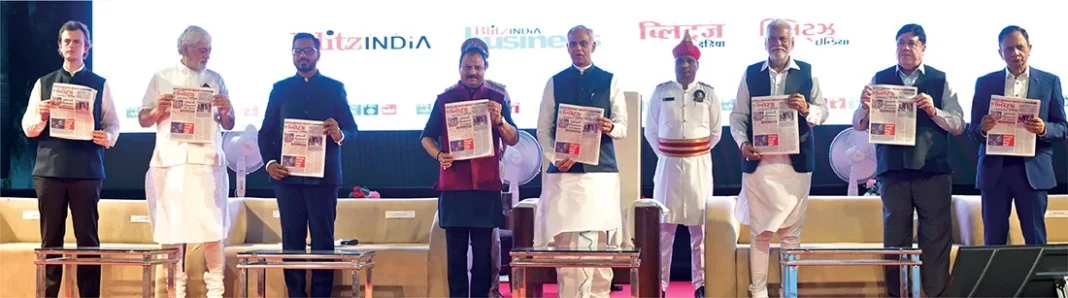
Development journalism takes centre stage at Blitz India’s Gujarat debut

Blitz Bureau

NEW DELHI: April 11, 2026, will be remembered as a defining moment for the Blitz India Media Group. The launch of its Gujarati edition in Rajkot—its first regional language venture—was not merely an expansion but a carefully articulated statement of intent. Positioned within India’s larger aspiration of becoming a Viksit Bharat by 2047, the initiative underscored a bold editorial philosophy: journalism must not only inform, but actively contribute to nation-building.

Blitz India’s Gujarati edition represents a strategic deepening of its development journalism mission. Far from being a routine linguistic extension, it seeks to bring into sharper focus stories of growth, innovation, governance, and inclusive progress—stories often overshadowed by a dominant narrative of conflict and negativity.

The setting matched the significance. The lawns of the Speedwell complex in Rajkot, cooled by a natural evening breeze, provided an almost symbolic backdrop—calm, balanced, and quietly purposeful. The dais reflected a convergence of governance, media, policy, and global engagement: Governor Acharya Devvrat; Rajkot MP Parshottam Rupala; Blitz India Chairman and Editor-in-Chief Deepak Dwivedi; Gujarat edition’s Director and Executive Editor Parth Nadpara; former UK MP Henry Smith; Shishir Priyadarshi, President of the Chintan Research Foundation; Dilip Sanghani, a prominent figure in India’s cooperative movement; and Rakesh Sharma, former President of the Indian Newspaper Society.

Governor Devvrat’s address anchored the evening in a larger philosophical framework. Congratulating the Blitz India team, he emphasised that the role of media in contemporary times extends beyond dissemination of information. It must foster positivity and constructive engagement. “When positive thinking increases in the world, development, peace, brotherhood and unity are born together,” he said, succinctly linking mindset with national progress.

His remarks drew attention to a systemic imbalance in news priorities. “If a thief breaks into someone’s house, it becomes news. But tell me, what inspires people to do good?” he asked, highlighting how acts of goodness and service often remain invisible. For a society’s mental and moral health, he argued, it is essential to prioritise positive and welfare-oriented narratives. By bringing such stories into the public domain, the media can create a ripple effect—encouraging others to act constructively.

Importantly, he also positioned the Gujarati edition as a cultural bridge, capable of connecting India’s values and developmental journey with the vast Gujarati diaspora worldwide.

Rajkot MP Parshottam Rupala extended this argument by rooting it in India’s civilisational traditions. Drawing from spiritual and literary references, he suggested that the idea of “development journalism” is not new but deeply embedded in India’s narrative traditions. Journalism, in his view, must serve as a medium of inspiration, not merely information.

He pointed to numerous examples—grassroots innovations, ethical institutions, community initiatives—that rarely receive media attention. Bringing such stories to light, he argued, can provide direction not only to India but also to the wider world seeking sustainable and value-driven development models.

Deepak Dwivedi’s address blended reflection with resolve. He acknowledged the criticism that often accompanies efforts at constructive journalism. There exists, he noted, a growing tendency to equate development-oriented reporting with partisanship. Yet, he argued, India’s own history demonstrates the transformative power of media in strengthening national movements and shaping global perceptions.

Dwivedi framed Blitz India’s initiative as a conscious effort to reclaim that legacy. In an era of technological change and information overload, he stressed the need for journalism that is research-driven, solution-oriented, and accessible to the last-mile citizen. The modern Indian, whether in a village or a city, is increasingly informed and connected—but still seeks clarity on how governance translates into tangible benefits.

The mission, therefore, is two-fold: to document India’s development journey with depth and credibility, and to make that knowledge accessible and relevant to ordinary citizens. This, he said, marks the beginning of “a new dawn of journalism” aligned with the aspirations of a developed India.

He outlined an ambitious roadmap—expanding Blitz India into 13 regional languages while strengthening its global footprint across multiple international platforms and languages. The aim is to take India’s growth story to audiences in 193 countries, fulfilling a larger responsibility of projecting India’s developmental narrative globally.

Dwivedi also emphasised that Blitz India operates as a non-profit platform, committed to sustainable and ethical journalism. Development journalism, he stressed, is not about praise or advocacy, but about rigorous research, balanced analysis, and value-based reporting that stands the test of time.

As the evening transitioned into informal interaction, the mood remained reflective. The convergence of political leadership, media practitioners, and policy thinkers had produced more than speeches—it had crystallised an idea.

That idea is simple yet powerful: journalism, when aligned with purpose, can shape not just narratives, but outcomes. In Rajkot, on that April evening, Blitz India positioned itself not just as a media platform, but as a participant in India’s unfolding development story.

Latest News

Circular knot: Textile city Panipat stitching a new story

Anoop Saxena NEW DELHI: In the industrial outskirts of...

Indian Institute of Influence: Premier academic institutions of India are today virtually ruling the world

Blitz Bureau NEW DELHI: In the high-stakes theater of global...

Drowning in drones: Made in India unmanned aerial vehicles giving new power to agriculture, defence, logistics

Parth Nadpara NEW DELHI: India’s drone ecosystem has entered a...

Art-i-facial: Indian tech grows beyond back-office ops; AI stack powering new orange economy

Blitz Bureau NEW DELHI: In the neon-lit gaming studios of...

Topics

Circular knot: Textile city Panipat stitching a new story

Anoop Saxena NEW DELHI: In the industrial outskirts of...

Reporting India; building India

Blitz Bureau NEW DELHI: The launch of the Gujarati edition...

Banking on technology: Fintech has matured beyond apps to become the driver of economic growth

Blitz Bureau NEW DELHI: In the wood-paneled boardrooms of Nariman...

Uneasy lies the south Fear reduced seats due to low headcount

Blitz Bureau NEW DELHI: Prime Minister Narendra Modi has cast...
spot_img