




Blitz Bureau
NEW DELHI: Prime Minister Narendra Modi has cast the Nari Shakti Vandan Adhiniyam (Saluting Women Power Act) as a historic leap – “among the most significant decisions of our times” – arguing it honours women’s empowerment.
But, according to a BBC analysis, Opposition parties say a simple women’s quota is being tied to a controversial redraw of constituencies, turning a gender reform into a wider political overhaul.
“We support reserving 33 per cent seats for women based on the current strength of Parliament. We also want a further freeze on expanding overall seats in the parliament until population trends stabilise. We object to the haste in convening this session in the middle of an election season,” John Brittas, MP of the opposition Communist Party of India (Marxist), told BBC.
The Constitution mandates that seats be allocated to each state based on its population, with constituencies of roughly equal size.
So far, India has redrawn parliamentary seats three times based on the decennial census in 1951, 1961 and 1971. Since then, governments of all stripes paused the exercise, fearing an imbalance of representation due to varying fertility rates across states.
It requires periodic delimitation – the redrawing and reallocation of seats – after each census to reflect updated population figures.
So far, India has redrawn parliamentary seats three times based on the decennial census in 1951, 1961 and 1971. Since then, governments of all stripes paused the exercise, fearing an imbalance of representation due to varying fertility rates across states.
The Modi-led Bharatiya Janata Party (BJP) Government has signalled a break from past caution, proposing a fresh delimitation based on the 2011 census.
In Kerala, with Europe-like fertility rates, an MP represents about 1.75 million people.
That shift has alarmed opposition parties – especially in the south – who fear it could cost them seats and influence, effectively penalising regions with lower population growth and stronger economies.
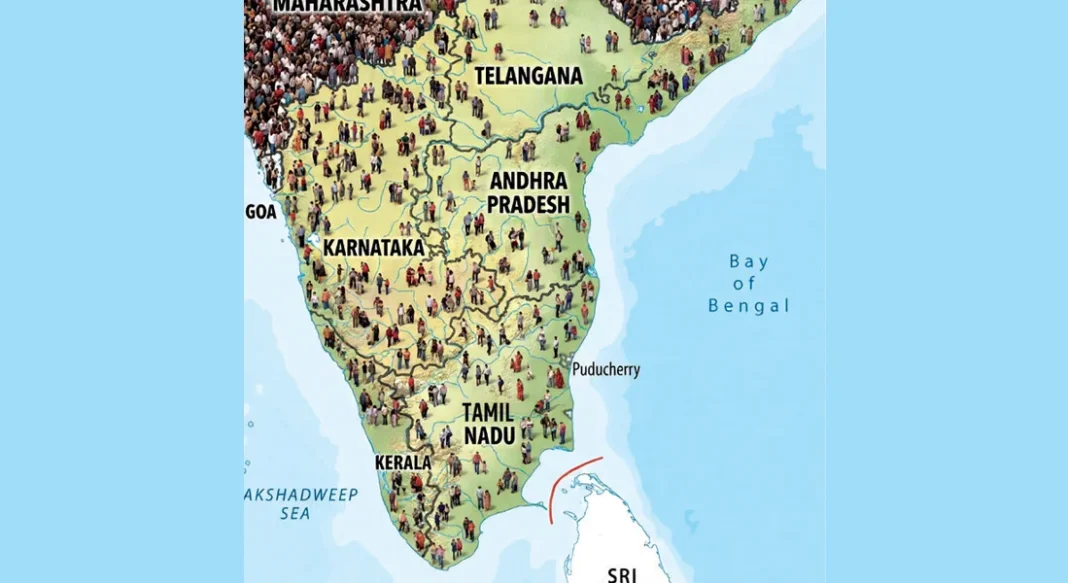
The five southern states – Tamil Nadu, Andhra Pradesh, Karnataka, Kerala and Telangana – account for about 20 per cent of India’s 1.4 billion people.
They also outperform the rest of the country in health, education and economic prospects. A child is less likely to be born here than in the north, due to lower population growth rates.
Their leaders are worried that the more prosperous south may lose parliamentary seats in the future, a “punishment” for having fewer children and generating more wealth.
Tamil Nadu, Kerala, Karnataka and Telangana had sought to extend the freeze on seat redistribution for 25 years.
The proposed legislation also remains mired in some confusion, say experts.
Arghya Sengupta of Vidhi Centre for Legal Policy, a Delhi-based think tank, told the BBC that although the new bill raises the cap on the lower house of parliament to 850 seats – from 550 earlier – the “basis for this number is unclear and does not appear to be proportionate to population growth recorded in the 1971 and 2011 census”.
Oddly, Sengupta says, there is no similar expansion for state assemblies, “creating a mismatch: fast-growing states could gain more MPs without a corresponding rise in MLAs”.
There are also concerns about how seats will be shared between states.
“While no state may lose seats, the absence of a clear proportional formula means outcomes could vary – and favour more populous states. This has significant federal implications,” says Sengupta.